Parfois — ce matin, par exemple — je reste de longs moments (plus d’une heure, en fait) sans la moindre envie de transcrire par écrit les sensations, images, pensées qui me viennent. Au réveil, par la fenêtre ouverte, mes yeux ont capté une foule de petits nuages roses, de la teinte de ces photos colorisées à la main, avant l’invention de la photo couleur; pendant que s’estompait la dernière image d’un rêve : le gros plan du visage d’une jeune femme trafiquée dont le corps ne fut jamais retrouvé, et ce que cela évoquait de souvenirs personnels au sujet d’une fugueuse de 14 ans, inconsciente du précipice qu’elle avait frôlé. Rêve des injustices jamais réparées, formant un terreau tellement épais que son poids même le transformait en roc dans lequel on retrouvait parfois un bout d’os ou l’empreinte d’un pied anonyme.
Le tout, au son du “Forêt paisible” de Jean-Philippe Rameau, forêt d’Amérique qui ne fut aucunement paisible, c’est le moins que l’on puisse en dire.
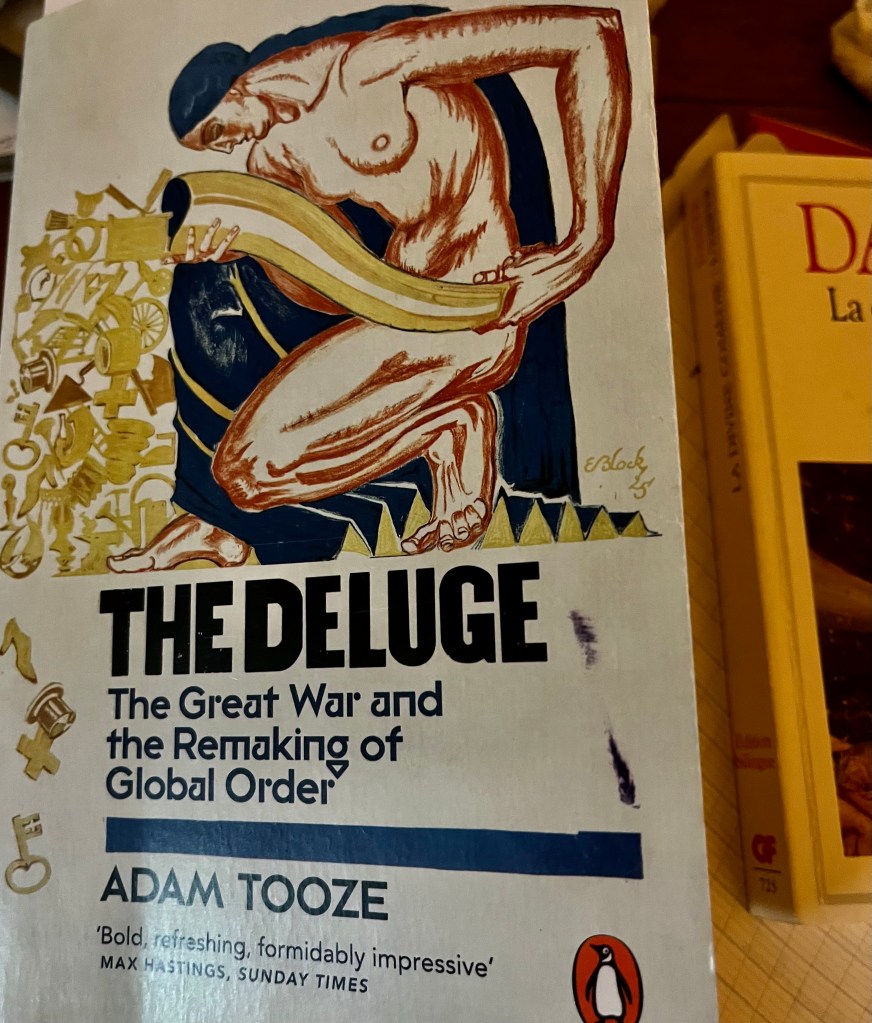
Hier durant l’orage violent mais bref qui s’est abattu sur la ville, j’étais à relire le livre de 2014 d’Adam Tooze, The Deluge – The Great War and the Remaking of Global Order. Tout ce qu’on a déjà oublié au sujet de la Première Guerre Mondiale, en fait. Dont les circonstances de l’entrée en guerre des Etats-Unis d’Amérique, en avril 1917, alors que le massacre durait déjà depuis plus de trois ans. Et l’attitude du président américain, Woodrow Wilson, profondément ancré dans sa volonté d’être LE grand homme sur la scène internationale, et la phrase devant le Congrès, concluant cette décision de lancer “ses” troupes dans le combat : “America is privileged to spend her blood and her might for the principles that gave her birth and happiness and the peace she has treasured. God helping her, she can do no other.” (L’Amérique considère comme un privilège de mettre son sang et sa puissance au service des principes qui lui ont donné naissance et bonheur, et la paix qu’elle chérit. Avec l’aide Dieu, elle ne saurait faire rien d’autre.”
Je t’en fous. Tout y est : la pratique d’utiliser le mot Amérique comme désignant les Etats-Unis et faisant fi des autres habitants du continent (après avoir massacré ceux qui occupaient le territoire avant), “son” sang alors qu’il coule dans les veines des autres, et tout le bagage de “l’exceptionalisme” formant la base des trois P — Paix, Progrès et Profit — qui devaient régir les relations internationales sous la gouverne de son pays, désigné par Dieu, et bla et bla, la rengaine habituelle des têtes imbues de leur personne. À l’époque, on travestissait encore le tout dans un noble discours de moralité (mais qui se résumait, en fait, à la supériorité de l’Homme Blanc sur tout autre nuance d’épidermes humains). Maintenant, la moralité prête à rire, plus qu’autre chose et même l’indignation fait figure d’une forme de déficience mentale, “hé! nous n’en sommes plus là ! Allez ! À la casse !” Et le Profit comme seul et unique survivant dans les figures de style dont certains tentent encore de se parer. Mais qui y croit encore, à la Paix et au Progrès, autre que ceux qui en tire Profit ?
Tout ça n’est pas si éloigné que ça dans le temps, vraiment. Quelques semaines avant la déclenchement des hostilités en 1914, ma mère naissait à Paris, père, mère et nourrisson étaient rapatriés à Montréal sur l’un des derniers paquebots à quitter la France avant la guerre.
Je relis, question de maintenir un peu de perspective sur la folie ambiante, dans ses manifestations les plus récentes. Encore espoir de trouver la sortie de l’auto-route? D’une certaine façon, vivre, c’est espérer.
Ecrire, oui. La gamine étique, ses observations, les conclusions qu’elle en tire. De tous les personnages, la plus difficile à rendre en mots.
*
Sometimes — this morning, for instance — I stay for long periods (over an hour, in fact) without the slightest urge to put down in writing the sensations, images, thoughts that occur to me. Upon waking, through the open window, my eyes captured a crowd of tiny pink clouds, of the same shade as those in hand-colorized photographs, before the invention of color photography; while was fading away the final image of a dream : a closeup view on the face of a young woman who had been trafficked whose body had never been found, and what that evoked of personal memories about a 14 year old runaway unaware of the void on the rim of which she had walked. Dream of injustices never repaired, forming such a thick soil that its very weight transformed into stone, in which one could sometimes find a piece of bone or the imprint of an anonymous foot.
All this to the sound of Jean-Philippe Rameau’s “Forêt paisible“, American forests that were anything but peaceful, that’s the least that can be said about them.
Yesterday during a storm that was both violent and brief over the town, I was re-reading the book by Adam Tooze published in 2014 The Deluge – The Great War and the Remaking of Global Order. Everything that we’ve already forgotten about the First World War, in fact. Including the circumstances under which the United States of America entered the war in April of 1917, when the massacre had already been ongoing for over three years. And the attitude of the American President, Woodrow Wilson, deeply anchored in his will to be THE great man on the international scene, and the sentence in front of the Congress, concluding this decision to send “his” troops into the fray : “America is privileged to spend her blood and her might for the principles that gave her birth and happiness and the peace she has treasured. God helping her, she can do no other.”
Like hell. It contains everything: the practice of using the word America as designating the United States with total disregard for the other inhabitants of the continent (after killing off those who occupied the territory previously), “his” blood although it runs in other people’s veins, and all the luggage concerning “exceptionalism” at the base of the three Ps — Peace, Progress and Profit — that were to rule over international relations under the governance of his country, designated by God and all the usual yada yada issuing forth from heads filled with their own importance. At the time, the whole thing still came under the guise of noble speeches about morality (but which would be summarized, in fact, as the superiority of the White Man over every other shade of human skin)). Now, morality is laughable, more than anything else, and even indignation is considered like some kind of mental retardation “hey! That’s not where we’re at anymore ! Come on ! Breakage Time !” And Profit as sole survivor in the figures of speech in which some still attempt to drape themselves. But who still believes in Peace and Progress, except those who profit from them ?
All that is not so very distant in the past, really. A few weeks prior to the opening of the hostilitis in 1914, my mother was born in Paris, father, mother and newborn were repatriated to Montreal aboard one of the last ships to leave France before the war.
I re-read, so as to keep some perspective on the current madness in its latest manifestations. Still some hope of finding the off-ramp ? Living is hoping, in some sense.
Writing, yes. The emaciated kid, her observations, the conclusions she draws from them. Of all the characters, she is the most difficult to put into words.

