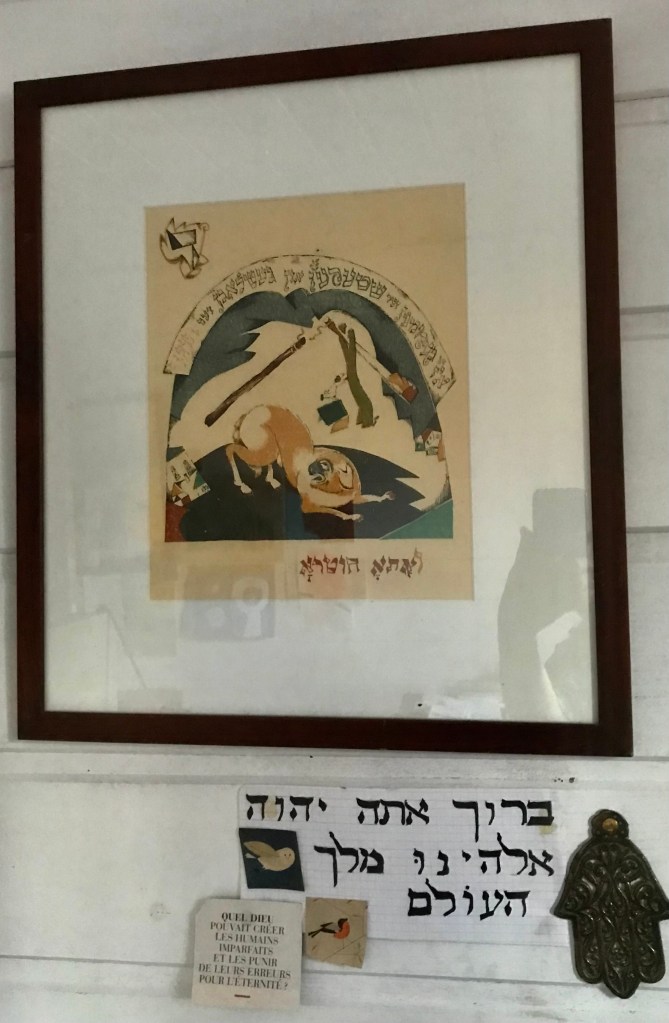
L’ambiance du rêve avait des éléments des tueries en pleine rue aux Etats-Unis par les agents ICE, du livre de Aharon Appelfed Le garçon qui voulait dormir*, de deux comptines en hébreu, celle du Had Gadyah le soir de la Pâques et celle de Yonatan a katan, le gentil petit garçon courant vers la fenêtre au réveil, de souvenirs d’enfance que m’avait confié le père de ma fille, de Gaza, de Cisjordanie, d’un camp de réfugiés en Grèce, des incendies dévorant des forêts, du Roi Famine**…: dans le rêve, tout ça donnait une sorte de colonie de réfugiés de toutes origines où deux hommes adultes tenaient un petit garçon par la main lors de la promenade, afin d’éviter qu’il ne lui arrive malheur aux mains de réfugiés-abuseurs car c’était un lieu en plein air où l’on ne pouvait faire confiance à personne, certains en étaient réduits à manger des fourmis grillées par la chaleur, je n’arrivais pas à m’y résoudre, en sortant pour la promenade, les deux adultes et le petit garçon passaient devant trois hommes à l’apparence peu avenante, près d’un tas de terre qui avait servi d’aliment mais qui avait été abandonné depuis que d’énormes fourmis noires très toxiques l’avaient rendu impropre à la consommation.
La référence au Roi Famine, je crois, est au moment dans le deuxième tableau quand, s’adressant à la foule des affamés, le Roi Famine s’adresse à “des voyous et leurs petites amies, des maquereaux, des voleurs à la tire, des assassins, des mendiants, des invalides et autres rebuts de la grande ville, tout ce que la misère, le vice, le crime et une famine sprirituelle éternelle, insatiable peuvent donner de plus terrifiant.” Car c’est bien ainsi que tous les Rois Famine de la terre constituent leurs milices et en cela, aucun pays ne fait exception. Et dans les camps de tentes sur les plages de Palestine, au sortir de la 2e guerre mondiale, on y trouvait de tout aussi, parmi les survivants. Tout comme parmi les réfugiés qui ont afflué aux Etats-Unis à la même époque. Et dont certains ont eu des enfants qu’ils élevèrent à leur image et ressemblance. L’origine “ethnique” ou “religieuse” n’a rien à y voir lorsqu’on distingue entre les pervertis et les autres, et tous les Rois Famine se ressemblent.
La terre. La Terre. Le pays. “Nous avons fui dans les vergers pour libérer le peuple d’Israël, persuadés que la bêche apporterait la délivrance…Ils ont fauté pourtant. Sans le vouloir, ils ont fauté.” *
Et les héritiers encore, partout, toujours, de reprendre les phrases inachevées des sacrifiés, et de tenter de leur ajouter quelques uns de leurs propres mots. On peut y consacrer des vies, sans jamais parvenir plus loin que la prochaine virgule; mais c’est toujours ça de pris.
*Aharon Appelfeld, Le garçon qui voulait dormir, roman, traduit de l’hébreu par Valérie Zenatti, éditions de L’Olivier 2011
**Léonid Andréïev, Le Roi Famine, traduction et présentation d’André Markowicz, Editions Mesures 2023
*
The atmosphere in the dream combined elements of the shootings in the streets by ICE agents in the United States, of the book by Aharon Apelfed The boy who wanted to sleep, of two children’s nursery rhymes in Hebrew, that of Pesach, Had Gadyah, and that of Yonatan a katan, the nice little boy running toward the window when he wakes up, of childhood memories my daughter’s father had related to me years ago, of Gaza, of the West Bank, of a refugee camp in Greece, of fires devouring forests, of the King of Famine…: in the dream, all that produced a kind of colony of refugees from everywhere where two adult men held a little boy by the hand when it was time for the walkabout, so as to avoid his coming to grief at the hands of abusive refugees, because it was an open air area where you couldn’t trust anyone, some were down to eating ants roasted by the heat, I couldn’t bring myself to doing it, leaving for the walk, the two adults and the little boy walked by three men with a most unappealing look, near a pile of earth that had served as food but been abandoned since huge very toxic black ants had rendered it unfit for consumption.
I think the reference to King Famine is to the moment in the second scene when, addressing the crowd of famished ones, King Famine speaks to “thugs and their girlfriends, pimps, pickpockets, assassins, beggars, invalids and other big city refuse , everything that destitution, vice, crime and an eternal insatiable spiritual famine can produce of the most terrifying.” Because that is truly how all the King Famines on earth constitute their militias and in that, no country is an exception. And in the camps of tents on Palestinian beaches, after the 2nd world war, you could find a bit of everything too, among the survivors. Just as was the case among the refugees that flowed to the shores of the United States in that same period. Among which some had children and raised them in their own image and resemblance. “Ethnic” or “religious” origin has nothing to do when distinguishing between the perverted and the others, all the Kings of Famine resemble one another.
The earth. The land. The country. “We fled through the orchards to liberate the people of Israel, convinced that the plow would bring deliverance…Yet, they were at fault. Without wanting it, they were at fault.” (In Appelfeld)*
And over and over again, everywhere, always, the heirs pick up the unfinished sentences of the ones who were sacrificed, and attempt to add to them a few words of their own. Some can spend whole lives at it, without getting any further than the next comma; but that’s already something.

