Rêves : J’étais étendue sur un toit en pente, inexorablement entraînée vers le vide, j’avais très peur et je n’y pouvais rien; avant, il avait été question d’aller voir un film au cinéma Le Parisien, mais il était à 19h15 et il était déjà trop tard pour y arriver à l’heure, le tout dans une ambiance de En Attendant Godot; puis, dans le rêve suivant, j’étais très malade et j’allais mourir mais je devais d’abord prendre un bus pour une consultation médicale, il y en avait un qui s’arrêtait aux différents services de l’université de Montréal, dont le CHUM (centre hospitalier de l’université de Montréal) disait une personne à une autre, en sortant de la cafétéria universitaire où j’attendais l’heure de mon rendez-vous, les profs qui me connaissaient m’ébouriffaient les cheveux dans un geste d’affection; puis, j’étais avec deux autres personnes, en tournée à travers des villes françaises, à rendre divers objets dans différents ministères, au sortir d’un immeuble très ancien qui était celui du ministère de la justice à Toulouse, sans rapport avec sa version contemporaine, je ne retrouvais plus les deux autres personnes, je marchais marchais marchais à leur recherche, quand je les retrouvais toutes deux, elles ne semblaient pas comprendre que je croyais les avoir perdues, elles me disaient que je devais prendre l’ascenseur pour le 5e étage en fa dièse, cet ascenseur était incroyablement étroit, peint en mauve-glycine avec des moulures dorées, je me suis éveillée avant d’atteindre l’étage en question.
*
Effectivement, la référence aux enfants-pionniers auxquels j’ai rêvé hier se trouve bien dans Le garçon qui voulait dormir d’Aharon Appelfeld lorsque lui et d’autres jeunes rescapés des camps se trouvent sur la plage à Naples à s’entraîner pour leur “nouvelle vie” en Israel (bien que la dune dans le rêve soit plutôt celle de la dune du Pyla près d’Arcachon). Je me suis mise à le relire. Il rêve beaucoup du temps avant les horreurs, dans un de ses rêves, il retrouve son oncle Arthur qui dit : “Celui pour qui l’essentiel est que les Juifs soient musclés vit dans un monde où l’injustice règne. Les Juifs font partie de la famille humaine, comme tout le monde. L’homme précède le Juif.” J’ajouterais : la femme aussi, évidemment, mais je crois qu’ on n’est pas sur le point de changer nos habitudes quand il est question de parler de l’humanité, comme si la partie “homme” pouvait exister dans son solipsisme.
Il y a surtout toute la question du changement de nom, quasiment obligatoire — un des jeunes se suicide plutôt que d’abandonner le nom que lui avait donné ses parents. Le prétexte en étant de faire “table rase” du passé et de créer une “cohésion” entre ces nouveaux Juifs musclés dans leur terre promise. Raison pour laquelle ils étaient aussi “invités” à se tenir loin des autres réfugiés encore plongés dans leurs souvenirs “d’avant” — qu’il s’agisse des shtetls ou des camps. Aharon s’appelait Erwin. Zeev, le père de ma fille, s’était appelé Vladimir en Russie.
En plus du nom de plume Maria Damcheva, personnellement, j’ai eu trois “noms de famille” différents : celui de mon père, comme c’est le cas pour la plupart des enfants, puis celui d’un mari, puis celui d’un autre. Je ne ressens aucun attachement particulier envers aucun des trois. En fait, je n’ai jamais compris le koan zen posant la question “en toi-même, comment t’appelles-tu ?” parce qu’en moi-même, je ne m’appelle pas, je suis, tout simplement. Ou alors, si je dis mon nom à voix haute, c’est dans un mouvement d’agacement devant une bêtise quelconque — par exemple “ah Lucie ! Pourquoi as-tu renversé le thé ?”. Mais “en moi-même”, quel besoin aurais-je de me nommer ? Je ne crois pas que ça soit vraiment comme ça que fonctionne l’humain “en lui-même”.
À moins d’être insécure au point d’exiger qu’on appose son nom sur chaque bout de rue, immeuble, gare, commerce et statue comme si le nom en question prouvait que la misérable loque humaine avait vraiment existé.
*
Je suis à la page 157 de Le garçon qui voulait dormir. Il rêve, à nouveau; cette fois, il se retrouve dans les Carpates et veut retrouver la maison de son enfance. Il craint que le train ne l’emmène ailleurs et un inconnu lui dit. “N’aie pas peur. Ce n’est pas un petit monstre qui va effrayer celui qui comme toi a connu les septs niveaux de l’enfer.” Et sur ces paroles limpides, je me réveillai”.*
Aharon Appelfeld, Le garçon qui voulait dormir, traduction de l’hébreu par Valérie Zanetti, Editions de L’Olivier, 2011
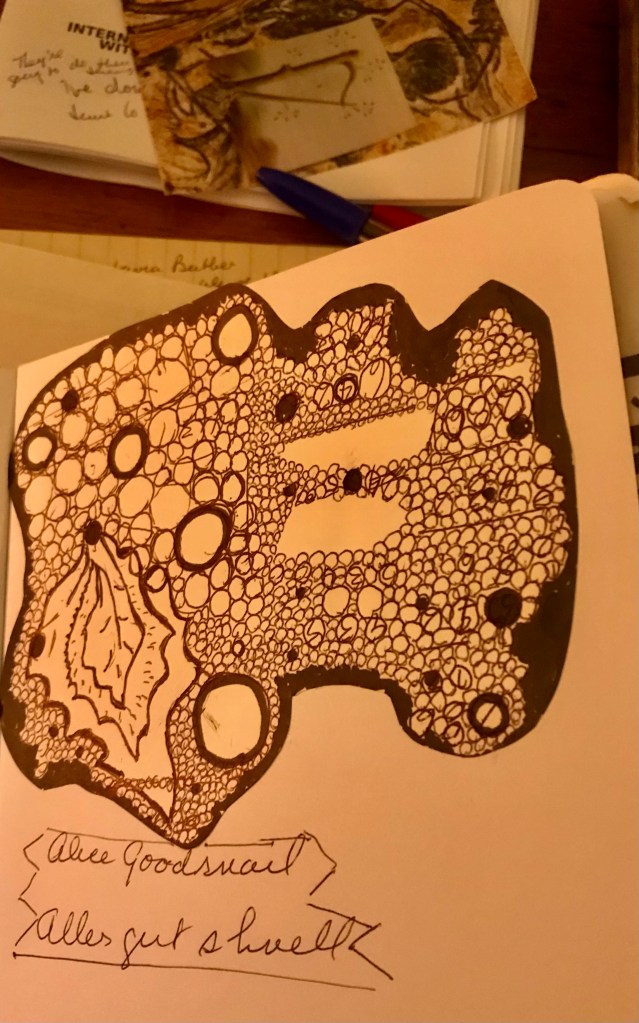
(Illustration : les mots Alice Goodsnail sont ceux qu’une gamine de 5 ans croit entendre et qu’elle utilise comme une formule magique. En fait, les mots prononcés par l’adulte sont “alles gut, shnell” (une courte nouvelle que j’ai écrite, il y a bien des années de cela.)
*
Dreams : I was lying down on a steep rooftop, inexorably drawn toward the void, I was very frightened but there was nothing I could do about it; prior to this, there had been talk of going to see a movie at Le Parisien movie house but the film was at 7.15 pm and it was already too late to get there on time, all of this in a mood of Waiting for Godot; then, in the next dream, I was very sick and about to die, but first, I had to take the bus for a medical appointment, there was one that stopped at the various university services, including the CHUM (Montreal University Hospital Center) one person was saying to another, while I was in the university cafeteria waiting for my appointment, the teachers who knew me ruffled my hair when they walked by, in an affectionate gesture; then, I was with two other people, touring French towns to return to them objects that had been taken in various ministries, upon leaving the very old building that was the one of Toulouse’s ministry of justice (not at all like the contemporary building), I couldn’t find the two other persons, I walked walked walked looking for them and when I found them both, they didn’t seem to understand that I had thought I had lost them, they told me I had to take the elevator for the 5th floor F sharp, that elevator was incredibly narrow, painted in the mauve color of wisteria with golden mouldings, I woke up before reaching the floor in question.
*
Indeed, the reference to the children-pioneers I dreamt about yesterday was in Aharon Appelfeld’s Le garçon qui voulait dormir when he and other survivors from the camps were gathered on the beach in Naples, training for their “new life” in Israel (although the sand dune in my dream is one found outside the French town of Arcachon). I started reading it again. He dreams a lot of the days before the horrors, in one of his dreams, he meets up with his uncle Arthur who says : “The one for whom the essential thing is that a Jew have muscles lives in a world where injustice reigns. Jews are a part of the human family, like everybody else. The man comes before the Jew.” I would add : the woman also, obviously, but I think we are not about to change our habits when speaking about humanity, as if the “man” part could exist as a stand-alone.
There is mainly the whole question of the change of name, almost mandatory —one of the youths prefers to kill himself rather than giving up the name his parents gave him. The reason for the change was to make a “clean slate” of the past and to create “cohesion” among these new Jews with muscles returning to their promised land. Reason for which they were also “invited” to stay clear of the other refugees still plonged in the memories of the “before” — be it of the shtetls or of the camps. Aharon’s name was Erwin. Zeev, lmy daughter’s father, was named Vladimir in Russia. e père de ma fille, s’était appelé Vladimir en Russie.
Beside my pen name of Maria Damcheva, personally,, I’ve had three different “family names” : that of my father, as is the case for most children, then that of a husband, then that of another. I experience no particular attachment to any one of the three. In fact, I’ never understood the zen koan asking the question “within yourself, what do you call youself ?” because within myself, I don’t call myself anything, I am, that’s all. Or, if I say my name out loud, it’s because I’m annoyed over something stupid I’ve just done — for instance “Oh Lucie ! Why did you spill the tea?” But “within myself”, what need could I possibly have of naming myself ? I don’t really think that’s how the human mind works “within itself”.
Unless you are insecure to such a degree that you need to see you name affixed to every street, building, train station, store and bit of statuary, as if the name in question could serve as proof that this miserable human wreck had truly existed.
*
I am on page 157 of Le garçon qui voulait dormir (The boy who wanted to sleep). He is dreaming again; this time, he is in the Carpathians and wants to return to his childhood homes. He is afraid that the train will take him elsewhere and a stranger says to him/ “Don’t be afraid. There isn’t a single piddly little monster that can frighten one such as yourself who has known the sevent levels of helle.” And on these crystal clear words, I awoke.”
*
(Illustration : the words Alice Goodsnail are those a 5 year old girl thinks she hears and which she uses as some kind of a magic spelle. In fact, the words pronounced by the adult are “alles gut, shnell” (a short story I wrote, many many years ago.)
 iknowiknowiknowblog