Rêve : Il était très long, il y avait un moment, à la fin d’une phrase, où l’interprète devait faire un bond en l’air avec un mouvement de ciseaux avec les jambes, ce que j’avais omis dans le texte, évidemment, et la voiture décorée de plumes en papier du circassien venait d’arriver pour me montrer comment l’exécuter, quand le chat a bondi sur le lit, ce qui m’a réveillée. (Sans ce mouvement à la fin de la phrase, le reste du texte n’avait aucun sens, raison pour laquelle le rêve au complet est irracontable.)
*
Oui, encore une journée de farniente, hier, hormis l’écoute d’une entrevue de l’ancien juge et dorénavant sénateur italien Roberto Scarpinato sur la “mafiosasisation du monde” (nullement à l’honneur du système judiciaire français, soit-dit en passant). Mais, pour l’essentiel, cicatrices recouvertes, j’ai pris le soleil dans mon jardin où tout pousse à l’état sauvage et tenté de lire deux des livres en langue anglaise offerts gentiment par une amie qui ne pratique pas du tout cette langue. Selon la pratique américaine, tous deux recouverts de louanges de la part des critiques — le premier promettant de réduire le lecteur aux larmes à force de rire, et le second, de le faire hurler de ce même rire. Le premier, écrit par un américain ayant vécu en Angleterre, en a peut-être fait rire certains amateurs de blagues racistes, à sa sortie en 1995; je l’ai abandonné avant d’entamer le 4e chapitre. Le second, publié en 2000 par un britannique à l’humour plus subtil, est surtout intéressant pour ce qu’il raconte de l’attitude du trentenaire lorsque la naissance de ses enfants déplace complètement le centre d’intérêt de sa femme envers ces derniers, alors que lui, personnellement, trouve les bébés mortellement ennuyeux. Alors, il s’invente une histoire lui permettant de s’évader régulièrement hors-logis pour aller revivre sa vie d’adolescent avec trois autres paumés. Je n’ai pas encore hurlé de rire, mais c’est vraiment bien observé.
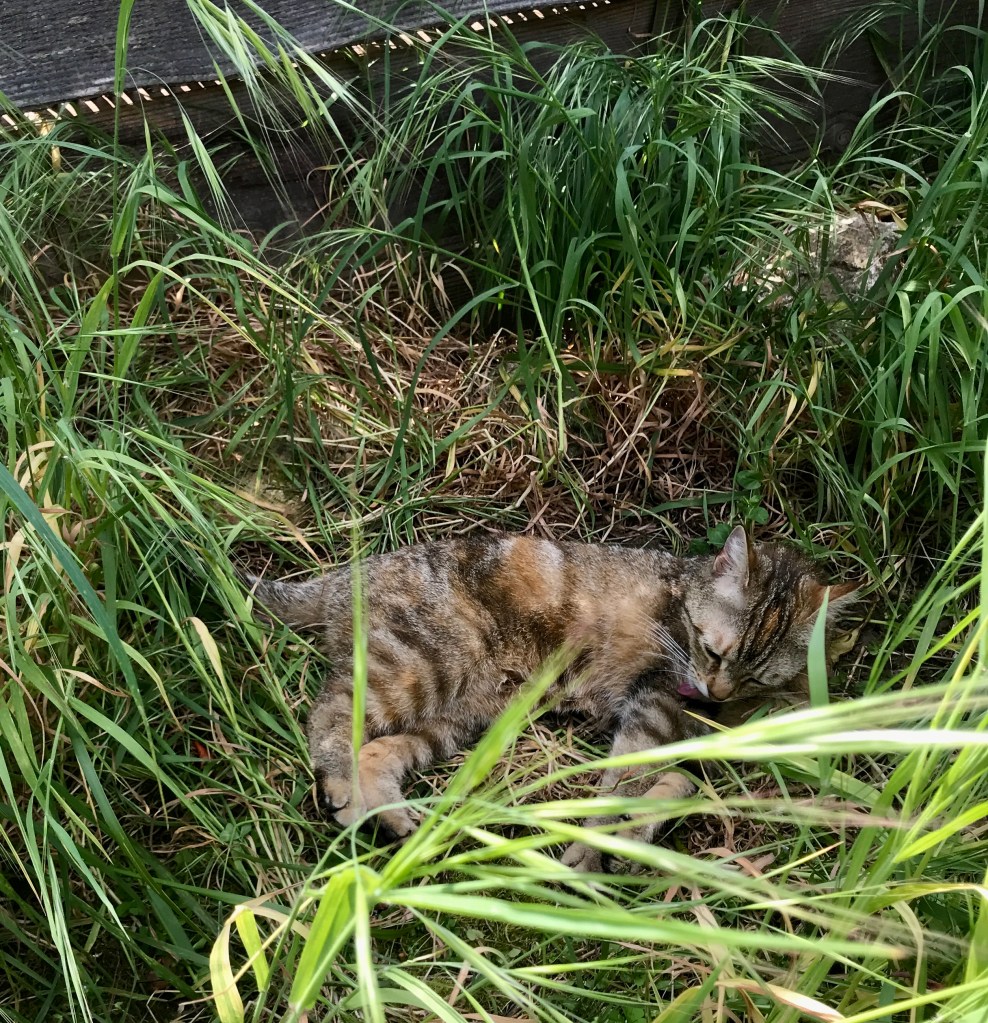
Voilà. Vais-je retrouver un rythme plus productif, éventuellement ? Peut-être, qui sait. Pour l’heure, mon rythme ressemble davantage à celui de mon chat. Le soir, lorsque je lis adossée aux oreillers, elle bondit sur le lit, marche la longueur de mon corps, glisse sa tête sous le livre et me regarde longuement au fond des yeux. Puis, elle me lèche doucement un bout du visage alors, tenant le livre dans la main gauche, je me sers de mon pouce droit ou d’un doigt pour caresser l’espace allant de son museau à celui entre ses deux yeux et celui entre ses deux oreilles. Elle ferme les yeux, ronronne, puis se roule en boule au bout du lit, ou bondit pour retrouver son propre espace de sommeil.
*
Le son de la langue italienne me plaît beaucoup.
Midnight in Sicily, livre de Peter Robb, lu chez ma soeur au Mexique lors d’une convalescence en 2018, livre dans lequel j’avais découvert cette partie du poème Satura d’Eugenio Montale :
II.
Mais l’histoire n’est pas
le bulldozer de la dévastation totale que l’on prétend.
Elle laisse des souterrains, des cryptes, des trous
et des cachettes. Il y a des survivants.
L’histoire peut même être bienveillante :
elle détruit autant qu’elle peut .
(et si elle peut aller plus loin, tant mieux)
mais l’histoire manque d’informations
et ne peut pas toujours se venger.
L’histoire ratisse le fond
comme un filet déchiré ici et là
et plus d’un poisson s’en sort.
Parfois, on rencontre le fantôme vivant
d’un évadé, et il n’a pas l’air particulièrement heureux.
Il ne sait pas qu’il est dehors, personne ne le lui a dit
Les autres, toujours dans le filet, se croient
plus libres que lui.
*
History isn’t
the devastating bulldozer they say it is.
It leaves underpasses, crypts, holes
and hiding places. There are survivors.
History’s also benevolent: destroys
as much as it can; overdoing it, sure,
would be better, but history’s short
of news, doesn’t carry out all its vendettas.
History scrapes the bottom
like a drag net
with a few rips and more than one fish escapes.
Sometimes you meet the ectoplasm
of an escapee and he doesn’t seem particularly happy.
He doesn’t know he’s outside, nobody told him.
The others, in the bag, think
they’re freer than him.
Eugenio Montale, Satura
II.
La storia non è poi
la devastante ruspa che si dice.
Lascia sottopassaggi, cripte, buche
e nascondigli. C’è chi sopravvive.
La storia è anche benevola: distrugge
quanto più può: se esagerasse, certo
sarebbe meglio, ma la storia è a corto
di notizie, non compie tutte le sue vendette.
La storia gratta il fondo
come una rete a strascico
con qualche strappo e più di un pesce sfugge.
Qualche volta s’ incontra l’ectoplasma
d’uno scampato e non sembra particolarmente felice.
Ignora di essere fuori, nessuno glie n’ha parlato.
Gli altri, nel sacco, si credono
più liberi di lui
*
Dream: It was very long, at one point, at the end of a sentence, the performer had to jump up in the air making a scissoring movement with his legs, which was something I had omitted in the text, obviously, and the circus person’s vehicle, decorated with paper feathers, had just arrived to show how the movement was to be executed when the cat bounded up on the bed, which woke me up. (Without this movement at the end of the sentence, the rest of the text didn’t make any sense, reason for which the dream in its entirety is impossible to repeat.)
Yes, another day of farniente yesterday, other than listening to an interview of the former judge and now Italian senator Roberto Scarpinato on the “mafiozisation of the world) (which is in no way complimentary to the French judicial system, by the way.) But, for the most part, with the scars covered up, I took the sun out in the garden where everything grows wild, and attempted the reading of two of the English books so kindly offered to me by a friend who does not speak that language. As is the American custom, both books are covered with praise from the critics — the first promising to reduce the reader to tears from laughing so much at the tales of an American who lived in England which may have reduced some to tears over his racist jokes when the book came out in 1995; I gave it up before reaching the 4th chapter. The second, published in 2000 by a British man whose humor is more subtle, is mainly interesting for what it tells of the attitude of a thirty-something man when the birth of his children removes him entirely from his wife’s main focus of interest, whereas he personally finds babies terribly boring. So, he makes up a story allowing him regular escapes back into his adolescent world with three other lost souls. I’m not finding it “howlingly funny”, but very well observed.
Voilà. Will I snap back into a more productive mood, sooner or later ? Perhaps, who knows. For the time being, my pace is more like that of my cat. In the evening, while I’m reading, propped up against the pillows, she bounds up on the bed, walks up the length of my body, pokes her head under the book and stares deeply into my eyes. Then she licks a bit of my face gently and, holding the book in the left hand, I use my right thumb or a finger to caress the area that runs from her nose to the space between her eyes and that between her ears. She closes her yes, purrs, then curls up at the foot of the bed or bounds off to her own sleeping space.
*
I much enjoy the sound of the Italian language.
Midnight in Sicily, la book by Peter Robb, lI read in 2018, while convalescing at my sister’s in Mexico, a book in which I discovered this part of the poem Satura by Eugenio Montale (see above) . :


Love the quote
LikeLike