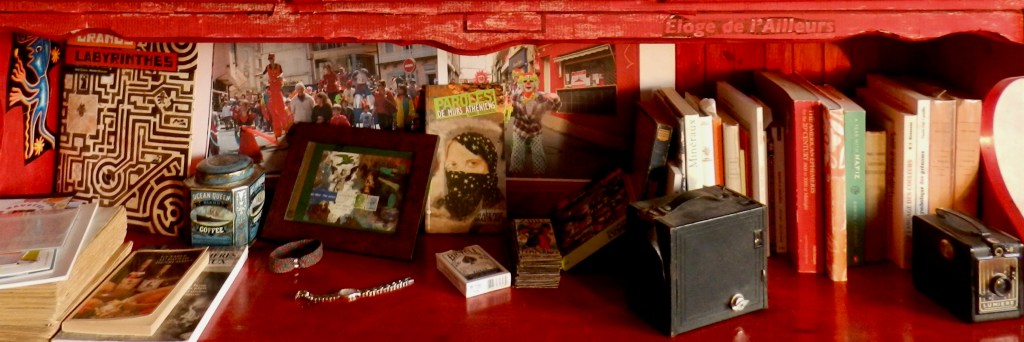
la photo date de plusieurs années, mais il fait tellement sombre et triste ici que je ressens le besoin de couleurs vives, alors voilà.
Heureusement que j’étais déjà habituée à la solitude avant les confinements. Il n’empêche: par temps gris, l’absence de contact humain ou animal se fait sentir. Raison pour laquelle le personnage dans l’histoire vient d’hériter d’un chat ? Peut-être. Elle est en train de relire la traduction par Seamus Heaney de Beowulf, un poème anglo-saxon du 10e siècle et, grâce à ce personnage qui découvre on amour des allitérations, je me rends compte de mon goût personnel pour des phrases telles “he is hasped and hooped and hirpling with pain“, ces répétitions sonores et rythmiques faisant tout le charme des “nonsense poems” dans Lewis Carroll, par exemple: “‘Twas brillig, and the slithy toves Did gyre and gimble in the wabe…”. Intraduisible mais c’est sans importance puisque les mots eux-mêmes ne sont pas porteurs de sens, mais uniquement du plaisir d’un débit cadencé. Ce qui me ramène toujours à l’idée qu’à l’origine, les humains communiquaient par “appels” avant de passer aux chants, aux poèmes et, plus tard, à la prose.
Que cela soit exact ou non, c’est une pensée que j’aime bien puisqu’elle opère un lien entre les humains et les chants d’oiseaux, par exemple. Une sorte de rapprochement avec les autres éléments de la mosaïque.
*
the phogo is several years old, but the weather is so glum and grey here that I feel the need for some bright colors, so here they are.
Luckily, I was accustomed to solitude prior to the confinements. Even so: in glum weather, the absence of human or animal contact can rest heavily on the mind. Is this the reason why the character in the story has just inhherited a cat? Maybe. She is currently reading Seamus Heaney’s translation of Beowulf, a 10th century Anglo-Saxon poem and, thanks to this character, I become aware of my own love of alliterations, I notice my own taste for sentences such as “he is hasped and hooped and hirpling with pain“, those rhythmical and sound repetitions also making up the charm of Lewis Carroll’s nonsense poems, for instance: “Twas brillig, and the slithy toves Did gyre and gimble in the wabe...” Untranslatable but that doesn’t matter since the words themselves are meaningless and only exist for the enjoyment of their rythmical flow. Which constantly brings me back to the thought humans “spoke” in calls prior to moving on to songs, poems and, later, prose.
Whether this is true or not, I like this thought because it provides for a link between humans and birdsong, for example. A kind of moving closer to the other elements in the mosaic.

