Rêves : un homme, assis, les jambes pendantes au bord d’une falaise, à se demander comment se prémunir du danger auquel il fait face; puis, longue interruption du sommeil, suivi d’un rêve dans lequel se présente une occasion exceptionnelle d’emmener des gens visiter mes chiens au paradis des chiens, mais j’hésite vu l’enthousiasme de mes grands et gros bouviers des Flandres qui pourraient en effrayer certains.
Kopeck, Solly et Balou — Kopeck et Balou, sans doute les deux chiens les plus gentils et les plus intelligents que j’aie connus — je le dis sans rien enlever aux autres chiens que j’ai eus comme compagnons dans ma vie, mais ces deux-là méritaient vraiment le qualificatif d’exceptionnels.
Aucun rapport à première vue avec mes lectures d’hier ou de la nuit. Terminé d’un trait la lecture de Parias* avec le mot “vilénie” résonnant comme une cloche dans ma tête. Celle dont la France a fait preuve envers les réfugiés d’Allemagne et des autres territoires envahis par l’armée hitlérienne. Dévoilant à la face du monde, non seulement sa propre faillite morale mais celle dans laquelle nous vivons depuis et dont les effets ne font que se développer comme des cellules cancéreuses tellement imbriquées dans le système qu’elles en viennent à le définir, comme si les cellules saines n’existaient qu’en tant que source d’alimentation pour elles.
Le bouvier des Flandres fut presque éradiqué durant la Première Guerre Mondiale, alors qu’il servait à porter des messages à travers les lignes ennemies. Ce sont des bêtes d’une force physique, d’une intelligence et d’une loyauté sans faille…et particulièrement futées quand il s’agit de contourner les obstacles. Comparer la loyauté d’Hannah Arendt à celle de mes bouviers, ça n’est pas du tout ridicule à mes yeux, bien au contraire. Contre toute attente, le bouvier des Flandres a survécu. On peut espérer qu’il en soit ainsi de l’intelligence humaine face à la vilénie.
“La Déclaration universelle des droits de l’homme affirme le droit à l’asile comme un droit inaliénable et interdit explicitement les actes de dénaturalisation; pourtant, accorder le statut de réfugié n’a rien d’automatique et demeure une prérogative souveraine de l’Etat, que celui-ci défend d’ailleurs jalousement. Entre la protection de la dignité humaine et l’autodétermination d’un collectif politique, l’aporie semble insurmontable.” **
La faille. Celle qui ouvre sur l’abime.
*
Poème d’Hannah Arendt dédié à W. B. (Walter Benjamin)
Un jour, le crépuscule se lèvera de nouveau,
La nuit tombera des étoiles,
Nous serons allongés, les membres disloqués,
dans le proche, dans le lointain.
Dans les ténèbres retentiront
de douces petites mélodies.
Ecoutons bien, perdons nos habitudes,
brisons enfin les rangs.
Voix lointaines, chagrin proche :
la voix de ces morts,
que nous avons envoyé comme messagers
pour nous guider vers le sommeil.
Hannah Arendt, 1942
*
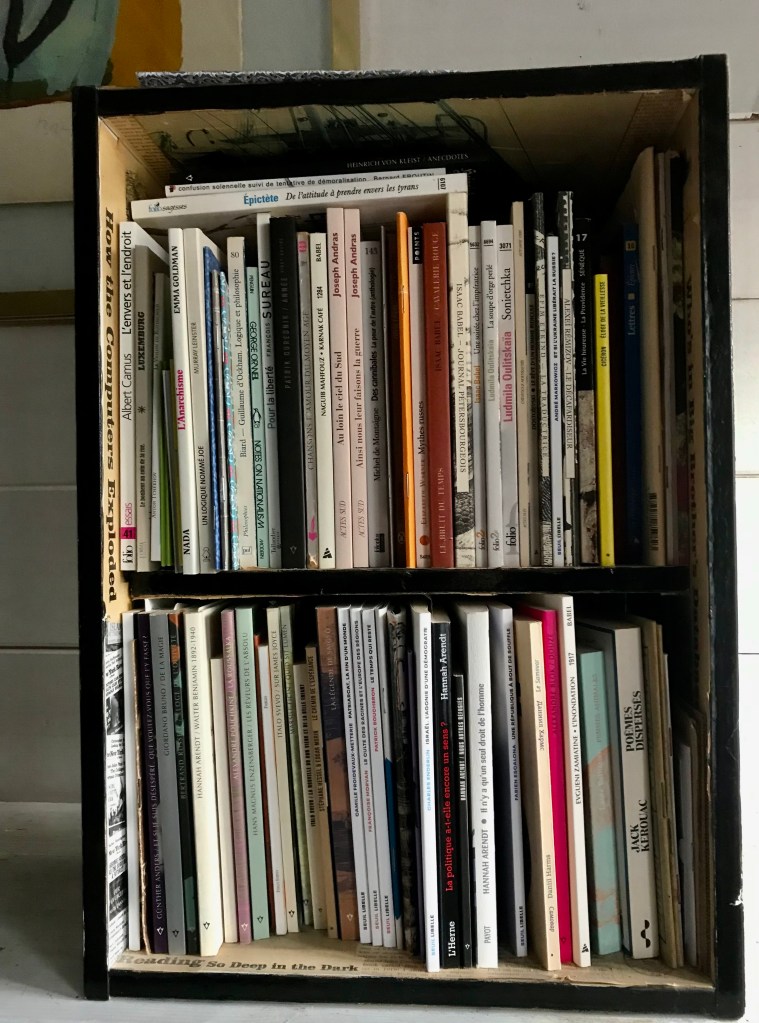
Illustration : tirée de ma “bibliothèques des petits formats” :
Charles Enderlin : Israël l’agonie d’une démocratie
Hannah Arendt : La politique a-t-elle encore un sens ?
Hannah Arendt : Il n’y a qu’un seul droit de l’homme
Hannah Arndt : Nous autres réfugiés
*Marina Rouilliez, Parias, Hannah Arent et la “tribu” en France 1933-1941), L’Echappée 2024
** Hannah Arendt, Il n’y a qu’un seul droit de l’homme, traduction de l’allemand et de l’anglais par Emmanuel Alloa, Payot, 2021
Dreams: a man sits, his legs dangling over the edge of a cliff, wondering how to protect himself from the dangers facing him; then, a long interruption in sleep, followed by a dream in which there was an exceptional opportunity to bring some people to a visit with my dogs in dog paradise, but I was hesitating, seeing the enthusiasm of my big and tall bouviers des Flandres which could frighten many of them.
Kopeck, Solly and Balou — Kopeck and Balou being undoubtedly the two kindest and smartest dogs I have known — that said without taking anything away from the other dogs I’ve had as companions in my life, but those two truly deserved to be considered exceptional.
At first glance, nothing to do with my readings of yesterday or from the night. Finished the reading of Parias in a single sitting with the word “villainy” resounding in my head like a bell. That France displayed toward the refugees of Germany and of other territories occupied by the Hitlerian army. Unveiling before the world, not only it own moral failure but the one in which we have lived ever since, the effects of which keep on developing like cancerous cells so deeply embedded in the system that they end up defining it, as if the healthy ones were there only as fodder for them.
As a breed, the bouvier des Flandres was almost eradicated during the First World War, when it served as a message bearer across enemy lines. They are equiped of a physical strength, of an intelligence and of a flawless loyalty…and particularly clever when it comes to skirting obstacles. Comparing Hannah Arendt’s loyalty to that of my bouviers, is not in the least bit ridiculous in my view, quite the contrary. And against all odds, the breed survived. One can hope the same will hold true for human intelligence in the face of villainy.
“The Universal Declaration of Human Rights calls the right of asylum an inalienable right and explicitly forbids acts of denaturalization; yet, there is nothing automatic in the granting of refugee status and it remains a sovereign prerogative of the State, one that it guards over jealously. Between the protection of human dignity and the self-determination of a political collective, the intellectual paradox appears insurmountable.”
The flaw. The one that opens straight out onto the abyss.
*
Poem by Hannah Arendt dedicated to W. B. (Walter Benjamin)
Some day, the dawn will rise again,
The night will fall from the stars,
We will be stretched out, limbs dislocated,
close by, in the distance.
Soft little melodies
will sound in the darkness
We shall listen to them closely, shedding our habits
breaking rank at last.
Distant voices, grief close by:
the voice of those dead
that we sent out as messengers
to guide us toward sleep.
Hannah Arendt, 1942
 iknowiknowiknowblog
Interesting to realize Arendt wrote that poem the year I was born. What a world I had unknowingly been thrown into. As is the case for all of us , blind as we are to it , fortunately as we grow up. We have, on our own environment as much as we can handle.
LikeLike
As the tale unfolds, I tend also to see at what point in the overall story I happened to drop into the world; constantly discovering more and more aspects of it — awesome, in the true sense of the word. As for the local vs larger scale of things, the whole notion of fractals keeps growing in my mind. But more on that some other time.
LikeLike