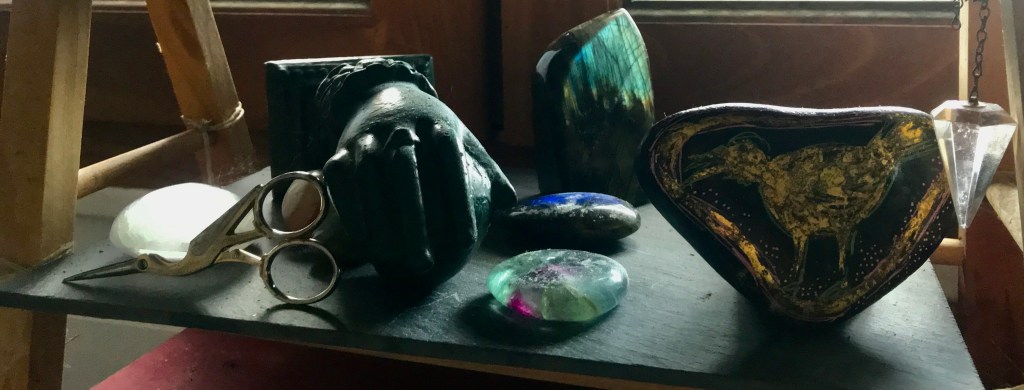
Rêve : Je faisais face à l’Obstacle, et l’Obstacle, informe, invisible comme Dieu sur la montagne devant Moïse, disait : “Non, au Commencement n’était pas le Verbe, au Commencement était Moi, l’Obstacle que tu ne pourras jamais surmonter. Je Suis et toujours, je m’opposerai à ce que tu mènes à terme ce que tu entreprendras. Moi, l’Obstacle, je décrète : “Tu n’y arriveras jamais.” Il était ici, là, partout. Il Etait. Il n’avait nul besoin de se nommer. Il Etait ce qui Etait. L’Obstacle. Insurmontable, par définition, protéiforme, il avait préséance sur tout. Il sécrétait le sentiment d’impuissance que ressent l’enfant devant l’adulte unique détenteur des interdits, de leurs définitions et applications, illogiques, incompréhensibles. Indiscutables. Et chaque fois qu’il croyait avoir enfin compris, l’enfant découvrait que l’Obstacle n’avait pas disparu, bien au contraire, il avait changé de forme, “c’est pour mieux te faire obstacle, mon enfant”, disait le Loup qui avait avalé Mère Grand et revêtu son bonnet de nuit afin de mieux t’avaler, toi aussi.
Et bien le bonjour, Maître Loup. Comme entrée de jeu… Je songe au petit bossu dans le conte allemand, celui dont parle Hannah Arendt dans ses souvenirs de Walter Benjamin. Cet homme dont elle disait qu’il lui avait appris “à nager ni avec le courant ni contre le courant” *
Je veux aller dans ma cave
pour y tirer mon petit vin
il y a un petit bossu
qui m’a attrapé ma cruche
Je veux aller dans ma cuisine
y faire bouillir ma petite soupe
il y a un petit bossu
qui m’a cassé mon petit pot.
Ah, les voix des jamais-jamais. Jamais tu ne donneras satisfaction, jamais, jamais. On aura beau se dire qu’on n’y comptait pas de toute façon, c’est faux. Au fond, on aurait bien aimé donné satisfaction, on n’avait rien contre en principe, mais apparemment, ça n’était pas possible. Le prix en était trop élevé ? Je ne sais pas. Le malentendu était trop fondamental, je crois.
Alors le kadima, davaï n’est pas tant de l’entêtement qu’un sentiment de l’inévitable. Au fond, au commencement était le malentendu concernant les attentes.
Allez.
*Hannah Arendt, Walter Benjamin, 1892-1940, traduit de l’anglais par Agnès Oppenheimer-Faure, Editions Allia, 2015
*
Et oui, comme toujours, la perspective de l’incompréhension qui accueillera “inévitablement” L’Horloger des Brumes se dresse devant moi comme le fait toujours la perspective de croiser à nouveau ce regard fuyant ou ce propos condescendant, le Jugement des Sachant, Éternels Adultes qu’on croise toujours, même à l’orée de ses 80 années de vie.
Dream: I was facing the Obstacle, and the Obstacle, shapeless, invisible like God on the mountain in front of Moses, was saying: “No, In the Beginning was not the Word, in the Beginning there was Me, the Obstacle you will never manage to overcome. I Am and I will always be against you brining to completion what you will have set out to do. Me, the Obstacle decree: “You will never succeed at it.” It was here, there, everywhere It Was. It had no need to name itself. It Was what Was The Obstacle. Insurmountable by definition, shape-shifting, it took precedence on everything. It secreted the feeling of powerlessness the child experiences in front of the adult, sole bearer of the prohibitions, of their definiitions and applications, illogical, incomprehensible. Indisputable. And every time he thought he had understand at last, the child discovered that the Obstacle had not disappeared, quite the contrary, it had changed shape, “it’s the better to be an obstacle to you, my child,” said the Wolf who had swallowed the Granny, and put on her night cap the better to swallow you down also.
And top of the morning to you, Master Wolf. I think of the little hunchback in the German tale, the one Hannah Arendt talks about in her recollections about Walter Benjamin. The man from whom she said she had learned to “swim neither with the flow, nor against it“.Cet homme dont elle disait qu’il lui avait appris “à nager ni avec le courant ni contre le courant” *
I wish to go down to my cellar
to draw some of my little wine
there is a little hunchback there
who has grabbed hold of my jug
I wish to go to my kitchen
to boil up my little soup
there is a little hunchback
who has broken my little pot.
Ah, the voices of the Never-Nevers. Never will you be satisfactory, never, never. You can tell yourself as you like that you dicn’t expect you would anyway, but that’s not true. Deep down, you would have loved to be satisfactory, you had nothing against it in principle, but apparently, it simply wasn’t possible. The price was just too steep ? I don’t know. The misunderstanding was too basic, I think.
So the kadima, davaï, isn’t so much stubbornness than a sense of the unavoidable. Bottom line, in the beginning was the misunderstanding over expectations.
So, onward.
 iknowiknowiknowblog