Rêves : Tout le monde critiquait son attitude à elle mais, surtout, on critiquait celle de “30” sosie et double d’un membre du gouvernement duquel “30” disait tout le mal qu’il y avait à dire à son sujet, c’était le fait qu’il en parle qu’on accablait de reproches, pour les gens, le fait d’en parler, c’était plus inacceptable que les faits eux-mêmes; puis, on me demandait de donner un coup de main à quelqu’un qui avait reçu une requête officielle de soumettre un rêve récent sur le formulaire administratif qu’il venait de recevoir et je me disais que, moi, je fournirais un de mes rêves récents, mais pas celui de cette nuit.
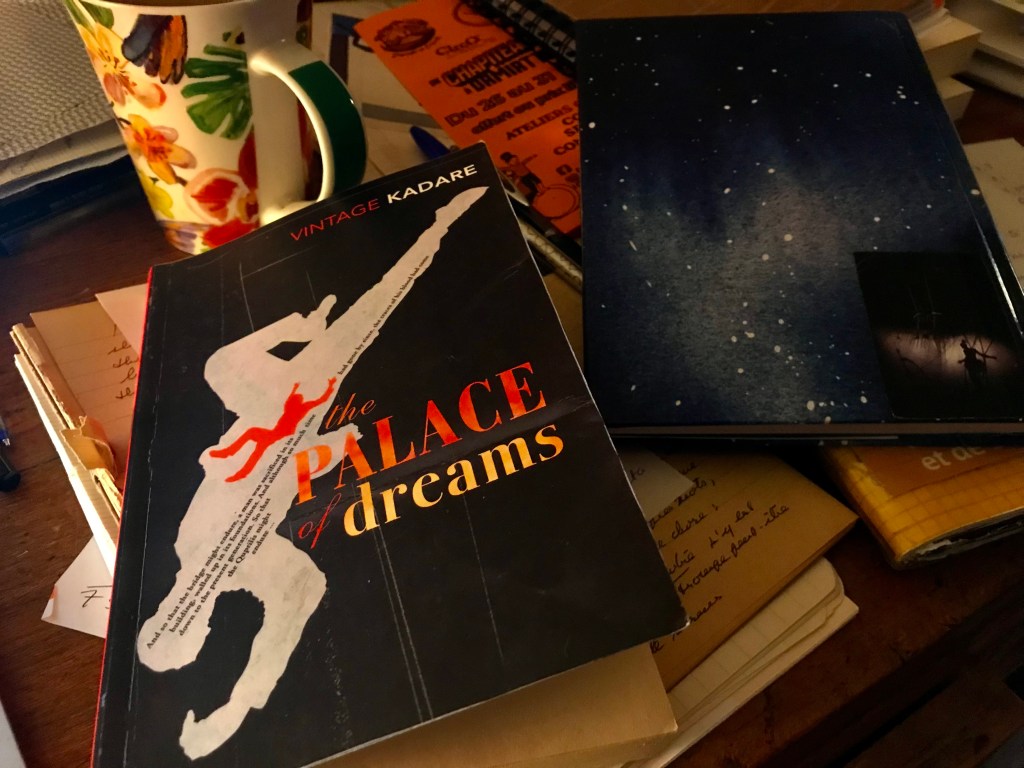
Curieux rappel du livre d’Ismael Kadaré, The Palace of Dreams* (Le Palais des rêves) lu en anglais il y a des années de cela (à partir d’une traduction par Barbara Bray de la traduction française faite par Yusuf Vrioni de l’original en albanais, version française qui n’était plus disponible.) Evidemment, de nos jours, le palais n’aurait qu’à consulter les rêves enregistrés sur ordinateur, le processus serait beaucoup plus rapide. Lequel de processus ? “L’idée du Souverain derrière la création du Tabir, était qu’Allah lançait un rêve prémonitoire sur le monde de façon aussi habituelle qu’il suscitait un éclair ou dessinait un arc-en-ciel ou envoyait une comète nous frôler, comète tirée des profondeurs mystérieuses de l’univers. Il lançait ses messages vers la terre sans se soucier d’où ils atterriraient. Il était trop éloigné pour se soucier de pareils détails. Il nous appartenait de découvrir où le rêve avait atterri — de l’extraire des millions, des milliards d’autres rêves, comme on rechercherait la perle tombée dans le désert. Car l’interprétation de ce rêve, tombée comme une étincelle dans le cerveau de l’un parmi des millions de dormeurs, pourrait servir à sauver du désastre le pays ou son Souverain ; pourrait aider à éviter la guerre ou la peste ou créer de nouvelles idées.” Evidemment, dans le cas du Souverain, il s’agit surtout de le sauver, lui et son règne.
Hier, j’ai traduit deux textes que j’ai publiés sur la page facebook Maria Damcheva : le premier texte, celui du Nerd Reich annonçant qu’un livre écrit en 2000 par Paulina Borsook, Cyberselfish — A critical romp through the terribly libertarian culture allait être re-publié et paraître à la mi-septembre. Borsook avait fréquenté le milieu de la Silicon Valley dans ces années-là et bien identifié le courant libertarien et profondément égoïste sous-tendant le mouvement vers les ordinateurs personnels dont, en apparence du moins, l’utilisateur serait le maître inconditionnel et individuel de son propre destin. Pour ce qui est de la réalité, on ne fait que commencer à en découvrir les effets (dit-elle, en pianotant sur son clavier).
Le second texte était celui de l’historien Timothy Snyder déroulant les treize éléments signalant le suicide des Etats-Unis de son statut de super-puissance, suicide en plein déploiement par Trump et son administration et ce, en moins d’une année d’exercice du pouvoir. Non pas pour pleurer la perte de ce statut, dans le cas de Snyder, mais pour signaler comment tous les éléments avant-coureurs de ce désastre étaient déjà présents dans la démocratie plus qu’imparfaite du pays et faire appel à un renouveau visant plus de justice. L’original en anglais On Superpower genocide se trouve ici.
Et dans ma tête, “18”, le jeune “18” observe attentivement les faits et gestes de l’ingénieur des collines, et se perd en contemplation du bleu du ciel et des apparitions blanches qui le traverse. Oui, je dois les noter, oui.
Sans oublier cette curieuse impression de familiarité ressentie en lisant le poème de W.H. Auden à la mémoire de W.B. Yeats, celle de retrouver le rythme exact de la prière que je récitais près de mon lit, le soir, quand j’avais 5 ans :
Now I lay me down to sleep
I pray the Lord my soul to keep
If I should die before I wake
I pray the Lord my soul to take
Dans le poème de Auden :
In the deserts of the heart
Let the healing fountain start,
In the prison of his days
Teach the free man how to praise.
*Ismail Kadare, The Palace of Dreams, translated by Barbara Bray from a French translation by Yusuf Brioni of the Albanian original, Vintage Books 2008
*
Dreams: Everyone was criticizing her attitude but, mostly, they were criticizing that of “30”, look-alike and double of a member of the government of whom “30” was saying all the evil that could be said about him, it was the fact that he talked about it that drew all the reproaches from people, the fact of mentioning them was more unacceptable than the facts in themselves; then, I was requested to lend a hand to someone who had received an official summons to submit a recent dream on an administrative form he had just received and I was telling myself that, in my case, I would provide one of my recent dreams, not the one from this night.
Odd reminiscence of Ismael Kadare’s , The Palace of Dreams* read in English years ago . Obviously, nowadays, the palace would only need to consult the dreams recorded on computers, the process would be much faster. What process ? “The idea behind the Sovereign’s creation of the Tabir was that Allah looses a forewarning dream on the world as casually as He unleashes a flash of lightning, or draws a rainbow or suddenly sends a comet close to us, drawn from the mysterious depths of the Universe. He dispatches a signal to the earth without bothering about where it will land; He is too far away to be concerned with such details. It is up to us to find out where the dream has come to earth — to flush it out from among millions, billions of others, as one might look for a pearl lost in the desert. For the interpretation of that dream, fallen like a stray spark into the brain of one out of millions of sleepers, may help to save the country or its Sovereign from disaster, may help to avert war or plague or to create new ideas.” Needless to say in the Sovereign’s case, it was mainly about saving himself and his reign.
Yesterday, I translated two texts that I then published on the Maria Damcheva facebook page: the first, that from The Nerd Reich announcing that a book written in 2000 by Paulina Borsook, Cyberselfish — A critical romp through the terribly libertarian culture was going to be re-published and would come out in mid-September. Borsook had spent time in the Silicon Valley environment in those years and fully identified the libertarian and profoundly egotistical strain underlying the movement toward personal computers which, appearance-wise at least seems to make the user the unconditional and individual master of his fate. As for the reality, we are only beginning to discover its effects (says she, typing away on her keyboard.)
The second text was that of historian Timothy Snyder rolling out the thirteen elements signaling the suicide of the United States from its status as a superpower, a suicide in full deployment by Trump and his administration less than a year into this mandate. Not to cry over the loss of this status, in Snyder’s case, but in order to signal how all the forewarnings of this disaster were already in place in the more than imperfect democracy of the country, and to call on a renewal aiming for more justice. The English original On Superpower genocide can be found here.
And in my head, “18”, the youth named “18” closely watches the comings and goings of the hill engineer, and loses himself in contemplations of the blue of the sky and of the white apparitions that drift across it. Yes, I must write them down, yes.
Without omitting that odd sensation of familiarity while reading the poem W.H. Auden wrote in memory of W.B. Yeats, of reconnecting with the same rhythm as that of the prayer I used to recite next to my bed at night, when I was 5 years old :
Now I lay me down to sleep
I pray the Lord my soul to keep
If I should die before I wake
I pray the Lord my soul to take
In Auden’s poem :
In the deserts of the heart
Let the healing fountain start,
In the prison of his days
Teach the free man how to praise.
*Ismail Kadare, The Palace of Dreams, translated by Barbara Bray from a French translation by Yusuf Brioni of the Albanian original, Vintage Books 2008


I much appreciate and prefer Aiden’s take.
LikeLike
no kidding 🙂 me too
LikeLike