Très long rêve qui se déroule dans un ancien palais converti en endroit d’expérimentation sociale, où les gens de différents milieux sont supposés explorer le mystère de leur propre voix, puis — est-ce le même rêve ou un autre — nous sommes à l’étage des chambres dans la maison de la grand-mère irlandaise, la maison au bord du fleuve à St-André-de-Kamouraska et elle en a marre de notre présence et veut que nous dégagions, quand je descend l’escalier, c’est sa maison sur la rue St-Hubert à Montréal, la porte donnant sur la rue est ouverte, je retrouve ma grand-mère dormant dans un fauteuil, on dirait qu’elle est morte mais non, elle s’éveille et fait une scène en découvrant que nous sommes encore là.
Il est vrai qu’elle avait des manières très impérieuses et que je me suis souvent trouvée bannie à la cuisine chez-elle — ce qui n’était pas du tout pour me déplaire, car à la cuisine, il y avait Nen qui me laissait nourrir ses tortues avec des bouts de laitue. Quant à la maison au-dessus du fleuve, à S-André-de-Kamouraska, c’est là qu’à l’âge de 5 ans, je fis l’expérience de ma première migraine ce qui avait fort déplu à ma grand-mère (“no grandchild of mine will start complaining of aches and pains“), elle avait ordonné que je rejoigne les autres à la table, avec pour résultat que j’avais vomi sur la nappe et subi mon premier bannissement béni à la cuisine. Un 19e siècle à la Dickens n’était jamais loin dans ses manières; il faut dire qu’orpheline de mère à l’âge de 5 ans, elle ne savait pas grand chose de la tendresse maternelle.
Je suppose que tout ça a un lien quelconque avec le fait que The Cider House Rules de John Irving se déroule dans un orphelinat où l’un des orphelins lit David Copperfield et Great Expectations aux autres orphelins; déjà en soi, la chose me paraît assez improbable et ça ne me rend pas l’écriture d’Irving plus intéressante pour autant; j’imagine qu’on peut facilement atteindre 720 pages de texte en fournissant des descriptions physiques et des anecdotes au sujet de chaque personne apparaissant dans l’histoire, y compris celles ou ceux qui ne sont que des figurants destinés à faire progresser le récit. Mais je n’ai aucune envie de me balader dans l’histoire d’un orphelin élevé par un médecin avec une addiction à l’éther, fournissant des avortements à la demande ou des accouchements à des femmes produisant de nouveaux orphelins. Iriving a une fascination pour la description de l’horreur qui me déplaît, elle me semble passer complètement à côté de l’essentiel.
Pour l’heure, je gribouille et je griffonne encore dans une sorte de no man’s land mental personnel. Un atelier, cet après-midi, pour ce que ça vaudra.
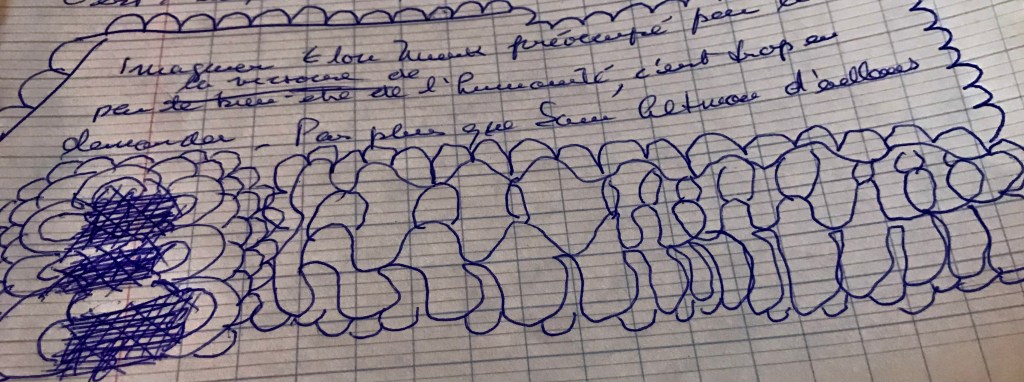
Quant à l’illustration, plutôt qu’une traduction de l’article sur le procès que livre Musk de Grok à Altman de OpenAI, disons que ça représente les 950 millions de personnes qui ont utilisé un chatbot dans une seule journée (ce qui n’est pas encore suffisant pour que les “doomers” réalisent leurs prédictions sur la course vers le Jugement dernier, à force de manipuler des milliards, il faut croire qu’ils ont complètement perdu la boule.)
*
Very long dream that takes place in an ancient palace converted into a space for social experimentation, where people from different backgrounds are supposed to explore the mystery of their own voice, then — is this in the same dream or another — we are at the level of the bedrooms in the house of the Irish grandmother , house near the river in St-André-de-Kamouraska and she’s had enough of us and wants us to shove off, when I go down the stairs, it’s in her house on St-Hubert street in Montreal, the door out to the street is open, I find her sleeping in an armchair, she looks dead but no, she wakes up and makes a scene when she discovers we are still there.
True enough, she had imperious manners and I often found myself banished to the kitchen at her place — which did not displease me in any way because, in the kitchen, there was Nen who let me feed her turtles with bits of lettuce. As for the house above the river in S-André-de-Kamouraska, it’s the one where at age 5, I experienced my first migraine headache which thoroughly displeased my grandmother (“no grandchild of mine will start complaining of aches and pains“), she had ordered me to join the others at the table, as a result of which I had vomited all over the tablecloth and been blessedly banished to the kitchen. A Dickens-like 19th century was never far removed from her manners, it should be said that she had lost her mother at the age of 5 and didn’t know much about maternal tenderness.
I suppose all this has some link to the fact John Irving’s The Cider House Rules takes place in an orphanage where one of the orphans reads David Copperfield and Great Expectations to the other orphans. In itself, this already strikes me as improbable, I don’t find Irving’s writing more interesting for all that, I guess you can easily reach 720 pages of text if you provide physical descriptions and telling anecdotes about every single person appearing in the story, even those with no more than a walk-on part meant to move the story along. But I have no wish to meander through the story of an orphan raised by an ether-addicted doctor providing abortions when needed or providing deliveries to women producing new orphans. Irving has a fascination for the horrific I dislike.
For the time being, I’m still scrawling and scribbling in a kind of personal mental no man’s land. A workshop this afternoon, for what it’s worth.
As for the illustration, let’s say that, instead of translating the article about Grok’s Elon Musk suing Sam Altman of OpenAI, it represents the 950 million people who used one of the chatbots in a single day (and that’s still not enough for the money required by the “doomers” intent on winning the race in their doomsday predictions, what with handling all those billions, they seem to have totally lost the plot.)
 iknowiknowiknowblog