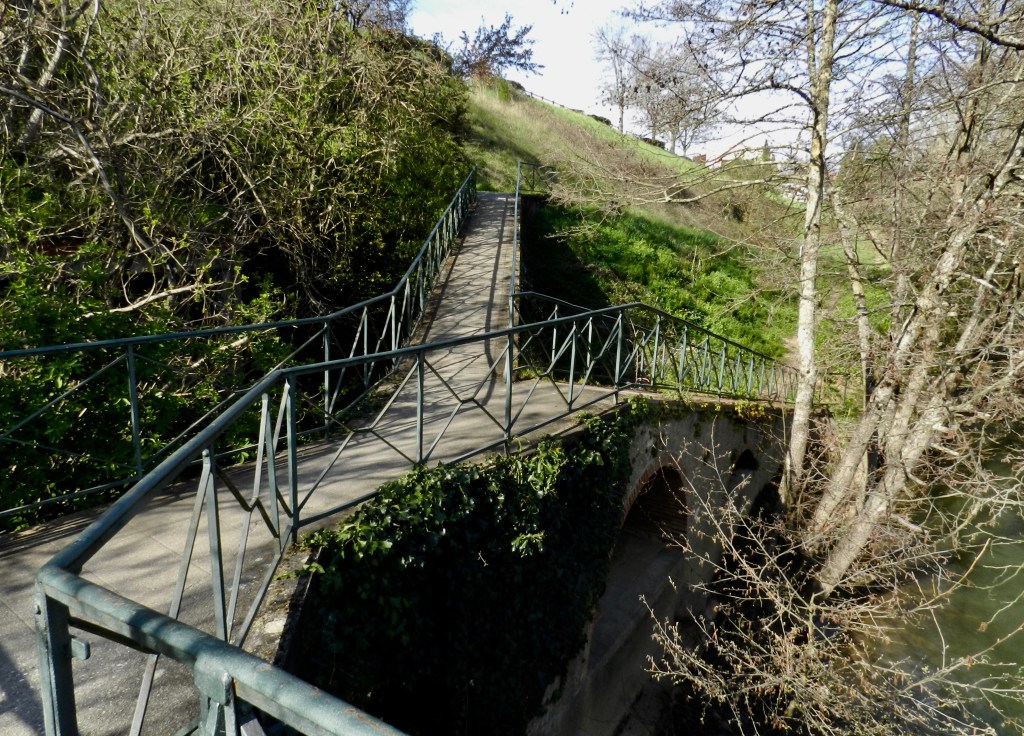
Dans le roman Nous autres de Zamiatine, la société du bonheur absolu a dressé un mur derrière lequel pousse la verdure, les animaux terrestres, les oiseaux et où grondent les orages, bref tout ce que la vie représente de non-contrôlé par la raison. Parce que, dans la société du bonheur absolu, la vie est régie par les tables de multiplication dont les vérités sont éternelles et incontestables. (Il faut croire que la société du bonheur absolu n’avait pas encore perçu tous les bénéfices à tirer des algorithmes.)
Toujours est-il que ma première lecture du roman de Zamiatine, écrit en 1921 et interdit en Union soviétique, ne fut pas concluante. La deuxième lecture (avant-hier) fut bien meilleure, surtout lorsque je tombai sur un passage qui a sûrement frappé George Orwell aussi avant d’écrire son 1984 (le roman de Zamiatine fut publié en anglais à “l’étranger” – de l’autre côté du Mur Vert, en somme.)
Dans le passage en question, le personnage principal vante l’équilibre parfait d’une société appliquant aux humains les vérités éternelles des tables de multiplication où deux fois deux donnent toujours quatre. Quelque chose me suggère qu’en lisant cela, Orwell s’est dit: et bien non, les sociétés totalitaires peuvent faire “mieux” encore, en imposant comme vérité le fait que deux fois deux donnent cinq. Les fameux “faits alternatifs” comme mode de pensée, en somme.
Pour l’heure, les “faits alternatifs” ne s’appliquent pas à la couleur des herbes folles et autres verdures qui poussent sans autorisation préalable. Mes meilleurs voeux aux herbes folles et autres verdures sauvages.
*
In his novel We, Zamiatin writes that the society of absolute happiness has set up a wall behind which green stuff grows, terrestrial animals and birds live, storms break out, in short, everything goes on living that reason cannot control. The society of absolute happiness is ruled by the multiplication tables the truths of which are eternal and unquestionable. (I suppose the society of absolute happiness hadn’t discovered all the benefits it could derive from algorithms.)
Be that as it may, on first reading, I was not much taken by Zamiatin’s novel, written in 1921 and denied publication rights in the Soviet Union. A second reading (day before yesterday) was much better, especially when I came across a passage that surely struck George Orwell before writing his 1984 (by then, the book had been translated in English in a “foreign country” – somewhere on the other side of the Green Wall, so to speak.)
In the passage in question, Zamiatin’s protagonist is glorifying the rule according to which two times two will always add up to four, which when applied to humans, becomes the way to achieve perfect equilibrium. Something tells me that, when Orwell read this, he must have thought: no, totalitarianism can go much further, by imposing the belief in a falsehood, for example, that two and two add up to five. The famous “alternative facts” as a mindset.
For the time being, “alternative facts” don’t apply to the color of wild grass and other greenery in those areas where they grow without prior authorization. My best wishes to wild grasses and greenery.

