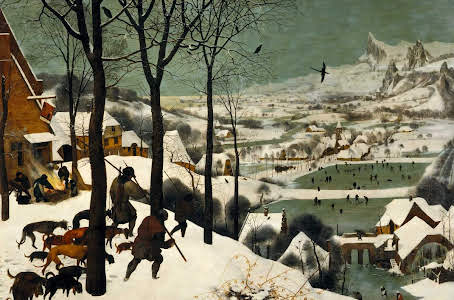
Chasseurs dans la neige – Brueghel l’Ancien – Hunters in the Snow – Brueghel the Elder
Ici, avant de plonger dans la relecture de Une Poule Avertie en Vaut Deux :
“Invisible (2)”
La découverte s’était produite alors qu’elle était assise dans le “fauteuil à oreilles” chez sa grand-mère, et qu’elle fixait le tableau sur le mur (une reproduction, apprit-elle plus tard, mais ce détail était sans importance.)
Elle avait trouvé le secret de l’invisibilité.
Elle n’y parvenait pas toujours, et rarement du premier coup. Elle avait dû beaucoup pratiquer mais, comme disait son père, ’on n’a rien sans rien.’
Dit simplement, le secret paraissait facile :il fallait choisir l’un des personnages dans le tableau et se perdre dedans. Surtout pas l’un des chasseurs, de leurs chiens ou des deux personnages au fond du promontoire parce que tout le monde les remarquait. Si on choisissait l’un des corbeaux, il fallait prendre celui qui ne faisait qu’une petite tache noire sur le premier toit en contrebas.
Mais il valait mieux opter pour l’un des patineurs ou, mieux encore, une des taches grises représentant quelqu’un marchant vers le clocher entre-aperçu dans les branches.
Plonger dans ce personnage et y rester. Alors, les grandes personnes pouvaient entrer et sortir du petit salon, s’y installer à deux ou à trois pour tricoter ou papoter, personne, absolument personne n’avait l’idée de fouiller le tableau des yeux pour la retrouver.
S’il y avait des grandes personnes dans la pièce, le seul ennui consistait à demeurer immobile au retour de l’invisibilité, et attendre dans le fauteuil d’être à nouveau seule avant de vérifier qu’elle était revenue tout d’un morceau; avant de ré-apparaître dans le grand salon, ou dans la salle à manger, ou, mieux encore, dans la cuisine pour y nourrir les tortues avec des bouts de laitue.
(Une collègue de l’atelier d’écriture a suggéré l’idée d’écrire une courte nouvelle chaque jour et je me suis dit: et pourquoi pas ?)
*
Et puis, il y aura peut-être aussi une courte au sujet de la dernière pomme restée dans le pommier – iabloko qui me remet en mémoire les pommes dans les poèmes de Mandelstam – le son du fruit tombant au sol; la pomme des ans qui roulent et roule à souveraine allure; le ‘pommier l’hiver sous la natte‘; ou ‘ainsi parle un enfant: “tiens, prends cette pomme” ou “pas de pomme pour toi”; les paupières de l’âge souverain, “deux grosses pommes sommeillantes“; la neige “à odeur de pomme“…; le son de pomme croquante que font les patins du carrosse sur la neige…
Bref, les pommes et le miel et les abeilles de Mandelstam dont sa femme disait qu’il était “zhizneradostny“, non pas dans le sens conventionnel de ‘joyeux’ mais habité de la joie sauvage que lui inspirait la langue russe.
*
Maria apaisait-elle l’enfant que j’étais en russe ou en ukrainien, je ne saurais dire. Mais elle chantait en russe la fois où elle m’avait posée sur ses genoux et avait pressé la peau d’une orange pour que j’en sente l’odeur et ressente la buée légère sur mon visage; l’odeur qui s’était associée à mon étonnement à la vue de ces signes en bleu inscrits sur son bras. Des années plus tard, le souvenir du bleu de l’encre et de l’odeur d’orange me reviennent en lisant les mots d’Eluard ‘la terre est bleue comme une orange.’
*
Pour l’heure : relecture du texte en essayant de l’imaginer à travers les yeux d’un autre.
*
Before plunging into a re-reading of Une Poule Avertie en Vaut Deux :
“Invisible (2)”
She had made the discovery while sitting in the “seat with ears” at her grandmother’s and while staring at the painting on the wall (a reproduction, she had learned later, but this detail was unimportant.)
She had discovered the secret to invisibility. She didn’t alway achieve it, and rarely on a first try. She had needed a lot of practice but, as her father said, « nothing worthwhile comes easy ».
Told in simple terms, the secret seemed easy enough: you had to choose one of the people in the painting and lose yourself inside it. You had to avoid the hunters, their dogs or the two characters in the background on the promontory because everyone noticed them. If choosing one of the crows, the one to choose was the one that looked like a black spot on the first rooftop below the cliff.
But it was better to opt for one of the skaters or, better yet, one of the grey smudges representing someone walking toward the bell tower half-seen between the branches.
Diving into this character and remaining there. Then, grownups could enter and leave the sitting room, settle in it by twos or threes in order to knit or gossip, no one, absolutely no one ever thought of searching the painting to find her.
If there were grownups in the room, the only bother was in keeping still when returning into the armchair, and waiting to be alone again before checking shewas back with all her limbs, before reappearing in the living groom, or the dining room, or best of all, in the kitchen to feed the turtles with bits of lettuce.
(A colleague from the writing workshop came up with the idea of writing a short every day, and I thought, why not?)
*
And then there may be one about the last apple remaining in the apple tree – iabloko which reminds me of apples in Mandelstam’s poems – the sound of the fruit falling to the ground; the apple of the years rolling on rolling on at a sovereign pace; the apple tree in winter with its feet in a straw matting; or as children speak ‘here, take this apple’ or ‘no apple for you’; the sovereign age’s eyelids, “two big slumbering apples“; the apple smell of snow; the crisp apple sound of the sleigh’s runners on the snow…
In short, Mandelstam’s apples and honey and bees – Mandelstam whose wife described him as “zhizneradostny“, not in the conventional sense of ‘joyful’ but rather for the wild joy he took in the Russian language.
*
Did Maria soothe the child I was in Russian or Ukrainian, I can’t say. But she sang in Russian the time she sat me on her lap as she squeezed some orange peel so I could smell the scent and feel the faint sprinkle; the smell that melded with my wonderment over the strange blue signs on her arm. Years and years later, the blue of the ink and the scent of orange peel came back to me when I first read Eluard’s ‘la terre est bleue comme une orange‘ – the earth is blue like an orange.
*
For now: reading through the text while trying to imagine it through someone else’s eyes.
 iknowiknowiknowblog