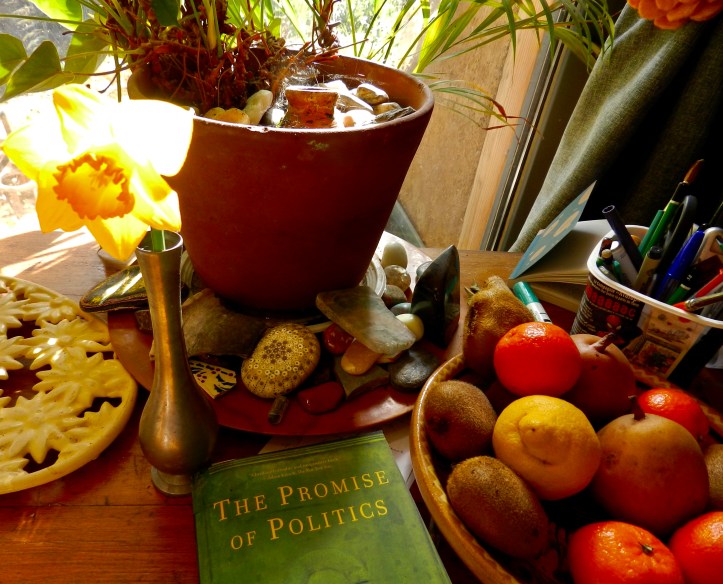
Vu le contexte, le titre “The Promise of Politics“* peut paraître une blague cruelle aux yeux de certains. Et pourtant, la grande lucidité d’Hannah Arendt est une alliée précieuse, justement pour cette raison.
Pas question pour moi de résumer sa pensée en trois phrases. Je ne compte plus le nombre de fois que j’ai lu et relu ce livre. Hannah Arendt a une façon bien à elle de développer sa pensée, faisant appel à des intuitions fondamentales. Si jamais je parviens à les résumer de façon utile, je le ferai. Qu’il me suffise de dire ici qu’elle considère les tyrannies comme a-politiques puisque, pour elle, la politique constitue la base sur laquelle des humains différents les uns des autres sont libres d’agir, en fonction même de ces différences.
Entretemps, j’ai aussi lu et relu Fiona Hill et Clifford G. Gaddy, Mr. Putin Operative in the Kremlin** et je viens de terminer la lecture d’une entrevue que Fiona Hill vient d’accorder et qui se trouve ici – uniquement en anglais, malheureusement, car vu sa connaissance approfondie du personnage central dans le déroulement des événements qui nous concernent tous et toutes, ce qu’elle en dit est d’une importance capitale.
Et je relis le poème de Seamus Heaney Mycenae Lookout *** (La sentinelle de Mycènes), poème en 5 parties que lui ont inspiré ses réflexions sur la guerre de Troie et la tragédie qu’en tira un certain Eschyle.
Tout ceci en anglais, j’en suis désolée pour ceux ou celles qui ne pratiquent pas cette langue.
Et je retourne à mes traductions pour le site Kedistan pendant que les augures scrutent le ciel et se disputent sur la signification des présages – et que les jonquilles s’épanouissent derrière chez-moi, dans l’ignorance totale des vicissitudes déclenchées par les humains.
*
Given the context the title “The Promise of Politics”* may strike some as a cruel joke. And yet, Hannah Arendt’s great lucidity is a precious ally precisely for this reason.
I certainly don’t intend to attempt summarizing her thinking in three neat sentences. I haven’t counted the number of times I’ve read and re-read this book. Hannah Arendt has a very personal way of unfolding her thinking, based on fundamental intuitions. If ever I manage to summarize some of this in a useful way, I shall. Suffice it to say here that she considered tyranny a-political, since for her, politics is seen as the basis for freedom of different humans to gather and act on the very basis of their differences.
In the meantime, I’ve also read and re-read Fiona Hill and Clifford G. Gaddy’s Mr. Putin Operative in the Kremlin**, and just finished reading an interview with her which I consider essential reading given her solid knowledge on the central figure in the current events affecting us all – only available in English, unfortunately since what she has to say is of fundamental importance.
And, once again, I read Seamus Heaney’s 5-part poem Mycenae Lookout,*** inspired by the Trojan War and the tragedy Sophocles produced from it.
All this in English, I realize, with regrets to any potential reader who does not practice this tongue.
And I return to my translations for the Kedistan website, while the augurs scan the skies and argue over the meaning of the omens – and the daffodils bloom in my backyard in utter disregard of vagaries set off by humans.
*Hannah Arendt, The Promise of Politics, edited and with an Introduction by Jerome Kohn, Schocken Books, New York 2005
**Fiona Hill and Clifford G. Gaddy, Mr. Putin Operative in the Kremlin, Brookings Institutution Press, Washington D.C. 2015
***Seamus Heaney, Mycenae Lookout in The Spirit Level, faber & faber, London 1996
 iknowiknowiknowblog