Instant –
Contrairement à je ne sais combien d’explications longues et ardues sur le continuum espace-temps, une phrase vers la fin du roman La conscience de Zeno*d’Italo Svevo réalise le travail en un…instant. Le protagoniste, Zeno en l’occurrence, est à analyser des images mentales, tentant d’évaluer leur concordance (ou non) avec des événements réels. Il dit: “Mais comment arrêter ces images quand elles se mettent à fuir à travers un temps plus que jamais pareil à l’espace?”
Dans le roman, Zeno arrive à la conclusion que ces “souvenirs” sont des créations mentales d’événements qui ne se sont jamais déroulés de cette façon. Pour cette lectrice, l’essentiel est ailleurs: dans cette approximation géniale de la sensation même des images qui nous échappent au sortir d’une nuit pendant laquelle on sait pertinemment avoir rêver…et où l’image ultime nous échappe comme un poisson dont on vient à peine de sentir l’effleurement d’une nageoire, entraînant tout le rêve là où vont les images seulement entrevues. Un aperçu et puis – disparue avant que les mots n’aient pu s’emparer de la vision.
C’est à la fois frustrant – comme peut l’être l’effet d’un mot “sur le bout de la langue” – et amusant comme un jeu de cache-cache qu’on jouerait avec sa propre tête. Ah! Bien joué, tête, tu m’as eue cette fois!
*
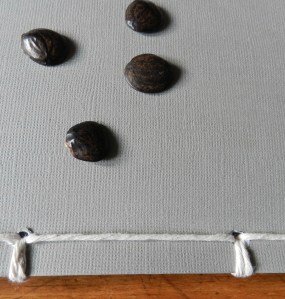
Chez une amie: nous sommes quelques-uns autour de la table. Soudain, un bruit assez prononcé d’une chose légère qui tombe par terre dans la pièce à côté. La conversation s’arrête, reprend et…encore. “Ah, j’ai découvert de quoi il s’agit,” dit l’hôtesse. Elle va dans la cuisine, et revient avec un bol rempli de belles gousses recouvertes d’un velours gris très doux. L’une des gousses éclate à ce moment précis…et distribue à tout venant cinq ou six grosses graines luisantes. Drôle et saisissant. Comme de voir un clown surgir de sa boîte.
J’en recueille quelques unes. Graines de glycine, à planter au printemps, contre la palissade.
(Mais comment la gousse fait-elle pour…)
*Italo Svevo, La conscience de Zeno, traduit de l’italien par Paul-Henri Michel, revu par Mario Fusco, collection Folio, Gallimard 2010
*
Unlike I don’t know how many long and difficult explanations about the space-time continuum, one sentence toward the end of Italo Svevo’s novel La conscience de Zeno* did the job in one…instant. The protagonist, Zeno to be precise, is analyzing mental images, attempting to see if they agree (or not) with real events. He says: “But how to arrest those images when they start fleeing in a time more than ever identical to space?”
In the novel, Zeno reaches the conclusion that these “memories” are mental constructs and that the real events did not play out in the same way. The essential part of this sentence is elsewhere for this reader: in this approximation that veers on genius of the very sensation of images escaping us as we emerge from a night in which we know for certain that we have dreamed…and where the final image escapes us the way a fish does after we’ve barely felt the light touch of its fin, taking the whole dream with it to wherever dream images migrate. Zip – a glimpse – then: gone before words can take hold of the vision.
It is at once frustrating – as can be the “tip-of-the-tongue” effect -and amusing like a game of peek-a-boo we’re playing with our own mind. Ah, nice move, head, you got me on that one!
*
At a friend’s house. There are a few of us around the table. From the other room suddenly, there’s a fairly pronounced sound of something light falling to the floor. We stop, then the conversation picks up and…the same sound again. “Ah, I’ve discovered what it is,” our hostess says. She goes to the kitchen and comes back with a bowl filled with beautiful pods covered in soft grey velvet. One of the pods snaps open at that moment and scatters on the floor five or six large seeds. Funny and striking. Like seeing a clown spring out of his box.
I gather a few. Wisteria seeds for planting against the fence next spring.
(But how does the pod manage to…)
*Zeno’s Conscience has been translated from the Italian into English. Look it up on The Book Depository. “A monument of sustained irony”, someone has called it. It is that, and many other things too – such as superior writing by any name you wish to give it.
 iknowiknowiknowblog