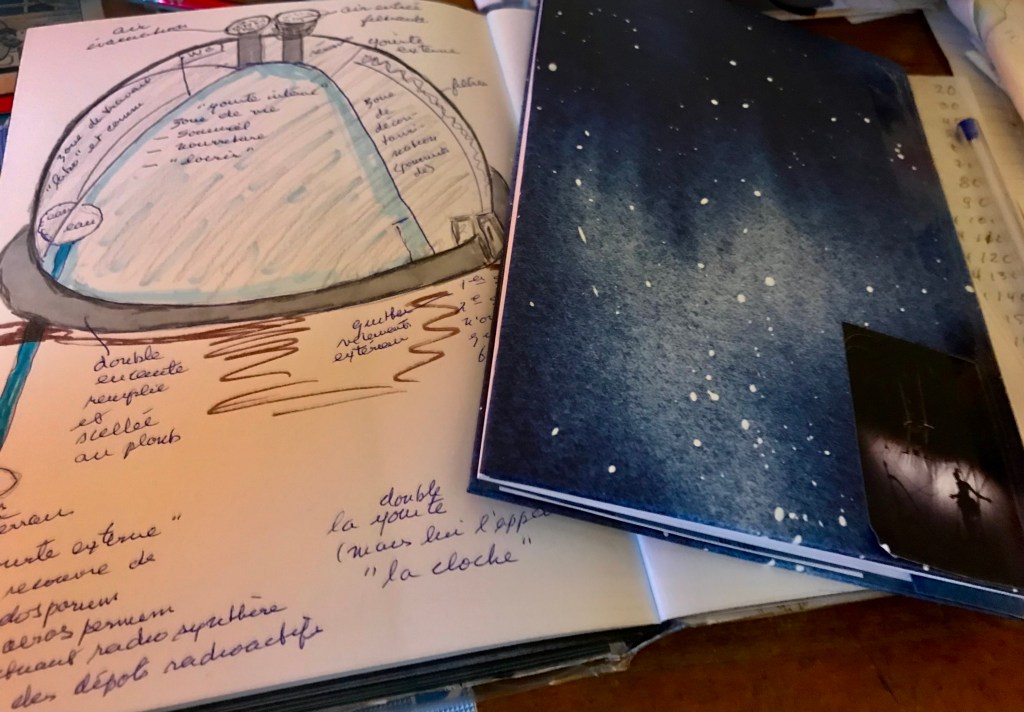
Rêves : dans le premier, il s’agissait d’une chanson dont les paroles étaient : “Il était perdu bien qu’il se soit vanté d’avoir toujours raison lorsqu’il louait les tyrans”; puis, il fallait que je me remette au piano, parce que la personne qui m’avait sauvée voulait que je donne un concert où allaient se retrouver tous les anciens, c’est-à-dire nous, et chacun proposerait un séminaire à partir de ce qu’il ou elle aurait appris dans la vie, j’écoutais celui qui me précédait, puis j’étendais la main vers mon cahier bleu nuit, c’était à mon tour de prendre la parole.
*
Par où commencer ? Par quelques notes prises en écoutant les réflexions d’André Markowicz devant la “mission d’information sur l’intelligence artificielle de l’Assemblée nationale”, peut-être:
— ce qu’on traduit, ça n’est pas une langue, c’est une voix s’exprimant dans cette langue. Il s’agit d’un chemin personnel en rencontrant un autre; le texte en résultant, c’est un organisme exprimant une voix, comment cette voix s’est exprimée dans une structure qu’on appelle un texte.
— ce qu’un système informatique n’est pas en mesure de faire puisqu’il “n’entend” pas ce que dit le texte par son choix de tel mot plutôt que tel autre, par ses sous-entendus, ses ironies, ses contresens intentionnels. Le système, lui, (qu’il appelle “le golem”) suit le trajet des probabilités induit par les logarithmes qui suggèrent que tel mot sera suivi par tel autre. Système adapté à la traduction “mécanique” d’instructions pour l’utilisation d’un aspirateur, par exemple, mais sans rapport avec la traduction d’un texte en prose ou de poésie.
— Il reprend la phrase de Rilke à un jeune poète, “si tu peux vivre sans écrire, n’écris pas“, et l’applique à la traduction, la même chose étant vrai en traduction, puisque là aussi, il s’agit d’écriture.
— Commentant un projet “d’écriture par IA” d’une pièce de Molière qu’on aurait découverte après sa mort — un pastiche, en somme, composé à partir de plagiats de son oeuvre — il cite “la blague arménienne en russe” : Question : Peut-on importer le socialisme en Suisse ? Réponse : Oui, mais à quoi bon ?
En effet, à quoi bon “imiter la vie” alors que c’est la vie même qui ne demande qu’à être reconnue dans des mots tirés d’elle ?
— La traduction en tant que ” politique de l’accueil”, “ouvrant le champ des possibles de la langue.”
Dans cet esprit, il est tout sauf indifférent d’utiliser le mot juste plutôt qu’un autre, de parler en à-peu-près de “trucs-machins” bof, tout le monde aura compris. Aura compris quoi ? Qu’une satire, c’est du pareil au même qu’un mensonge intentionnel et des faussetés destinées à créer la confusion ?
Golem, oui, comme le nommait Stanislaw Lem dans un récit en polonais jamais traduit en français ou en anglais (mais en espagnol et en…roumain). Golem XIV, s’appelait-il, comme un roi français bien connu, et supposément d’une intelligence dépassant totalement les capacités de compréhension de l’homoncule l’ayant façonné.
Aujourd’hui, des millions d’américains manifesteront dans un événement baptisé “No Kings” puisque c’était bien les injustices que leur imposait le roi Georges III d’Angleterre qui les avaient poussés à se soulever et à créer leur république, celle là même que le président actuel et ses sbires s’emploient à détruire .
*
Pendant ce temps, je continue le périple de mes personnages dans L’Horloger des Brumes, en me fondant sur Les Métamorphoses d’Ovide, certes, mais aussi sur deux réalités. L’une, évoquée par André Markowicz dans cette intervention, et à laquelle je pense souvent moi-même : lors de l’extinction des grands sauriens, tout ne fut pas détruit, des bêtes aux dimensions plus modestes survécurent et se développèrent. (Me revient le poème Satura d’Eugenio Montale). Mais aussi, les résultats de cette recherche sur les effets de l’herbicide glyphosate, tuant toute plante dite “mauvaise herbe” dans les champs de culture céréalière. Oui, le glyphosate les tue, dans la plupart des cas, mais certaines “mauvaises herbes” résistent et développent une immunité contre l’éradicateur (pour ce qui est de l’effet qu’il a sur les céréales en question, je n’ai rien trouvé encore.)
*
Non, l’histoire ne parvient jamais à tout détruire, il reste toujours des passages qui échappent à la catastrophe; ça n’est pas que l’histoire ne voudrait pas faire place nette, mais l’histoire a la mémoire courte et ne termine jamais complètement ses vendetta. Et grattant le fond de la mer, ses filets se déchirent, quelques poissons s’en échappent et il arrive que l’ectoplasme d’un évadé que l’on croise ne se rend pas compte qu’il est plus libres que les autres dans la nasse. Extrait du poème de Montale :
II.
La storia non è poi
la devastante ruspa che si dice.
Lascia sottopassaggi, cripte, buche
e nascondigli. C’è chi sopravvive.
La storia è anche benevola: distrugge
quanto più può: se esagerasse, certo
sarebbe meglio, ma la storia è a corto
di notizie, non compie tutte le sue vendette.
La storia gratta il fondo
come una rete a strascico
con qualche strappo e più di un pesce sfugge.
Qualche volta s’ incontra l’ectoplasma
d’uno scampato e non sembra particolarmente felice.
Ignora di essere fuori, nessuno glie n’ha parlato.
Gli altri, nel sacco, si credono
più liberi di lui
*
Dreams: In the first, there were the words of a song that said : “He was lost although he had bragged about always being right when he praised the tyrants“; then, I had to get back to my piano because the person who had saved me wanted me to give a concert where all the ancients would gather, meaning us, and each one would offer a seminary based on what he or she had learned in life, I was listening to the one preceding me, then I reached out my hand for my night blue notebook, it was my turn to speak.
*
Where to start? Perhaps with a few notes jotted down while listening to André Markowicz’ reflections before the “information mission concerning artificial intelligence” at the French National Assembly:
— one does not translate a language, but a voice expressing itself in that language. Translation consists of a personal path meeting another; the text it produces is an organism expressing a voice, and how that voice expressed itself in a structure we call a text.
— this is something a digital system is incapable of doing since it does not “hear” what the text says in its choice of this word rather than that other one, by its innuendos, its ironies, its intentional reversals of meaning. Whereas the system (which he calls “the golem”), follows the path of probabilities induced by the logarithms suggesting that this word will be followed by that other one. A system well adapted for “mechanical” translations, for instance, in translating instructions for the use of a vacuum cleaner, but one that has no relationship to the translation of prose or of poetry.
— He uses Rilke’s sentence to a young poet “if you can live without writing, do not write“, and applies it to translation, the same thing being true since translation is also writing.
— Commenting on a project of “writing by AI” a play by Molière discovered after his death – a pastiche, in other words, composed by plagiarizing his works — he quotes “the Armenian joke in Russian”: Question: Can one import socialism into Switzerland ? Answer: Yes, but what for ? “
Indeed, what’s the point in “imitating life” when life itself is more than eager to be recognized through words that belong to it ?
— Translation as “a policy of welcome”, “opening the field of possibilities in the language”.
In such a spirit, it is anything but indifferent to use the correct word rather than another, to speak in approximations about “that gizmo”, what the heck, everybody will understand. Will have understood what ? That a satire is the same thing as an intentional lie and falsehoods designed to create confusion?
Golem, yes indeed, as Stanislaw Lem called it in a Polish short story never translated in French or English (but in Spanish and in…Romanian). Golem XIV, he called it, like the well-known French king, supposedly with an intelligence totally beyond the comprehension of the homunculus who devised it. .
Today, millions of American will demonstrate in an event called “No Kings” since the injustices imposed on them by king George III of England is precisely what led them to rise up and create the republic the current président and his goons are intent on destroying.
*
Meanwhile, I’ll continue journeying with my characters in L’Horloger des Brumes, using Ovid’s Metamophoses, yes, but also two other realities. One, evoked by par André Markowicz in this intervention, and something I often think about myself: when the great saurians were extinguished, all was not destroyed, animals of more modest dimensions survived and developed. (This reminds me of Eugenio Montale’s poem Satura). But also, the results of that research on the herbicide glyphosate, used to eradicate all so-called “weeds” in the fields of grain crops. Yes, glyphosate kills them, in most cases, but some “weeds” resist and develop an immunity against the eradicator (as for its effect on the grains in question, I haven’t turned up anything yet).
No, history never manages to destroy everything, there always remain spaces that escape the catastrophe; not that history would not like to make a clean sweep of things, but history has a short memory and never completes its vendetta. And scraping the seabed, its nets tear open, a few fish escape, and sometimes you encounter the ectoplasm of an escapee, who hasn’t realized that he is freer than the ones inside the net. An excerpt from Montale’s poem :
II.
La storia non è poi
la devastante ruspa che si dice.
Lascia sottopassaggi, cripte, buche
e nascondigli. C’è chi sopravvive.
La storia è anche benevola: distrugge
quanto più può: se esagerasse, certo
sarebbe meglio, ma la storia è a corto
di notizie, non compie tutte le sue vendette.
La storia gratta il fondo
come una rete a strascico
con qualche strappo e più di un pesce sfugge.
Qualche volta s’ incontra l’ectoplasma
d’uno scampato e non sembra particolarmente felice.
Ignora di essere fuori, nessuno glie n’ha parlato.
Gli altri, nel sacco, si credono
più liberi di lui
 iknowiknowiknowblog