Rêves : J’étais assise dans une voiture sur une route de campagne, deux femmes et un homme en étaient sortis pour admirer le paysage, les deux femmes partaient, l’homme voulait les suivre avec la voiture, mais il constatait qu’elles étaient parties avec les clés et moi, de l’intérieur, je ne pouvais pas ouvrir un verrouillage automatique, alors il partait après les deux femmes pour récupérer les clés; puis, une histoire de mot de passe oublié pour ouvrir un téléphone; puis je suis dans un groupe où chacun à son tour doit dire s’il veut en faire partie, le “oui” passe rapidement d’une personne à l’autre, je dis “oui”, moi aussi et, le disant, je réalise que nous sommes une personne différente de celle que nous sommes individuellement quand c’est le collectif qui prédomine.
*
“Verrouillée” : c’est le mot qu’a utilisé la nouvelle dans l’atelier d’écriture, hier, pour décrire l’interdit qu’elle s’oppose depuis longtemps de parler de ses sentiments personnels. (Cette année, les séances explorent des souvenirs personnels liés ou inspirés par les différentes musiques suggérées par une participante différente à chaque séance.) Puis, elle a ajouté que son frère aîné, considéré comme le grand sage et intellectuel de sa famille lui avait dit un jour: “On écrit quand on a quelque chose à dire”, commentaire qu’elle avait reçu comme une gifle. “On écrit pour dire ce qu’on a à dire, soi,” ai-je dit. “Que pouvait-il savoir, lui, de ce qui t’importait à toi ? ” (Elle ajoute craindre de “s’effondrer” si elle ne respecte pas ce “verrouillage”, alors je lui ai proposé de remercier le verrou qui l’a si bien protégée toutes ces années, peut-être le verrou aura-t-il quelque chose à lui confier ? Elle a dit n’y avoir jamais pensé et qu’elle allait y réfléchir.)
La discussion s’est engagée ensuite sur la question du pourquoi écrire, à partir de la chanson d’Anne Sylvestre, Ecrire pour ne pas mourir.
Mais son commentaire sur le mot “verrouillés” m’a rappelé la fois où j’avais dit à une personne influente que j’étais en train d’écrire quelque chose qui se déroulait dans les montagnes de l’Oural entre 1860 et 1905 et qu’elle s’était moquée de moi en disant : “Mais qu’est-ce que tu connais à la Russie, toi ? On écrit ce qu’on connait !” J’avais été trop sonnée pour répliquer : “Non, on écrit ce qu’on voit et ce qu’on entend dans sa tête et puis c’est tout.”
Jusqu’à ce jour, partager ce que j’écris m’est difficile. Ça remonte à très loin. Chose certaine, je n’écris pas pour des “like” — et c’est bien heureux parce que je serais bien triste alors si “seulement” une ou deux personnes se donnaient la peine de me lire. Pourtant, c’est la qualité du regard porté qui importe, pas le nombre de paires d’yeux ! Dans ma tête à moi, ça n’est pas une question de quantité, c’est tout. (Raison pour laquelle, sans doute, ça m’agace tellement lorsque j’entends quelqu’un se plaindre que “seulement 15 personnes se sont données la peine de lire ce que j’ai mis des heures à écrire”. Je trouve ça très méprisant pour les 15 personnes en question. Et quand bien même il n’y en aurait qu’une ? Ou pas une seule ? Pour qui et pour quoi as-tu jugé essentiel de produire ce texte ? Et que sais-tu de qui il touchera peut-être sans que tu en sois même conscient ?)
Enfin.
Hier, sur facebook, deux ou trois personnes s’étaient données la peine de signaler leur lecture de la traduction du texte de Timothy Snyder concernant le malheur qui s’apprête à déferler sur les haïtiens à Springfield en Ohio. Sujet qui n’était même pas abordé dans les grands journaux américains, d’ailleurs. Doit-on en conclure que Timothy Snyder a “perdu son temps” à écrire ce texte, et moi, “perdu” le mien à le traduire ? Ça n’est pas ainsi que je vois les choses.
*
Dans un tout autre ordre d’idée, l’animateur de l’autre atelier (lettres aux prisonniers) a répondu à ma question hier : ce sont toutes les lettres adressées à des prisonniers qui ont été refusées à la poste l’autre jour, ce qui dépasse l’entendement. J’en saurai davantage lors de notre prochaine rencontre.
*
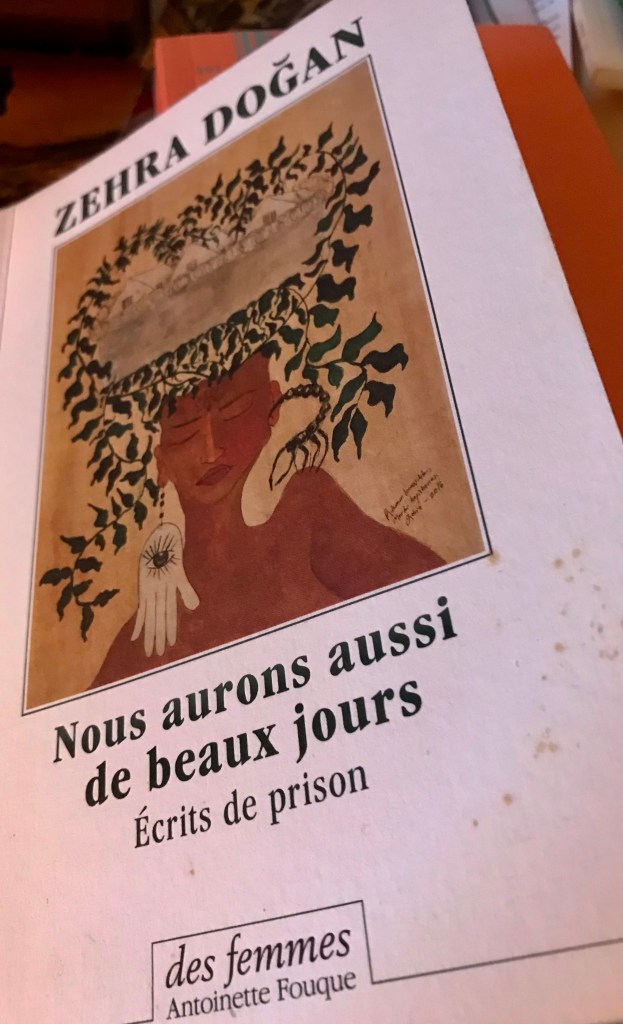
“16 janvier 2018 — Aujourd’hui, je vais te parler de mon atelier d’art ici. Nous avons un quartier plutôt étroit. Comme nous sommes une trentaine, cet espace restreint peut parfois nous contraindre à l’immobilité. Lorsqu’il est question de dessiner, je peux dire que ce contexte m’affecte directement. Alors, j’ai trouvé une solution : j’ai transformé le dessous de mon lit en atelier. À la condition de nettoyer l’espace et de tout ranger quand mon travail est terminé…Ah oui, il ne faut pas oublier non plus les “adeptes”…Il arrive qu’une ou deux personnes s’allongent carrément sur mon dos en m’écrasant pour mettre leur tête sous le lit. Et elles donnent des conseils…”Fais comme ceci. Fais comme ça ! Non, ça n’est pas bien, ah, ça c’est joli !” Si ça se trouve, quand je sortirai, je ne pourrai plus dessiner autrement.” Zehra Dogan, Nous aurons aussi de beaux jours, Ecrits de prison.
*
Dreams: I was sitting in a car on a country road, two women and a man had stepped out of it to admire the view, the two women left, the man wanted to follow them with the car but realized they had left with the keys and from the interior, I couldn’t open the doors that locked automatically, so he went after the two women to recuperate the keys; then, something about a forgotten password to unlock a phone; then I was in a group where each person in turn had to say if he or she wanted to be a part of it, the “yes” quickly made the rounds from one person to the other, I also said “yes” and, saying it, I realized we are a different person when the collective predominates from the one we are individually.
*
“Locked” : that’s the word the newcomer used at the writing workshop yesterday to describe the prohibition she’s imposed on herself for years about mentioning her personal feelings. (This year, the sessions explore personal memories linked to or inspired by a playlist suggested by a different participant each time). Then she added that her older brother, considered to be the great sage and intellectual in her family had told her one day: “One writes when one has something to say”, a comment she had received like a slap in the face. “One writes to say what one has to say”, I told her. “What could he know of what mattered to you?” (She added fearing she would “collapse” if she did not respect this “locking away” so I suggested she might want to thank the lock that has protected her so well for all these years, maybe the lock will have something to confide to her ? She said she’d never thought of that, and would think about it now.) The discussion moved on to the question of why one writes, based on the song by Anne Sylvrestre, Ecrire pour ne pas mourir (Writing so as not to die).
But her comment on the word “locked” reminded me of the time I had told an influential person that I was writing something that took place in the Ural mountains between 1860 and 1905 and she had made fun of me, saying “But what do you know about Russia ? One writes about what one knows!” I had been too stunned to reply: “No, one writes what one sees and hears in one’s head and that’s all there is to it.”
To this day, I find it difficult to share what I write. This goes back a long long way. One thing is certain, I don’t write for “likes” — which is lucky because I would be terribly sad if “only one or two” people had bothered reading what I write. It’s the quality of the looking that matters, not the number of pairs of eyes! In my head, it isn’t about numbers, and that’s all there is to it. (This is probably why it annoys me so when I hear someone complaining that “only 15 people went to the trouble of reading what I had spent so many hours writing”. That strikes me as very scornful of the 15 people in question. So what if even only one person read it ? Or none at all ? For whom and for what did you find it essential to produce that text ? Do you even know who it might reach without your ever being aware of it?
Oh well.
Yesterday, on facebook, two or three people went to the trouble of signalling reading the translation to Timothy Snyder’s text about the disaster about to fall on the Haitians in Springfield Ohio. Topic that wasn’t even mentioned in the major American papers, by the way. Must one then conclude that Timothy Snyder “wasted his time” writing it, and I “wasted” mine translating it ? That’s not how I see things.
*
On another topic, the leader from the other workshop (letters to prisoners) answered my question yesterday: it was all the letters addressed to prisoners that were refused at the post office the other day, which is beyond comprehension. I’ll know more about it at our next meeting.
*
“ January 16 2018 — Today, I will tell you about my art studio here. We occupy a rather narrow prison ward here. Since there are some thirty of us, we are sometimes forced into immobility because of the limited space available. When I want to draw, I must say this context affects me directly. So, I’ve found a solution: I’ve transformed the space under my bed into a workshop. So long as I clean up the space and put everything away when I’ve finished working…Oh yes, I mustn’t forget either my “devotees”…It sometimes happens that one or two people lie down squarely on my back , crushing me so they can stick their heads under the bed. And they provide advice…”Do this like this. Do that ! No, that’s no good, ah, that’s pretty!” It may so happen that once I come out, I won’t be able to draw otherwise.” Zehra Dogan, Nous aurons aussi de beaux jours, Ecrits de prison. (We Will also know fine days. Prison writings)
 iknowiknowiknowblog
Combien de personnes ont verrouillées une ou des parties d’ellesmemes? Toutes ?
LikeLike
je ne connais pas toute son histoire, mais les bribes qui en sont apparues dans les séances précédentes donnent à comprendre que l’histoire familiale offre plein de possibilités pour s’imposer des cadenas en société…
LikeLike