Rêve : Avec un jeune homme, étudiant au doctorat et stagiaire dans la boîte où je travaillais, nous construisions sur papier le modèle d’un système que nous baptisions PROPHET qui évaluerait le potentiel économique de nouvelles entreprises, puis je quittais l’immeuble dont les portes étaient aussi lourdes et épaisses que celles d’un coffre-fort et j’empruntais un des sentiers dans un vaste parc où je croisais des enfants et leur professeure de théâtre partant sur un autre sentier, le mien menait à une clôture métallique dans laquelle il y avait une ouverture par laquelle je me glissais pour poursuivre ma route sur un chemin de campagne familier.
Premiers mots au réveil : corpus callosum (en référence à cette clôture métallique). Suivi des mots dans la chanson One Time de Elaine Brown (on la trouve encore sur youTube).
Elaine Brown dont j’ai retrouvé la trace hier sur un site honorant des femmes du mouvement des Black Panther. Présidente du mouvement de 1974-1977 (après les arrestations de Huey Newton, en particulier, si ma mémoire est bonne), elle avait ceci à dire de son expérience : « Une femme chez les Black Panther était considérée, au mieux, comme insignifiante. Une femme s’affirmant était une pariah. Si une noire occupait un poste de leadership, on lui disait qu’elle causait l’érosion de la virilité des hommes noirs, qu’elle nuisait à l’avancement de la race noire. » Elle avait alors quitté le parti et fondé la National Alliance for Radical Prison Reform qui s’emploie à trouver du logement pour les prisonniers après leur libération. Elle fut la candidate présidentielle du Parti Vert américain en 2008.
Et pourquoi ce rappel des Black Panther ? À cause d’une image très “glamour shot” sur facebook hier, d’une belle et jeune femme noire armée, bras levé, avec ses frères armés sagement rangés derrière elle. Sur la page facebook d’un syndicaliste français disant ouais, l’heure est venu, tant pis pour les “stéréotypes” du profil bas. Auquel j’ai répondu, aussi calmement que possible pour un “stéréotype” qu’avant de se lancer tout feu tout flamme (et à distance) dans un appel aux armes pour un pays où l’on compte plus d’armes que d’habitants, il serait peut-être sage de se demander qui au juste sont ces Black Panther 2.0 soudainement réapparu? Ce “glamour shot”, vraiment, me fait l’impression d’une provocation grossière.
Et puis, je viens de lire 19 femmes de Samar Yazbek*. Dix-neuf syriennes qui ne voulaient rien d’autre que de la dignité et de la liberté pour elles-mêmes et les autres femmes de toutes confessions en Syrie. Emprisonnées, battues, torturées, détruites par le régime, oui, mais aussi coincées entre leurs familles craignant pour leur “honneur”, les camarades ne supportant pas qu’elles prennent des initiatives, et Daesh leur imposant le niqab. (Je ne distingue pas les viols des autres formes de torture.)
Tout ça me rappelant un moment dans le désert du Sinaï, en 1980 ou 1981 où apercevant encore une autre femme en noir sous le soleil écrasant, j’avais demandé pourquoi elles étaient vêtues ainsi. Le guide de me dire doctement que le “code d’honneur” des bédouins interdisait de tuer les femmes lors de vendetta, et qu’ainsi vêtues de noir, on pouvait les distinguer de loin. Ah bon, alors pourquoi ne pas imposer le noir aux hommes pour pouvoir leur tirer dessus à distance, avais-je demandé. On m’avait doctement expliqué que je ne savais pas de quoi je parlais.
Oh, mais que si : ces notions d’imposer l’inconfort et la responsabilité de l’honneur sur les femmes… et les rejeter si un homme lui porte atteinte et ce, depuis des siècles, boudu que c’est d’un ridicule à se demander c’est quoi, au juste, cette chose qu’on appelle l’intelligence humaine ? Corps calleux, quelle est ta réponse ?
*Samar Yazbek, 19 femmes, traduit de l’arabe (Syrie) par Emma Aubin-Boltanski et Nibras Chehayed, postface de Catherine Coquio, Stock 2017
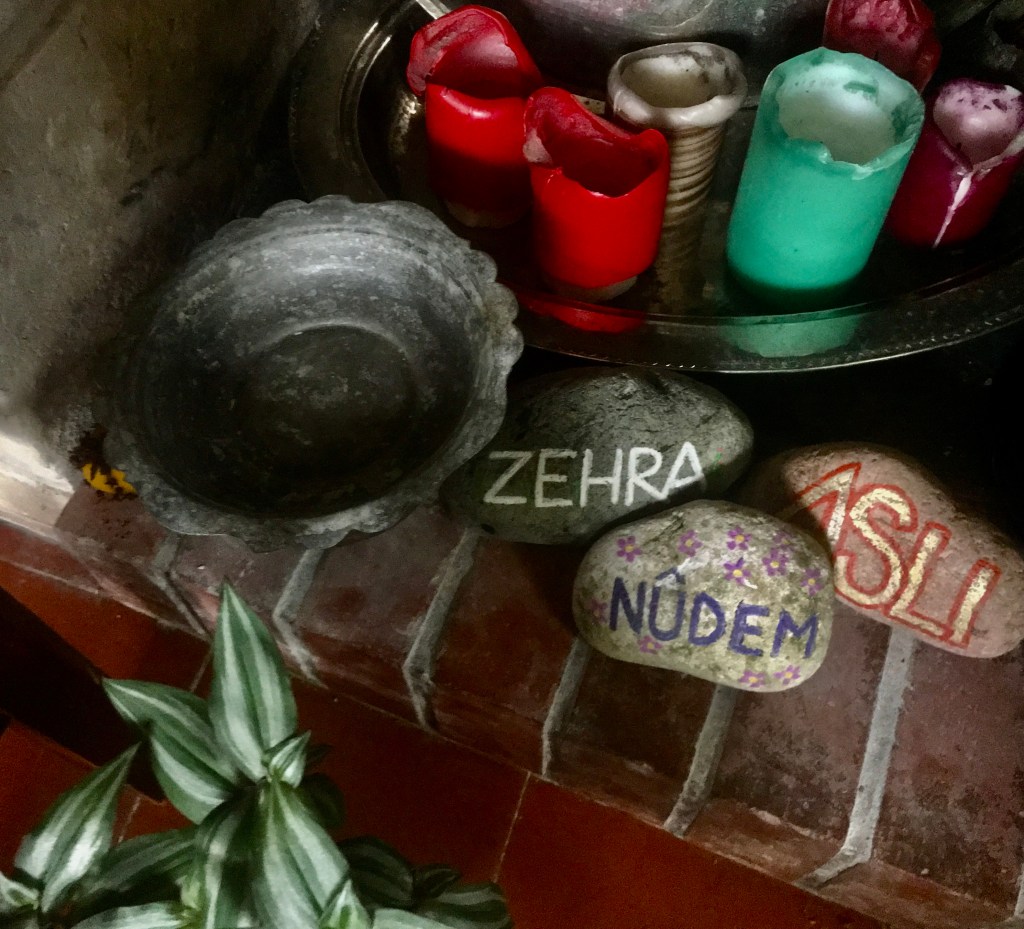
(Illustration : Asli Erdogan, libérée des prisons turques, très malade, vivant en Allemagne et ne trouvant plus la force nécessaire pour écrire ; Zehra Dogan, libérée des prisons turques, vivant en Allemagne et exposant à travers l’Europe; Nudem Durak, à ma connaissance toujours emprisonnée, souffrant d’un grave problème à la thyroïde détruisant sa voix pour laquelle elle fut emprisonnée pour le “crime” d’avoir chanté dans sa langue maternelle, et non en turc.)
*
Dream: With a young man who was a Ph.D student who was an intern in the firm where I worked, we were building on paper the model for a system we called PROPHET that would evaluate the economic potential of new businesses, then I left the building whose doors were as thick and heavy as those of a safe et I took one of the paths in a large park where I came across children and the woman who taught them theater leaving on another path, mine led to a metal fence in which there was an opening I used to slide across and pursue my journey on a familiar country road.
First words upon waking: corpus callosum (in reference to the metal fence). Followed by the words of the song One Time by Elaine Brown. (Still available on youTube.)
Elaine Brown whose trace I found yesterday on a website honoring the women of the Black Panther movement. Presidente of the movement from 1974 to 1977 (after the arrests of Huey Newton, in particular, if my memory serves) she had this to say about her experience: “A woman in the Black Power movement was considered, at best, irrelevant. A woman asserting herself was a pariah. If a black woman assumed a role of leadership, she was said to be eroding black manhood, to be hindering the progress of the black race.” She left the movement and founded the National Alliance for Radical Prison Reform that helps prisoners find housing after their release. She was the American Green Party’s presidential candidate in 2008.
And why this reminder about the Black Panther ? Because of an “glamour shot” image on facebook yesterday, of a beautiful and young armed black woman, arm raised, with her brothers meekly standing behind her. This on the facebook page of a French union man saying yeah, the time has come, too bad about the keep-your-head-down stereotypes. To which I commented, as calmly as possible for a “stereotype” that prior to setting off enthusiastically (and at a safe distance) to a call to arms in a country where there are more arms than people, it might be wise to ask first who exactly are these Black Panther 2.0 suddenly re-appeared? That “glamour shot” struck me as a gross provocation.
Plus, I’ve just finished reading Samar Yazbek’s 19 Women. Nineteen Syrians who wanted nothing other than dignity and liberty for themselves and other women of every faith in Syria. Imprisoned, beaten, tortured, destroyed by the regime, yes, but also caught between their families fearing for their “honor”, comrades who couldn’t stand them taking initiatives, and ISIS imposing the niqab on them. (I don’t distinguish rape from other forms of torture.)
All this reminding me of a moment in the Sinai desert, in 1980 or 1981 where, after seeing several women in black from head to toe under the flaming sun, I had asked why they were dressed like that. The guide giving me a scholarly explanation about the Beduin “code of honor” forbidding the killing of women in a vendetta, therefore, dressed in black, they could be distinguished from afar. Oh, well why not impose black on the men, then, so as to be able to shoot them down from afar, I asked. The scholarly one explained that I didn’t know what I was talking about.
Oh, but yes I did: if these notions of imposing the discomfort and the responsibility for the men’s honor rests on the women…who are then rejected if a man attacks them, and this goes on for centuries, then, damnit, this is so ridiculous as to ask one’s self what it is, exactly, that we call human intelligence ? Corpus callosum, what is your answer ?
(Illustration : Asli Erdogan, liberated from Turkish prisons, very ill, living in Germany and no longer finding the strength to write; Zehra Dogan, liberated from Turkish prisons, living in Germany and exhibiting across Europe; Nudem Durak, still in prison to my knowledge, suffering from a serious thyroid problem destroying her voice for which she was imprisoned for the “crime” of having sung in her maternal language, and not in Turkish.)
 iknowiknowiknowblog