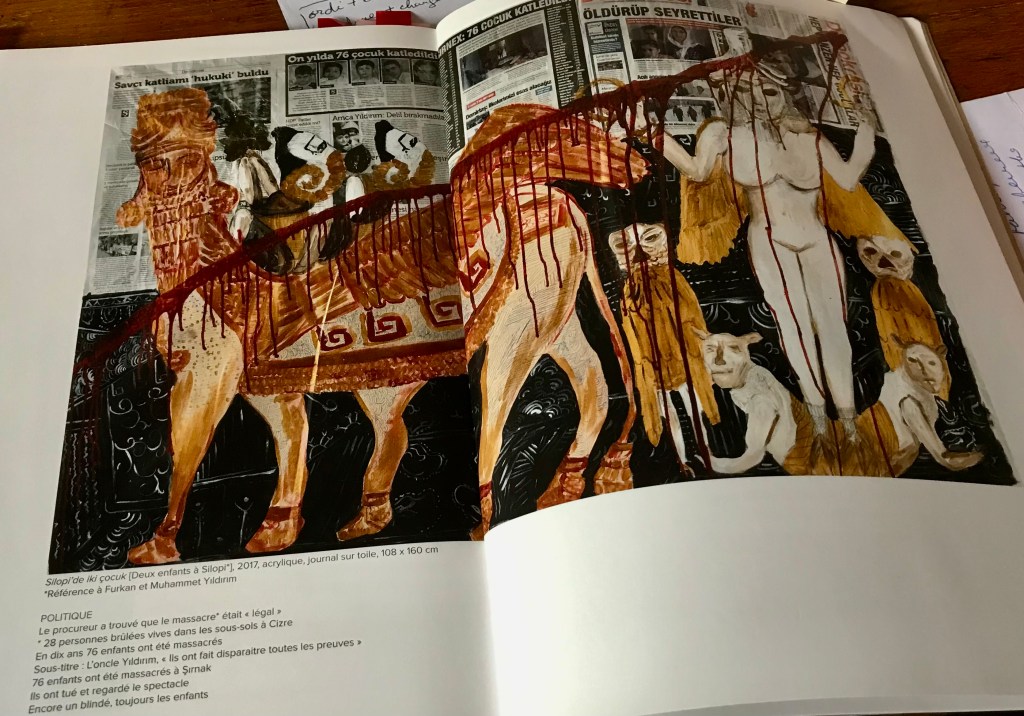
Zehra Dogan, 2017, acrylique et journal sur toile, “Référence à Furkan et Muhammed Yildrim”*
Une scientifique qui avait été ostracisée pendant des années parce qu’elle n’adhérait pas aux thèses acceptées par les autres, le vent ayant tourné, on la célébrait, et elle refusait de rencontrer celles et ceux qui l’avaient jugée plus bas que terre et qui l’encensaient dorénavant, “question d’honnêteté”, disait-elle; j’étais responsable d’une école de délinquants où tout allait de travers, personne ne s’y comportait comme il le fallait, malgré cela, on me félicitait comme si tout était très bien; le genre de rêve dont on se réveille épuisée et dont on émerge avec soulagement.
Et avec le sentiment que le véritable miracle c’est que, malgré des siècles et des siècles de violence, de haine, de brutalité, de grossièreté, de torture, de mutilations et de destruction, existent encore le beau et le bon qui se pratiquent chez les humains. Ça n’est pas faute d’avoir vu le bon et le beau moqués, méprisés, bafouées, calomniés et persécutés par des tyrans et des tyranneaux de tout acabit. Il faut croire qu’on tient beaucoup au beau et au bon.
Rêves en relation directe avec mes lectures et visionnements de soirée. Curieusement, quelqu’un a consulté la chronique du 26 août dernier où je parlais de Gil Duran et de son infolettre The Nerd Reich, car hier soir, je regardais une vidéo qu’il a enregistré avec une journaliste du nom de Pauline Borsook dont la carrière fut complètement détruite après la publication de son livre intitulé Cyberselfishness – a critical romp through the terribly libertarian world of high tech. C’était il y a plus de 25 ans maintenant et, sauf pour les exemples qui ont sans doute pris de l’âge, ce qu’elle observait alors se trouve confirmé dans tout ce qu’on voit maintenant. (Je suis à lire le livre tout récent d’un autre journaliste, Jacob Silverman, qu’il a intitulé Gilded Rage – Elon Musk and the Radicalization of Silicon Valley — et ça n’est pas uniquement au sujet d’Elon Musk mais il en est le “poster boy” en quelque sorte comme il est celui qui illustre au mieux les “ressentiment culturels s’exprimant dans un langage populiste” de ceux se proclamant des “réfugiés du libéralisme”…alors qu’ils en sont les principaux bénéficiaires, les exemples tirés de son livre correspondent à ce Pauline Borsook observait déjà à la fin des années ’90 : la montée de “personnalités autoritaires, impulsives, convaincues de leurs droits, insécures et vaniteux.”
Ces fortunes monstrueuses, ils les doivent aux années à taux d’intérêt quasiment nul qui ont suivi l’effondrement financier de 2008, l’injection de sommes pharamineuses par les états du Golfe et par des pluies de contrats du Pentagone corrompant les représentants des deux grands partis politiques américains. Le discours a suivi, avec des PDG comme celui de Palantir, Alex Karp, clamant haut et fort le plaisir qu’il aurait à tuer ses opposants ou celui d’Anduril, Palmer Luckey affirmant avec fatuité que “vous avez besoin de gens comme nous, une classe de soldats que la violence enthousiasme et excite dans la poursuite de bons objectifs” (définis par ceux que la violence contre autrui “enthousiasme et excite”, évidemment.) “Des gens comme nous, poursuit-il, qui sont malades de cette façon et qui ne perdent pas de sommeil en fabriquant des outils de violence afin de préserver la liberté” (de fabriquer des outils de violence, s’entend.)
Le livre de Paulina Borsook n’est plus disponible sauf sur les plate-formes de vente de seconde main, où il se détaille dorénavant à $76. On peut espérer une ré-impression dans le climat actuel…à condition de se tenir près d’éditeurs courageux qui ne soient pas dépendants d’argent provenant d’Arabie saoudite ou du Qatar, ou d’autres “bienfaiteurs-cyber”…
*La “référence à Furkan et Muhammed Yildrin” de Zehra Dogan est à deux jeunes frères kurdes,Furkan, 6 ans et Muhammed 7 ans, qui furent écrasés dans leur sommeil par un blindé de la police turque plongeant dans leur maison à Silopi, dans le sud-est de la Turquie. Les policiers ont fui sans autoriser le transfert des enfants à l’hôpital, et après avoir menacé la mère qui hurlait. La famille a dû se débrouiller seule pour s’y rendre, mais les enfants étaient déjà morts. Le préfet a qualifié le tout comme étant la volonté du “destin”. En 2017, Zehra Dogan a paint une série de tableaux sur fond d’articles de journaux turcs signalant d’autres “accidents dûs à la volonté du destin”.
*
A scientist was ostracized for years because she had not espoused the theses that were accepted by others, the wind had turned, she was being celebrated and refused to meet those who are considered her lowlier than dirt and who were now praising her, “a question of honesty”, she said; I was responsible for a school of delinquents where everything was going wrong, no one was behaving as they should, despite this, I was congratulated as if everything was just fine; the kind of dream from which you wake up exhausted and from which you emerge with relief.
And with the feeling that the true miracle is that despite centuries and centuries of violence, hatred, brutality, vulgarity, torture, destruction, the beautiful and the good still exist and are practiced by humans. Not that the good and the beautiful have not been mocked, despised, flouted, slandered and persecuted by tyrants and mini-tyrants of every ilk. Looks like we really like the good and the beautiful.
Dreams directly related to my readings and viewing last night. Oddly enough, someone consulted a column from August 26 last where I mentioned Gil Duran and his newsletter The Nerd Reich, because, last night, I watched a vidéo he recorded with a journalist by the name of Pauline Borsook whose career was totally destroyed after she published a book titled Cyberselfishness – a critical romp through the terribly libertarian world of high tech. That was over 25 years ago now and, except for the examples that may have aged, what she observed then is confirmed in everything we see now. (I’m reading a very recent book by another journalist, Jacob Silverman, titled Gilded Rage – Elon Musk and the Radicalization of Silicon Valley — and it isn’t only about Elon Musk, but he is something of the “poster boy” of the movement who best illustrates the “cultural resentments speaking in a populist register” of those who consider themselves “refugees from liberalism” …whereas they are its main beneficiaries; the examples from his book match those mentioned by Pauline Borsook who was already observing them in the late ’90s: the rise of personalities that were “authoritarian, impulsive, supremely entitled, insecure and vain”.
They owe those monstrous fortunes to years of close to zero interest rates following the financial collapse of 2008, the injection of stupendous amounts of money from the Gulf States and by showers of Pentagon contracts corrupting the two American political parties. The language followed, with directors like that of Palantir, Alex Karp, proclaiming loud and clear the pleasure he would derive from killing his opponents, or that of Anduril, Palmer Luckey fatuously saying that a “warrior class” (defined in his words as those that violence against others “fills with enthusiasm and excites”) made up of “people like us who are sick in that way and who don’t lose any sleep making tools of violence in order to preserve freedom” (as defined by said “warrior class”, of course.)
Paulina Borsook’s book is out of print and only available on second-hand platforms where it currently details at $76. One can hope for a re-edition soon in the current climate…conditional on keeping close to courageous publishers not dependent on cash from Saudi Arabia or Qatar, or other cyber-benefactors.
* Zehra Dogan’s “reference to Furkan and Muhammed Yildrin” is to two young Kurdish brothers, Furkan, 6, and Muhammed, 7, who were crushed in their sleep by an armored vehicle of the Turkish police plunging into their home in Silopi, in South-eastern Turkey. The policemen fled without authorizing the transfer of the children to the hospital and after threatening the mother who was howling. The family had to make do on its own to reach the hospital, but the children were already dead. The Prefect called the whole thing as flowing from the will of “fate”. In 2017, Zehra Dogan painted a number of works on the background of the newspaper articles published in Turkey about tragic “accidents willed by fate”.
 iknowiknowiknowblog
Inch Allah. Of course
LikeLike