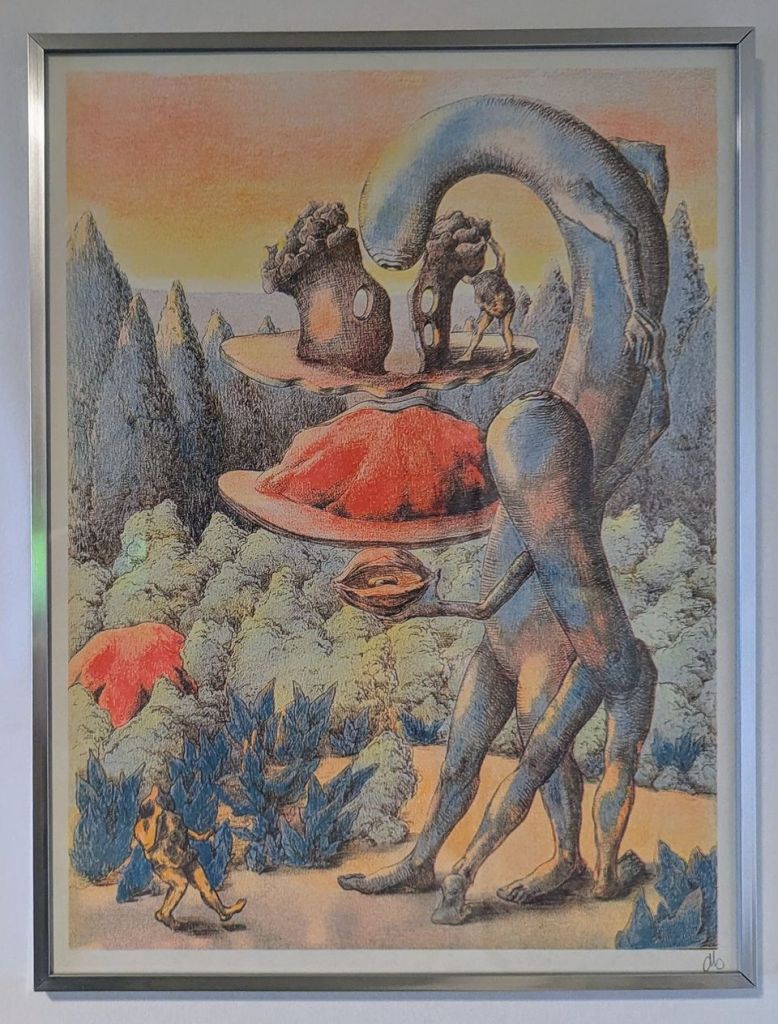
Dessin de Camille Messager
Il s’agissait d’une vidéo dans le genre “National Geographic” qui se déroulait des années dans l’avenir alors que des êtres visitant notre planète se demandaient si les formes éteintes de vie qu’ils y voyaient avaient fait preuve d’intelligence, à un moment ou à un autre ? Les images étaient dans ces tons pastel qu’avaient les vieilles photos colorisées à la main dans les anciennes copies des premiers National Geographic dans le meuble-bibliothèque vitré chez ma grand-mère maternelle.
Les couleurs qu’utilise Camille Messager me rappellent celles de ces images dont l’une dépeignait un groupe de gens quelque part chez les Ouzbeks, ou dans un autre groupe national quelque part dans ce qui était encore l’Union Soviétique à l’époque.
Les premières réflexions au réveil, elles, portant sur ce mystère apparent voulant que, très souvent en grandissant, les filles deviennent terriblement critiques de leur mère alors qu’elles pardonnent absolument tout à leur père, transformé en héros “au sourire si doux”. Que cette démarche fasse partie d’un processus normal à l’adolescence où, afin de grandir, il faut absolument que la fille parvienne à se distinguer de sa mère, c’est très pénible pour le parent, mais ça se comprend. Ça permet aussi à la mère de se rappeller qu’elle n’est pas que la maman, mais aussi une personne autonome avec son propre chemin à poursuivre. Passé un certain âge, par contre, ça devient destructeur, au point, dans certains cas, de sombrer dans un puits de reproches insensés comme moyen d’échapper aux conséquences de ses refus d’assumer la responsabilité pour sa propre vie et ses propres choix. Cela me semble une évidence, que la mère ait été merveilleuse, exécrable ou quelque part dans les eaux normales d’aimante-mais-imparfaite où se trouvent la plupart d’entre elles. Quant au merveilleux papa, que dire ? La façon d’en effacer les imperfections ressemble assez à cette “colorisation en pastel” des photos anciennes, je trouve.
Et donc, en route pour ce qui exige de l’attention dans le présent et ses complications. Malgré la dépense que ça représente sur un budget aussi serré que le mien, j’ai commandé la traduction française du livre de Quinn Slobodian hier à la librairie-café L’Autrucherie, parce qu’il y a des livres que je peux pouvoir partager avec des amis locaux qui ne pratiquent pas l’anglais.
Pour l’heure, je relis la 7e Élégie d’Akhmatova et ses “digressions lyriques” dans la copie des Editions Mesures et kadima, davaï “time waits for no one”.
*
It was a video in the “National Geographic” style taking place in years to come when beings were visiting our planet and wondering if the extinct life forms they were seeing had once been intelligent at some point? The images were in those pastel tones of the old hand-colored photos in the ancient copies of the first National Geographic magazines in the glassed-in book case at my maternal grandmother’s.
The colors Camille Messager remind me of those images, one of which showed a group of Ouzbek or other national group somewhere in what was still the Soviet Union at the time.
First thoughts upon waking dealt with that apparent mystery wanting that, very often as they grow up, girls become terribly critical of their mother while forgiving absolutely everything to their father, transformed into a kind ever-smiling and kind hero. That this be part of a normal process when the teenaged girl must distinguish herself from her mother in order to grow, can be terribly painful dor the parent, but it’s understandable. It also allows the mother to remember she is not only the mummy but also an independent human being with her own path to pursue. Past a certain age however, this becomes destructive to the point, in some cases, of falling into a well of insane reproaches as a way of refusing of avoiding the consequences of one’s one refusal to take on responsibility for one’s own life and one’s own choices. This seems obvious to me, whether the mother was wonderful, detestable or something in the normal waters of loving-but-imperfect where most of them find themselves. As for the wonderful papa, what can I say? I find the way of erasing his imperfections reminiscent of this “pastel coloring” of ancient photographs.
And so, onward to whatever calls for attention in the present and its complications. Despite the load on a budget as tight as mine I order the French translation of Quinn Slobodian’s book at the bookstore-coffee shop L’Autrucherie yesterday, because it is one of those books I want to be able to share with local friends who don’t speak English.
For now, I read Akhmatova’s 7the Elegy and its “lyrical digressions” in the edition published by Editions Mesures and kadima, davaï “time waits for no one”.
 iknowiknowiknowblog