Rêves : Je nageais dans un lac avec quatre ou cinq autres personnes, étonnée de tenir la distance sans ressentir de fatigue et de parvenir comme les autres jusqu’à la berge où on retrouvait pied; puis, spectacle de cirque dans lequel il fallait manoeuvrer d’immenses plaques de tôles sur roulettes – 3m de haut, 5m de long – dans un ballet complexe à plusieurs, en circulant parmi la foule, je portais le chemisier à carreaux rouge, blanc et jaune, acheté par ma fille à Mazamet lors de sa deuxième visite où tout paraissait si harmonieux, sans la moindre suggestion d’Une Saison en Enfer, titre que quelqu’un suggérait pour le spectacle.
*
Je ne sais pas ce qui détermine le choix d’une lecture de soirée; enfin, dans ce cas-ci, ce fut peut-être le fait de lire que l’historien Timothy Snyder et son épouse l’historienne Marci Shore quittaient les Etats-Unis pour des postes à l’Université de Toronto. Snyder est l’autorité américaine sur l’Europe de l’est et l’Ukraine en particulier, Marci Shore a écrit Ukrainian Night sur les événements du Maïdan en 2013-2014 qui ont provoqué la révolution en Ukraine.
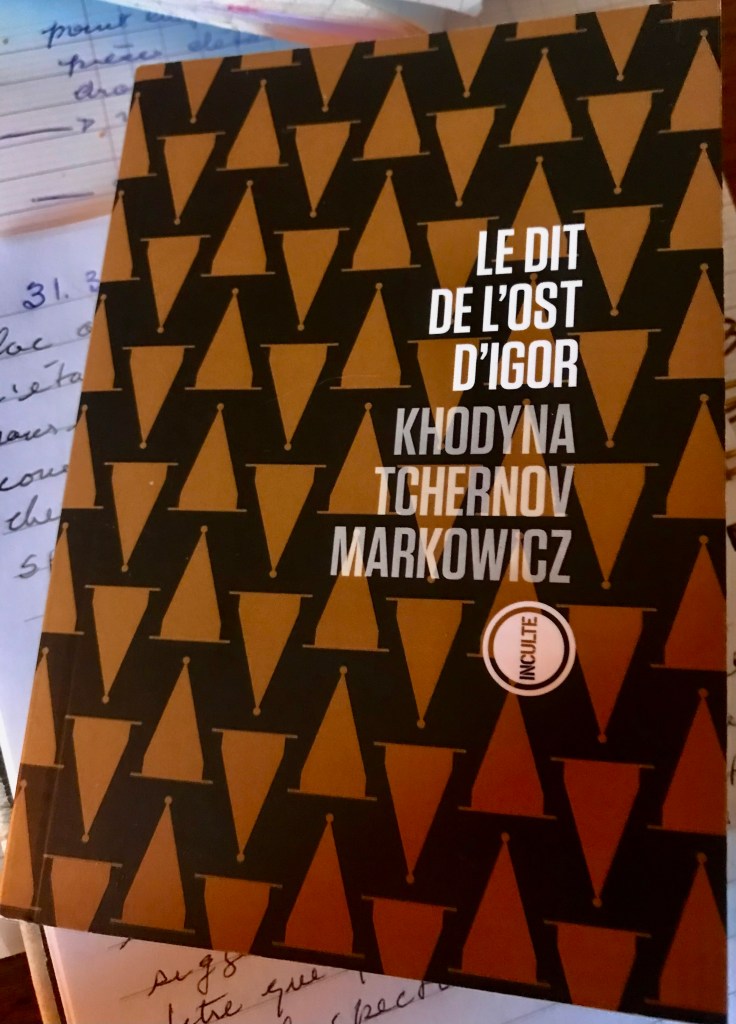
Toujours est-il qu’hier soir je me suis dirigée tout droit sur ce petit livre – un total de 139 pages, incluant la préface et la postface, texte du 12e siècle qui a cette particularité de ne pas célébrer une glorieuse victoire mais de raconter plutôt le démembrement de la Russie kiévienne par les luttes entre frères voulant tout s’approprier, traduction d’une traduction, “un exercice d’étrangement”, comme l’écrit André Markowicz en préface. *
C’est peut-être simple hasard, mais je note au passage la correspondance entre le nom de l’un des Vladimir, connu sous le nom de Beau Soleil, et la présence, dans l’hymne national de ces ennemis qui mourront “comme la rosée au soleil” et la référence aux frères – brattya en russe – qui ouvre aussi le Dit – “et si nous commencions, frères, comme jadis...” Et le “nom de plume” retrouvé de l’auteur, retrouvé – Khodyna, signifiant l’errant, celui qui marche, nom que se donne aussi le personnage de la Kalmouke (qui n’en est pas une) dans mes Contes d’Exil.
Bref, le moindre geste, la moindre pensée, a ses racines dans de multiples et minuscules mouvements d’une image en déclenchant une autre qui suscite un souvenir, puis un autre, en apparence sans rapport, et qui aboutit sur un geste de la main retirant un livre d’une bibliothèque.
*Khodyna, Tchernov, Markowicz, Le Dit de L’Ost d’Igor, éditions inculte, 2020
*
Avant cela, il y avait eu la visio-conférence de l’équipe des humanités. Et avant cela, un café en terrasse avec mon copain Rustine, pour une première discussion autour du projet à peaufiner d’une brochure hebdomadaire pour distribution sur le marché, au sujet des événements, grands et petits, affectant la vie des habitants de cette ville. Nous nous donnons six mois pour déterminer les tenants et aboutissants du projet. Ça me ramène au bulletin de la Clinique des Citoyens de St-Jacques – quartier populaire de Montréal, devenu depuis très couru, très “tendance”. À l’époque, comme on dit, avant la version québécoise de la carte Vitale (“carte Soleil”, qu Québec), une clinique populaire comme celle-là permettait aux désargentés de se faire soigner. Mon rôle était de recueillir des histoires et des commentaires – essentiellement, de femmes du quartier – d’en rédiger les versions à publier, et de procéder à l’impression sur une presse Multilith offset 1250, boulot que j’ai adoré. 1973, ma fille avait 4 ans, j’en avais donc 27, nous avions aussi lancé les premières crèches à $5 par jour (les “garderies populaires”) et des coops alimentaires dont il ne reste sans doute plus rien maintenant.
“Pas grrrave,” comme dirait quelques années plus tard mon prof de judo de 98 kg en ramassant du sol la version de ma personne ne pesant alors que 48 kg qu’il avait renversée d’un simple mouvement du poignet. Il était “yougoslave” – eh oui, existait alors un pays qui avait ce nom.
Allez, avant de me perdre dans un déambulatoire de vieux souvenirs, le lundi 31 mars 2025 avec ses tâches planifiées zé imprévues.
*
Dreams: I was swimming in a lake with four or five other people, surprised to be going the distance without feeling tired and to reach the shore like the others where I found my footing again; then, a circus show in which several of us had to maneuver huge sheets of metal on wheels in a complex ballet among the rows of spectators, I was wearing the checked red white and yellow blouse bought by my daughter in Mazamet in her second visit when everything seemed to flow in harmony, withtout the slightest suggestion of A Season in Hell, the title someone was suggesting for the show.
*
I don’t know what determine the choice of evening reading; although, in this case, it was probably from reading the news that historian Timothy Snyder and his wife, historian Marci Shore were leaving the United States for posting at Toronto University. Snyder is the American authority on Eastern Europe and Ukraine in particular, Marci Shore worte the book Ukrainian Night on the events of the Maidan in 2013-2014 that led to the Ukrainian revolution.
Whatever the explanation may be, last night I headed straight for this small book – a total of 139 pages, including both preface and afterword of a 12th century text the specificity of which is the fact it does not celebrate some glorious victory but rather the dismemberment of Kievian Russia by the bloody struggles between brothers wanting to possess it all, the book a translation of a translation, “an exercice in estrangement”, as André Markowicz writes in the preface.
It may be nothing but coincidence, but I note in passing the correspondence between the name of one of the Vladimirs, known under the name of Beautiful Sun, and the presence in the national anthem of those enemies that will die “like dew under the sun” and the reference in it to the brothers – brattya in Russian – also found in the opening line of the Tale of Igor’s Campaign – “and what if were to begin, brothers, as we did in former times...” And the “pen name” of the author, rediscovered – Khodyna, meaning the wandered, the one who walks, which is also the name I gave to the character of the Kalmuk (which she wasn’t) in my Tales of Exile.
In other words, the slightest gesture, the slightest thought has its roots in multiple and tiny movements from one image triggering another which brings up a memory, then another, apparently unrelated, all leading to a movement of the hand pulling up a book from a bookshelf.
*Khodyna, Tchernov, Markowicz, Le Dit de L’Ost d’Igor, éditions inculte, 2020
*
Before that, there was a visio-conference of the team from les humanités. And before that, a coffee on a terrace with my buddy Rusine (“Band Aid”) around a project to be refined of a weekly bulletin to be distributed on the market concerning events, big and small, affecting the lives of this town’s inhabitants. We are allotting ourselves six months to determine the ins and outs of the project. Which brings me back to the bulletin of the St-Jacques’ Citizens Clinic – a working class district in Montreal that has since become very trendy. In those days, as the saying goes, prior to the Québec version of a card to be presented for medical services (known as the “Carte Soleil” in Québec) a people’s clinic like that one allowed the un-moneyed class to receive medical treatment. My role was to gather stories and comments – essentially from neighborhood women – to wrtie them up for publication and to proceed with the printing on a Multilith offset 1250, a job I loved. 1973, my daughter was 4, which means I was 27, we had also launched the first daycare centers at $5 a day, and food coops of which nothing must remain anymore.
“Pas grrrave,” as would later say my judo teacher who weighed 98 kilos, as he picked up off the floor the 48 kg version of my person he had flipped over with a simple flick of the writ. He was from “Yugloslavia” – yes, in those days, there was a country known by that name.
OK, enough before getting lost down memory lane, this is Monday March 31st 2025, with its many planned as well as unexpected tasks.
 iknowiknowiknowblog