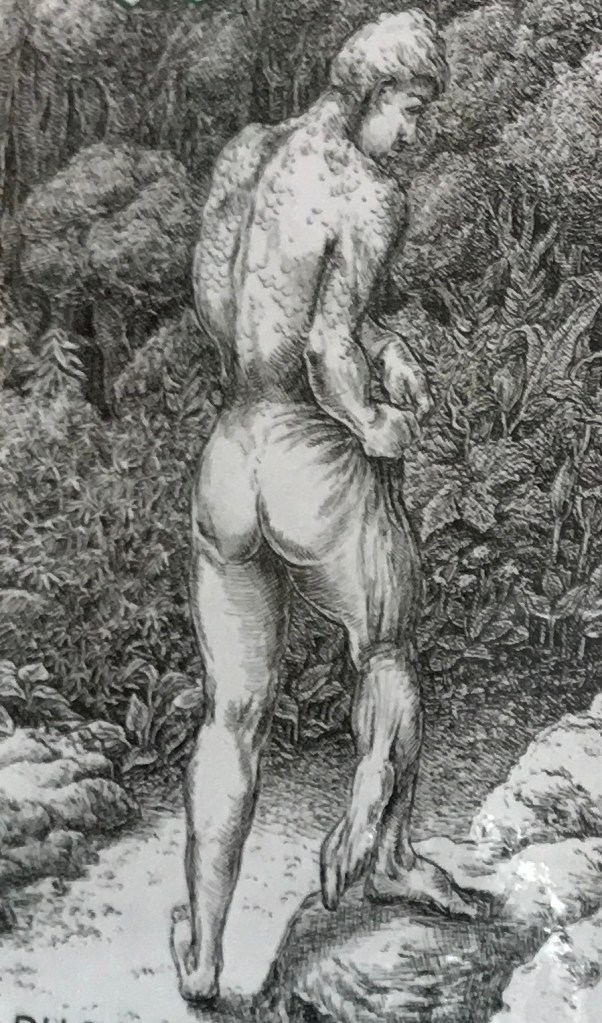
Illustration de Camille Messager
Rêves : Deux amis dont l’un est architecte, après avoir fait construire sa propre maison, il en fait construire une autre, différente, dont il remet les titres de propriété à son ami et son fils; “c’est un récit d’une simplicité minoenne,” dit l’architecte; puis une cavalcade de gamins dévalant des escaliers et tournoyant avec des coussins, quelqu’un rapporte des plantes arrachées de l’extérieur et qu’il faut mettre en pot, une plante pour chaque personne, je me mets à courir et à danser partout avec ma plante aux racines pleines de terre, en chantant, “ouh, coccicum, coccinum, coccinum, coccinum”* ce qui fait rire tout le monde , quelqu’un se met à me filmer.
*je viens de vérifier le mot – l’accusatif latin du mot coccinus désignant un type d’insecte, mais aussi le nom d’un outil pédagogique permettant aux écoles et aux universités de se connecter à toute une collection de dictionnaires du site en question. (Première nouvelle que j’en aie.)
*
Mais, au réveil, la première pensée est pour le projet Neuralink d’Elon Musk – l’ultime violation de l’intimité par implantation d’une “connexion” dans le cerveau assurant l’interface avec une intelligence artificielle. Présentée, bien sûr, comme un grand service auprès des handicapés pouvant communiquer ainsi par le biais d’un ordinateur; mais comment croire un seul instant aux intentions “humanitaires” au vu des comportements de cet homme qui considère que l’empathie est la plus grande menace à la civilisation ? Je choisis de noter mes rêves ici, rien ni personne ne m’y oblige et personne n’a accès à mes pensées non exprimées tout comme personne ne peut y accéder pour les modifier, s’il le souhaite.
Et comment douter que tel soit le projet, au vu de ce qui se passe présentement aux Etats-Unis ? Détruire ou modifier les données stockées dans les banques de données gouvernementales, se débarrasser de tout ce qui embêtes les “amis” – payants et autres – tout en chargeant le bourricot des “ennemis”, constituant un premier pas. Mais quel bonheur, doivent-ils se dire, si l’on peut littéralement contrôler le flux et le contenu des pensées des êtres considérés comme “utiles”.
Ce dont il sera certainement question dans le 4e épisode du feuilleton sur les humanités. (Le 2e épisode est disponible sur le site, ou par infolettre pour les abonnés.)
*
D’autres “commandes” pour la revue, à expédier ce matin, en gardant toujours espoir de revenir au récit de L’ingénieur des collines, qui attend patiemment sur ma table de travail. Il ne se récite certainement pas l’extrait des Métamorphoses d’Ovide qui sert d’exergue à cet exercice :
Rien ne périt dans le grand monde, crois-moi
tout varie et change de visage; on appelle naitre
commencer à être autre chose que ce qu’on était, et mourir
le contraire. Peut-être ces éléments-ci sont là
et ces éléments-là ici, mais
leur somme demeure.“
Ce qui, dépendant des circonstance, n’a guère de portée consolatrice.
*
Terminé la lecture de Nous Vivrons de Joann Sfar hier soir. Dernier échange (repris en 4e de couverture): “Finalement, vous êtes juif parce que vos parents sont juifs, et je suis musulman parce que mes parents le sont. Le reste c’est du bavardage.” – “Oui. On doit juste se débrouiller avec ça.”
Échange d’une “simplicité minoenne”, en effet.
*
Dreams: Two friends, one of whom is an architect, after having his own house built, he has another, different one, built for his friend and his son, “‘t’is a tale of Minoan simplicity” he says when he hands over the titles to the home; then a cavalcade of boys racing down stairs and gallivanting about with cusions, someone brings in plants pulled up by the root, one for each person, I start running and dancing everywhere with my plants and its roots full of earth, singing “ooh, coccicum, coccinum, coccinum, coccinum*” which makes everybody laugh, someone begins to film me.
*I just checked out the word – in latin, its the accusative of the word coccinus relating to a type of insect, and also the name of a pedagogical tool, allowing schools and universities a connection to the website’s entire collection of dictionaries. (News to me).
But, on waking, my first thought is for Elon Musk’s Neuralink project – the ultimate violation of intimacy by implant of a “connection” in the brain providing the interface with an artificial intelligence. Presented, of course, as a great service for quadraplegics who can then communicated through a computer; but how can one believe even for one second in the “humanitarian” intentions of this man who considers empathy as the greatest threat to civilization? I choose to jot down my dreams here, nothing and no one forces me to do it, and I will stop doing so whenever I so wish, nothing and no one has access to my unexpressed thoughts, just as no one can have access to them in order to modify them, if he so wishes.
And how can one doubt that this is the aim of the project, seeing what is happening at the moment in the United States? Destroying or modifying data stocked in governmental systems, ridding them of everything that might be a bother for “friends” – paying or otherwise – while loading down “ennemies” being a first step. But what bliss, they must tell themselves, if one can literally control the flux and content of beings considered as “useful”.
There will certainly be talk of this in the 4th episode of the series on les humanités. (The 2nd episode is available on the website or in a newsletter for subscribers, the English to be published today.)
*
More “jobs” for the webzine, to be expedited this morning, still holding on to the hope of getting back to the tale of the Hills Engineer, waiting patiently on my work table. He is certainly not quoting to himself the excerpt from Ovid’s Metamorphoses that serves an epigraph to this exercise:
Nothing perishes in this wide world, believe me
everything varies and changes appearance, we call birth
the beginning of something else from what we were and death
the opposite. Perhaps these elements here are now there
and elements over there, now here but
their sum remains.”
Which, depending on circumstances, does not have much value as a consolation.
*
Finished reading Joann Sfar’s Nous Vivrons (We Shall Live) last night. Final exchange (reproduced also on the back cover): “Ultimately, you are jewish because your parents are jewish, and I am a muslim because my parents are. The rest is just chatter.” — “Yes. We just have to manage with that.”
An exchange of “Minoan simplicity”, indeed.
 iknowiknowiknowblog