Rêves : une enfant accuse sa mère des pires vilénies sans possibilité de réplique; puis je rejoins un groupe de gens sans formation aux métiers du cirque mais chacun y fait un numéro, je m’essaie à tous sans grand succès mais la responsable du lieu me dit qu’elle aime beaucoup mes grands papillons en papier de riz qui ressemble à l’ange du futur de Walter Benjamin, un vent violent souffle du futur et je m’appuie du front dessus pour ne pas tomber; puis je suis sur un lit d’hôpital, un infirmier du nom de Laurent se jette sur moi exigeant un baiser que je lui refuse, c’est un Français qui a rejoint Daesh, je vois bien qu’il va me violer alors je rends mon corps plus dur et impénétrable que de la pierre, je marche je marche je marche à travers des corridors en béton.
*
Je pense souvent à Anna Akhmatova, ces jours-ci. À ses poèmes, bien sûr – surtout Les Élégies du Nord,* d’ailleurs – mais aussi à la femme et à la mère. Le père de son fils, fusillé en 1921, puis à son fils, envoyé au goulag en 1938, et à nouveau en 1949. Il lui en voulait beaucoup, disait qu’elle n’avait pas fait assez pour le faire libérer. Alors, j’ai ressorti les Entretiens avec Anna Akhmatova** de Lydia Tchoukovskaïa parce qu’il me semblait bien que…Et je retrouve toutes les pages où elle et Lydia courent à droite et à gauche pour lui envoyer des colis, pour lui trouver des vêtements chauds (et comme dit Lydia Korneïeva : “Tous ceux à qui je téléphonais comprenaient immédiatement et sans rien demander: “Un bonnet ? Nous n’en avons pas, mais des mouffles, ça ne vous intéresserait pas ?” Et la torture debout, les stations debout interminables en pleine chaleur de juillet dans les files de femmes devant les prisons – nul endroit où s’asseoir, nul endroit pour aller pisser.” Non, vraiment, elle n’avait pas fait grand chose pour lui… Une lettre à Staline, la première fois, sans réponse, les mois, les années dans l’attente et l’envoi de colis; puis en 1956, la course joyeuse pour lui trouver un costume dans la drôle de période du “demi-tour gauche, qui se fait de nouveau sur commande. Nous avons glorifié Staline, maintenant nous allons le traîner dans la boue.” Un nouveau règne sous lequel, comme le dit Akhmatova lorsque ses poèmes sont refusés pour publication : “La sélection s’est faite selon le mot d’ordre: la frontière est bien gardée, mais on ne la connaît pas.”
Le fils d’Anna Akhmatova, Lev Goumiliov, s’est passionné, c’est bien le mot, pour une pseudo-théorie voulant que les “ethnos” des périodes ascendantes et déclinantes d’énergie vitale. La Russie, selon lui, ainsi que la Chine et le monde arabe étant en période ascendante (mais la Russie, elle était un “super-ethnos”, bien sûr.) Ses théories sur l’eurasisme biologique n’ont pas connu beaucoup de succès au début, mais elles font partie du charabias dont se nourrit la pensée de Vladimir Poutine.
Je pense à Anna Akhmatova, je pense à son fils – comme deux faces d’un vase fracassé.
*
De la traduction en vue pour les humanités aujourd’hui – une version anglais de l’entrevue de Jean-Marc Adolphe avec Oleksandra Martviichuk, prix Nobel de la Paix 2022 et directrice de l’ONG Centre pour les libertés civiles. Nous poursuivons le tissage de liens avec l’Amérique – nord et sud, le webzine s’orientant vers un avenir trilingue, à tout le moins.
Et le récit de la gamine progresse avec, en plus, réception hier d’une nouvelle esquisse par Camille Messager du visage du gamin nommé 18; je lui confirme que, oui, c’est bien lui.
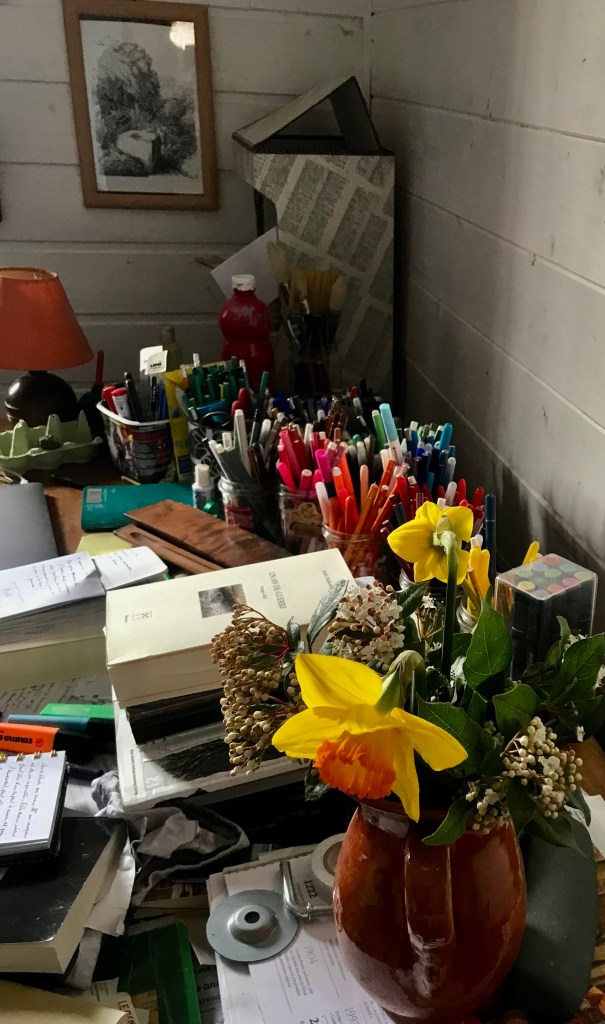
Et les deux premières jonquilles du jardin, avec des fleurs piquées à une haie retournée à l’état sauvage.
*Anna Akhmatova, Les Elégies du Nord et autres poèmes, choix, traduction et présentation d’André Markowicz, Editions Mesures 2023
**Lydia Tchoukovskaïa, Entretiens avec Anna Akhmatova, Le Bruit du Temps, 2019
*
Dreams: a girl child accuses her mother of the worst vileness imaginable with no possibility of a reply; then I meet up with a group of people with no training in circus arts but each one is performing a number, I try my hand at all of them with no great success but the person in charge of the place says she very much likes my large butterflies in rice paper, they resemble Walter Benjamin’s angel of the future, a violent wind is blowing from the future and I rest my forehead against it so as not to fall; then I’m on a hospital bed, a nurse’s aid by the name of Laurent throws himself on me demanding a kiss which I refuse to give him, he is one of the French who joined ISIS, I can see he’s going to rape me so I make my body harder and more impenetrable than stone, I walk I walk I walk down concrete hallways.
*
I often think of Anna Akhmatova these days. About her poems of course – mainly her Northern Elegies, in fact – but also her as a woman and as a mother. The father of her son, shot in 1921, then her son, sent to the gulag in 1938, and again in 1949. He had a lot of resentment against her, saying she had not done enough to have him liberated. So I pulled out Entretiens avec Anna Akhmatova by Lydia Tchoukovskaïa because I really had the impression that… And I find all the pages where she and Lydia are running around to send him parcels, to find warm clothes for him (and as Lydia Korneyeva says: “Everyone we phones understood immediately and without asking anything: “A hat ? We don’t have any but you wouldn’t be interested in a pair of mittens? “ And the standing torture, endless waiting in the July heat in lines of women in front of the prisons – nowhere to sit, nowhere to pee,” no, really, she hadn’t done much for him…A letter to Stalin, the first time, with no response, months, years of waiting and of sending parcels; then, in 1956, the happy running around to find him a suit during that odd period of “half-turn we performed on command. We had glorified Stalin, now we were going to drag him through the mud.” A new reign under which, as Akhmatova says when her poems were refused for publication: “The selection was done according to the new watchword; the border is well covered, but its location unknown.”
Anna Akhmatova’s son, Lev Goumiliov, was passionate about (the word is apt) a pseudo-theory that said that “ethnos” had rising and declining periods of vital énergy. Russia, according to him, along with China and the Arab world were in an ascending period (but Russia was a “super-ethnos”, of course. His theories on biological eurasism were not popular at first, but it is part of the gobbledygook that feeds Vladimir Putin’s thinking.
I think of Anna Akhmatova,I think of her son – like two faces of a shattered vase.
*
Translating in view for les humanités today – an English version of the talk Jean-Marc Adolphe had with Oleksandra Martviichuk, Nobel Peace Prize recipient in 2022 and dirctor of the NGO Center for Civil Liberties. We are pursuing the weaving of links with America- north and south, the webzine heading for a trilingual future, at the least.
And the girl child’s tale progresses, added to which I received a new sketch yesterday from Camille Messager for the boy called 18’s face; I confirmed that, yes, that was him all right.
And the first two daffodils from the garden, with flowers taken from a hedge growing wild.
 iknowiknowiknowblog