Rêves : une personne demande “qui te dit et qu’est-ce qui te fait croire qu’en tant qu’X, tu vas mieux réussir, cette fois ?”; puis je vidais d’énormes jarres en terre cuite de plantes séchées, Gabriel Attal n’était pas content lorsque je m’arrêtais pour me reposer, de plantes mortes il en restait encore et encore dont deux grands parterres dont je récoltais les graines, tout en ne comprenant pas pourquoi les autres ne donnaient pas un coup de main; puis une jeune femme avec laquelle j’avais eu bien des disputes venait me dire adieu, elle partait s’établir en Allemagne, je l’embrassais, le coeur en capilotade parce que j’avais eu espoir que nous apprendrions à nous comprendre ou, à tout le moins, à nous respecter mutuellement; puis quelqu’un me raccompagnait en voiture chez-moi avec un camarade de travail et nous déposait au pied d’une longue côte enneigée, je disais en riant “allez, viens, on va s’ouvrir l’appétit en grimpant jusqu’à chez moi.”
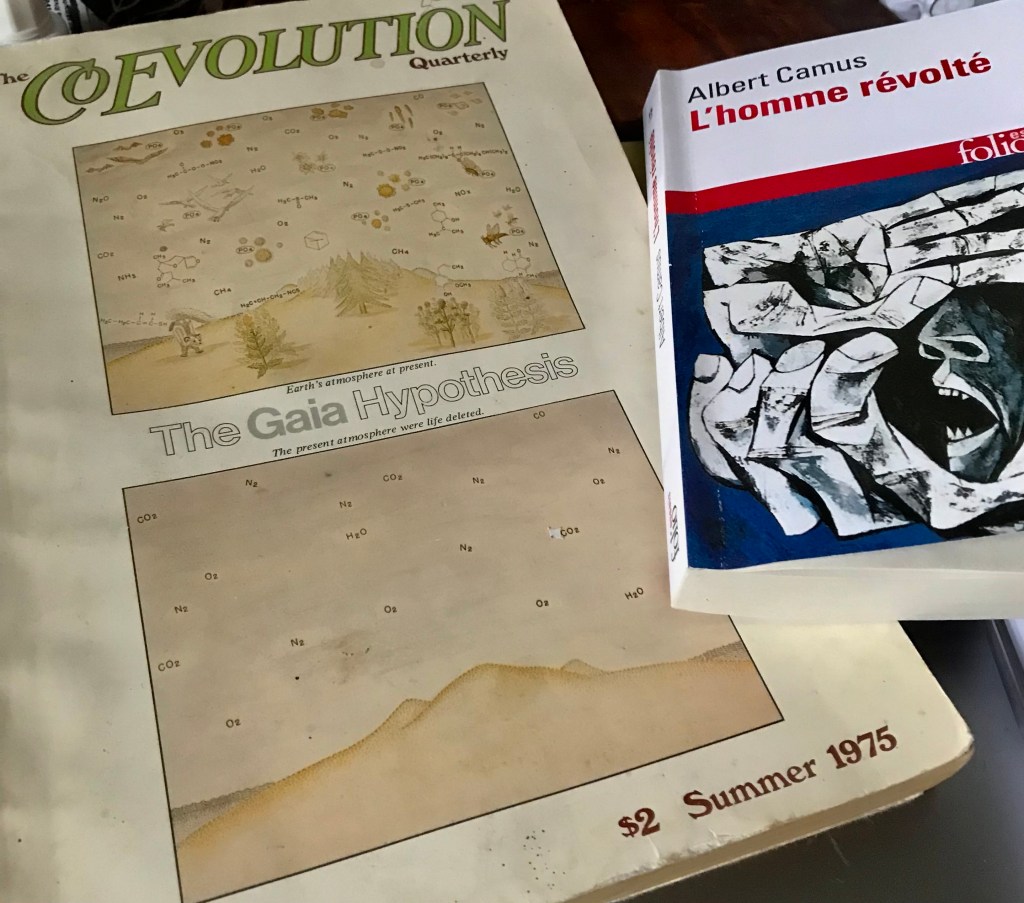
Ces rêves sont un peu comme un résumé de la journée d’hier, les personnages de X et de Gabriel Attal représentant clairement les forces économiques actuelles et leur fidèles exécutants sur la scène politique (brève apparté, tout de même, pour ces vidéos à peine croyables d’Elon Musk – avec son fils de 4 ans en accessoire – debout à côté du président des Etats-Unis, assis à son bureau dans le Bureau Ovale – avec le gamin lançant des “chut” menaçant…au président, puis l’approchant pour lui dire “tu n’es pas le président, vas-t-en !”; comme improvisation dans la mise en scène, c’était réussi). Les plantes mortes à arracher pour faire place aux semis des graines récoltées, et les deux livres illustrés ci-haut – résumé de la conversation avec un jeune homme qui aime bien prendre le café avec moi, à l’occasion, avec qui nous discutons de l’état général de la planète et de ses divers habitants. Il était question et de l’hypothèse Gaïa de Lynn Margulis et James Lovelock – considérant la terre comme une entité dont les éléments sont dépendants les uns des autres, et de réseaux d’ordinateurs auto-gérés, alors j’ai ressorti la copie du Co-Evolution Quarterly de l’été 1975 que je traîne encore avec moi, dans lequel il était question de ces deux choses, avec des textes enthousiastes sur l’arrivée des ordinateurs personnels et tout ce qu’ils permettraient de concorde et d’entre-aide entre les humains à travers la planète. Théoriquement, ça demeure une possibilité, certes, mais les conditions paraissent réunies pour tout autre chose en termes d’asservissement de l’esprit humain.
Et puis, L’Homme Révolté d’Albert Camus.* Que j’ai lu à l’âge de 15 ans et qui a mis en place bien des choses dans ma tête. Soixante-trois ans plus tard, je l’ouvre et, tout comme alors, j’en souligne les cinq premières phrases : “Qu’est qu’un homme révolté ? Un homme qui dit non. Mais s’il refuse, il ne renonce pas : c’est aussi un homme qui dit oui, dès son premier mouvement. Un esclave, qui a reçu des ordres toute sa vie, juge soudain inacceptable un nouveau commandement. Quel est le contenu de ce “non”?”
Mon jeune ami ne connaît pas. Je lui prêterai après nouvelle lecture (nous échangeons souvent des livres qui nous paraissent utile à une “résistance” qui ne ressemble en rien à ce qu’elle a pu représenter ici pendant la 2e Guerre Mondiale. Les temps s’y prêtent, follement.)
*
Et dans le Dictionnaire amoureux de Pouchkine**, hier soir ? La rubrique intitulé Dostoïevski, Fiodor (1821-1881). Les temps s’y prêtent aussi.
*Albert Camus, L’Homme Révolté, éditions Folio chez Gallimard (première parution en 1951).
**André Markowicz, Dictionnaire amoureux de Pouchkine, Plon, 2025.
*
Dreams : a person asks “who and what makes you think that, as X, you will do better, this time ?; then I’m emptying huge clay jars of their dried out plants, Gabriel Attal is displeased when I stop for a rest, there was still lots and lots of dead plants including in two huge lawns where I collected the seeds while not understanding why the others didn’t come to lend a hand; then a young woman with whom I had had many disagreements came to say goodbye as she was leaving to settle in Germany, I embraced her, broken hearted because I had hoped we could still learn to understand one another or, at the very least, learn mutual respect; then someone drove me and a comrade from work to the foot of a long hill covered in snow and I laughingly said “come, we’ll develop a good appetite by climbing up to my place.”
These dreams are something like a summary of the day, yesterday, the characters of X and of Gabriel Attal clearly representing the current economic forces and their faithful executives in the political sphere (still, a brief sidebar here, for those videos, almost unbelievable, of Elon Musk – with his 4 year old son as a visual prop, standing next to the President of the United States sitting at his desk in the Oval Office, and the kid intimating threatening shushing… to the president then, standing next to the desk, telling him “you’re not the president, go away”, as an improv in the staged set-up, it was quite a success”). The dead plants to pull up in order to make room for the collected seeds and the two books illustrated above summarizing the conversation I had yesterday with a young man who enjoys having coffee with me on occasion, for discussions about the general state of the planet and of its various inhabitants. There was talk of the Lynn Margulis and James Lovelock, whose Gaia Hypothesis considered the planet as an organisms whose elements were co-dependant, as well as of auto-managed computer networks, so I pulled up the copy of the Co-Evolution Quarterly from the summer of 1975 that I still carry around with me and where there is talk of these two things, with enthusiastic material over the arrival of personal computers and everything they will allow in terms of understanding and mutual help among humans across the planet. Theoretically, this remains a possibility, undoubtedly, but the conditions now appear reunited for something else entirely in terms of enslavement of human minds.
And finally, Albert Camus’ The Rebel. Which I read at the age of 15 and which put in place many things in my head. Sixty-three years later, I open it again and, as I did then, I underline the first five sentences: “What is a rebel? A man who says no. But if he refuses, he does not give up: he is also a man who says yes, right from the onset. A slave who has been ordered around all his life, suddenly considers a new order as unacceptable. What is the content of this “no”?”
My young friend did not know about this book. I will lend it to him following this fresh reading (we often exchange books we find useful in a “resistance” that does not resemble in any way what it may have been during the 2nd World War. The times are ripe for it, in the craziest of ways.)
*
And in the Dictionnaire amoureux de Pouchkine, last night ?The entry titled Dostoïevski, Fiodor (1821-1881). The times are ripe for it, also.
 iknowiknowiknowblog