Rêves – C’est assez drôle comment le cerveau est malin : hier matin, je me souvenais très bien d’avoir noté pendant la nuit les mots “ville pleine de vendus” dans le cahier des rêves, mais au réveil, j’ai constaté qu’il n’en était rien; en fait, j’avais rêvé que je notais, question de pouvoir continuer à dormir…
Ce matin, aucune note après un très long rêve comme un film d’action mettant en vedette une bande de pilleurs de banques en costume cravate, opérant à visage découvert. Ils étaient bien connus, entraient par la grande porte et ne dévalisaient rien, ils s’emparaient tout simplement du contrôle de la banque; avec une scène où je suis en fuite avec d’autres en direction de la mer, nous traversons un boisé de conifères immenses, l’ombre de leurs branches sur le sol roux, comme une dentelle ravissante, je veux montrer aux autres qui me pressent de courir; et deux moments où je suis suspendue au-dessus du vide, dans l’un je m’agrippais à un tissu pendant le long d’un pont énorme, dans l’autre, le pli du coude droit me retenait au barreau d’un escalier aussi à pic qu’une échelle contre un mur.
*
Tête pleine au réveil. Du film “À pas aveugles” de Christophe Cognet, vu sur Médiapart hier, à partir de photos prises au péril de leurs vies par des prisonniers et des prisonnières à Dachau, Buchenwald, Mittelbau-Dora, Ravensbrück et Auschwitz-Birkenau. Avec les images transposées sur verre, il se promène sur les lieux pour retrouver les endroits exacts d’où furent faites les prises de vue; pendant que des visiteurs contemporains se promènent et se photographient pour bien montrer qu’ils y étaient. Deux des trois femmes qu’on appelait des “lapins” parce qu’ utilisées comme cobayes dans des expériences dites “médicales” ont survécu à leur calvaire, ainsi que celle qui les a photographiées. Dans les tranchés où s’accumulaient les cadavres brûlés lorsque le Krematorium était en panne, “quand il pleut, les fragments remontent” – qui ressemblent à des cailloux blancs; ce sont des os. (Dans mon cahier, je note : “et la terre, elle, n’y est pour rien. Innocence aveugle ? Aveugle, je ne crois pas, mais je ne saurais la décrire.”)
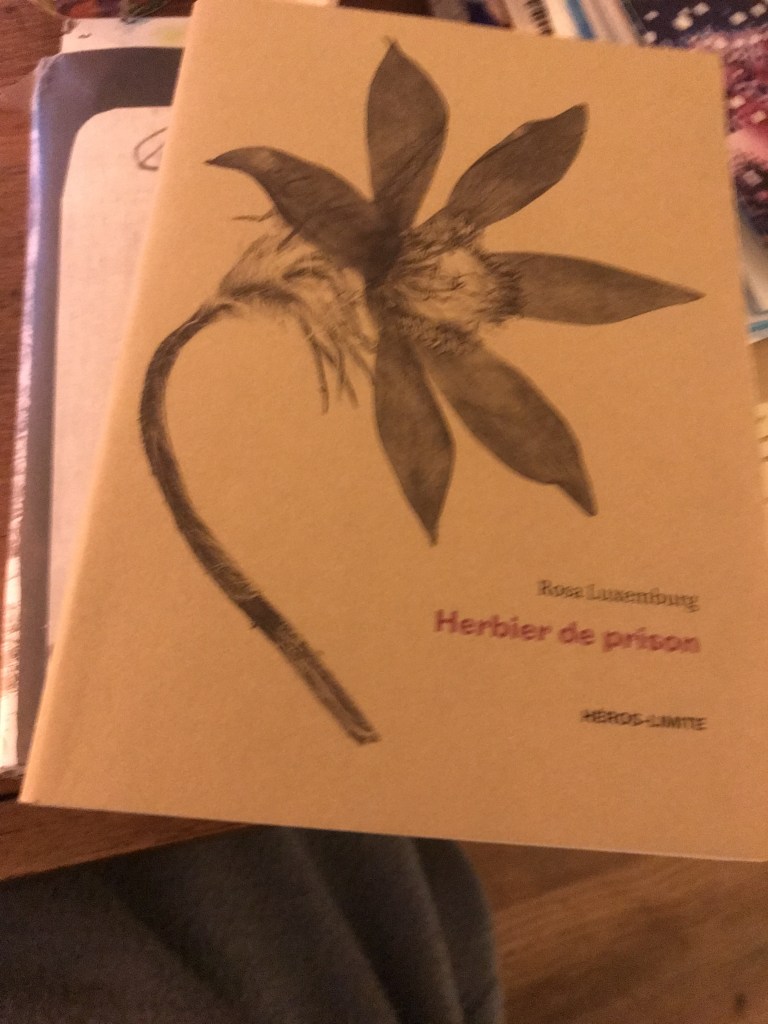
Et hier soir, relecture des lettres et des commentaires de ma très chère Rosa Luxembourg dans son Herbier de prison*. Très chère pour son amour du vivant, pas seulement des humains, pour sa compréhension des poisons qu’étaient le nationalisme et le bolchévisme, pour son amour de la vie, du bon café et des gâteaux…Elle parlait huit langues et prêtait la même attention passionnée à la différence entre le grand perce-neige et le petit (qui “a les trois pétales intérieurs non pas pointus mais découpés en forme de coeur, avec trois petits traits verts sur chacun“). Les fleurs lui étaient fournies par courrier, notamment par trois femmes, Mathilde Jacob, Luise Kautsky et Marta Rosenbaum, toutes trois assassinées à Theresienstadt et Auschwitz, environ vingt ans après son assassinat le 15 janvier 1919.
*
*Rosa Luxembourg, Herbier de Prison, édition Héros-Limite, 2023, traduction de Claudie Weill, Gilbert Badia, Irène Petit et Muriel Pic
*
Et les notes et réflexions de l’Ogresse au sujet du “banquier voleur” qui l’a récupérée, elle et son frère, sur une île où il a abandonné les irrécupérables à leur agonie, après la 4e déflagration.
*
Dreams – It’s rather funny how clever the brain can be: yesterday morning, I recalled perfectly how I had jotted down the words “town full of sell-outs” in the notebook of dreams during the night, but upon waking, I saw there was nothing there; in fact, I had dreamt that I was jotting down, as a means to co on sleeping…
This morning, not a single note after a very long dream like an action movie featuring a bunch of bank robbers in suits and ties, operating bare-faced. They were well known, entered through the main door and took off with nothing, they simple seized control of the bank; with one scene where I am fleeing with others toward the sea, we go through a woodlot with huge conifers, the shadow of their branches on the rust-colored ground, like a ravishing lace, I want to show it to the others who urge me to run; and two moments when I am suspended over the void, in one I was clinging to a piece of fabric hanging along the side of an enormous bridge, in the other, the crook of my right elbow was holding me fast to the bars of a staircase as steep as a ladder against a wall.
*
My head is full upon waking. Of the film “À pas aveugles” (With blind steps) by Christophe Cognet, seen on Médiapart yesterday, done from photographs taken at the risk of their lives by prsoners in Dachau, Buchenwald, Mittelbau-Dora, Ravensbrück and Auschwitz-Birkenau. With the images transferred onto glass plates, he walks on site to find the specific places where the films were shot; while contemporary visitors walk around, photographing themselves to show they were there. Two of the three woman who were called “rabbits” because they were used as subjects for so-called “medical” experiments survived their ordeal, as well as the woman who photographed them. In the trenches where the burned corpses accumulated when the Krematorium was out of service, “when it rains, fragments emerge” – they look like white pebbles; they are pieces of bone. (In my notebook, I write : “and the earth has nothing to do with it. Blind innocence ? Blind, no, something else I can’t describe.”
*
And last night, reading through the letters and comments of my beloved Rosa Luxemburg in her Prison Herbarium. Beloved for her love of all the living, not only humans, for her understanding of the poisons in nationalism and bolshevism, for her love of life, of good coffee and cakes…She spoke eight languages and paid intense attention to the difference between the great snowdrop and the small (which “has its three interior petals not pointy but cut out in a heart shape, with three small streaks of green on each one“.) The flowers were sent to her by mail, notably by three women, Mathilde Jacob, Luise Kautsky and Marta Rosenbaum, all three murdered in Theresienstadt and Auschwitz, about twenty years after her own assassination on January 15 1919.
*
*Rosa Luxembourg, Herbier de Prison, édition Héros-Limite, 2023, traduction de Claudie Weill, Gilbert Badia, Irène Petit et Muriel Pic
*
And the notes and musings of the Ogress concerning the “robber banker” who recuperated her and her brother on an island where he abandoned the irrecuperables to their agony, following the 4th explosion.
 iknowiknowiknowblog