Rêves : j’étais un jeune homme et j’allais faire des prédications de rue qui exigeaient une bonbonne de gaz, je n’étais pas trop certain comment l’installer mais je faisais celui qui savait, je comptais utiliser un subterfuge pour revoir une jeune femme, et même, pénétrer à son insu dans sa cellule au couvent maronite, pendant que, mine de rien, elle surveillait mon installation depuis sa fenêtre; puis, deux jeunes peintres en bâtiment hirsutes et rigolards, tout de blanc vêtu pénètrent dans ma chambre alors que je traînasse au lit, j’en suis très gênée et eux, pas du tout; puis un groupe de jeunes hommes qui glandouillent, à faire n’importe quoi, à parler de tout et de rien, occupés à être jeunes ensemble, je fais comme eux.
*
Ce qui n’a rien à voir avec ce que j’ai noté hier après la lecture sur Politico d’une entrevue de Ryan Crocker, ancien ambassadeur américain. L’intervieweur lui dit: “C’est vraiment une situation dans le brouillard de la guerre où il est très difficile de voir où en sont les forces du Hezbollah en ce moment.” Crocker répond : “Je suis assez âgé pour avoir la perspective à long terme. J’étais au Liban en 1982 lors de l’invasion israélienne. Ils appelaient leur opération “Paix pour la Galilée”. Et 42 ans plus tard, le Liban est plus éloigné de la paix qu’il ne l’était en ’82 au lancement de cette invasion. Cette invasion et l’occupation israélienne qui s’ensuivit ont créé Hezbollah. Cette invasion-ci n’y mettra pas fin.”
Et ces paroles totalement justes : “Une chose que j’ai apprise au cours de ces années, surtout en Iraq et en Afghanistan, c’est que le concept de la défaite d’un adversaire n’a de signification que dans l’esprit de ce dernier. Si l’adversaire a le sentiment d’être vaincu, il est vaincu. S’il n’a pas ce sentiment, il ne l’est pas. Ces décapitations feront-elles que l’adversaire se sentira vaincu ? Je suppose que le temps nous le dira mais je parierais le contraire.”
J’y étais aussi en 1982. En Israël dans mon cas, où, toute pacifiste et végétarienne que j’étais à l’époque, je me retrouvais à travailler avec les Américains sur la construction de deux bases militaires aériennes promises à Israël dans le cadre des accords du Camp David. Bases à partir desquelles furent lancées l’opération “Paix en Galilée“. J’ai devant moi une médaille que j’ai souvent pensé à jeter aux ordures, mais que je garde justement pour cette raison. Mon patron de l’époque m’avait chargée de commander les boîtiers en bois d’olivier contenant la dite médaille qui nous fut distribuée en grande pompe; il prétendait avoir trouvé la citation gravée sur une de ses faces (le connaissant, ça voulait dire que quelqu’un d’autre y avait pensé et qu’il lui avait piqué l’idée.) La citation est tirée des Lévitiques, 26.6, et se lit : “Je mettrai la paix dans le pays.”
L’ironie cruelle de ces mots, garants de la paix des cimetières, est là sur l’étagère, rappel constant de ce qu’il en est vraiment et de mon hostilité persistante envers les Ariel Sharon, Benjamin Netanyahou et consorts.
*
Message qui n’a rien à voir, à l’intention des lecteurs qui ont l’amabilité de signaler qu’ils ont aimé une chronique : pour une raison que j’ignore, ces “like” ne s’inscrivent pas sur ma page…mais apparaissent avec un certain retard…dans mes mails. Merci à vous.
*
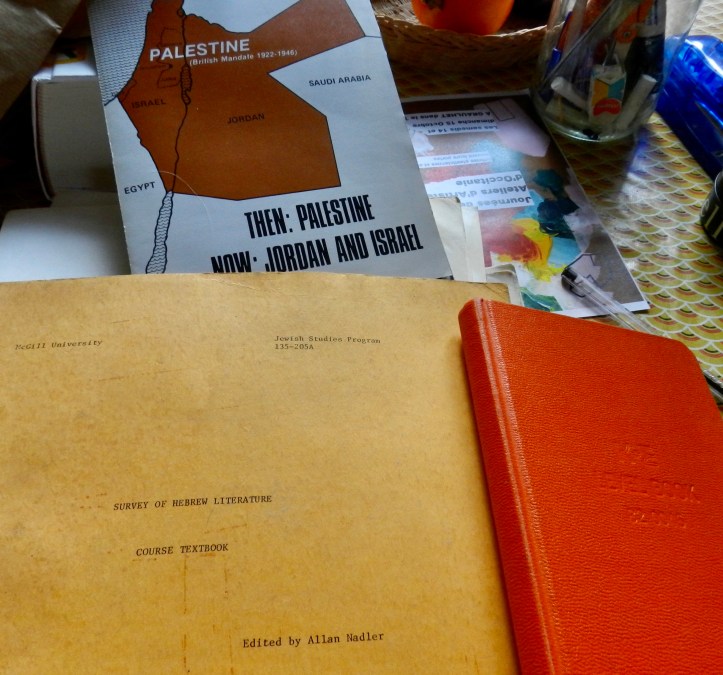
Illustration : la brochure intitulée Palestine ci-haut date de cette glorieuse époque où on prétendait que la terre en question était restée inoccupée pendant des siècles, dans l’attente du retour du peuple élu, dans une sorte de suspension magique, oeuvre de Dieu Lui-même.
Pendant que se poursuit la ronde incessante des enfants martyrs, juste bons à fournir des symboles et le pathos parfois utiles dans les déclarations publiques des uns et des autres, liés dans leur haine commune.
*
Dreams: I was a young man and I was going to preach on the street, this required a a tank of gas, I wasn’t too sure how to set it up but I pretended I knew, I was counting on using a trick to see a young woman again and even go into her cell at the Maronite convent without her knowledge, while she stood at her window, as if by accident, watching my installation ; then two young hairy and joking housepainters all dressed in white come into my room while I’m dawdling in bed which embarrasses me greatly and them, not at all; then a group of young men doing nothing much, talking about this and that, busy being young together, I do the same.
*
Which has nothing to do with what I jotted down yesterday after reading an interview of former American ambassador Roy Crocker on Politico. The interviewer says : “It’s really a fog of war situation in that it’s very difficult to see what Hezbollah’s strength is right now.” Crocker answers : “I’m old enough to take a very long view. I was in Lebanon in 1982 when the Israelis invaded. They called their operation “Peace for Galilee.” And 42 years later Lebanon is further from peace than it was in ‘82 when that invasion kicked off. That invasion and the subsequent Israeli occupation created Hezbollah. This invasion is not going to end it.”
Plus these totally correct words: “One thing I’ve learned over years, especially in Iraq and Afghanistan, is that the concept of the defeat of an adversary only has meaning in the mind of that adversary. If that adversary feels defeated, he is defeated. If he doesn’t, he’s not. Will these decapitations make the adversary feel defeated? I guess time will tell but I would bet against it.”
I was also there in 1982. In Israël where, as much of a pacifist and a vegetarian as I was, I found myself working with the Americans building the two military airbases promised to Israel as part of the Camp David Agreement. From where were launched the “Peace in Galilee” operation. I have before me a medal I’ve often thought of thowing out in the garbage but that I keep for that very reason. My boss at the time had charged me with ordering the olive wood holders for said medal, distributed with great pomp and circumstance on April 25th, official date of the handing over of the airbases; he claimed he had thought of the quote inscribed on one of its sides (knowing him, that meant someone else had the idea and he stole it.) The quote is taken from Leviticus, 26.6, and reads: “I will give peace in the land.”
The cruel irony of those words, guaranteeing the peace of the cemeteries, is there on the shelf, a constant reminder of what the facts are in reality – and my lasting enmity for the likes of Ariel Sharon, Benyamin Netanyahu and consorts.
*
An unrelated messagefor readers who kindly signal they liked a column: for some unknown reason, these “likes” don’t show up on my page…but with a certain delay…in my emails. My thanks to you.
*
Illustration : the pamphlet above titled Palestine dates back to that glorious period when it was claimed that the land in question had remained unoccupied for centuries, awaiting the return of the chosen people, in a kind of magical suspension, the work of God Himself.
While the endless rounds of martyred children go on, only good as fodder for symbols and the pathos that proves useful at times in the public declarations of the ones and the others, linked in their common hatred.
 iknowiknowiknowblog