4h30: debout depuis une heure. Toux et mal de gorge de plus en plus envahissants. Quant au chaton, on m’avait manifestement raconté n’importe quoi pour s’en débarrasser: elle est beaucoup trop petite pour contrôler sa vessie et, maintenant qu’elle a découvert les joies de se blottir dans un lit bien chaud et moëlleux, moi et mes couvertures “bénéficions” de ses mictions. Lavé la couette hier soir, draps et couvertures suivront aujourd’hui.
*
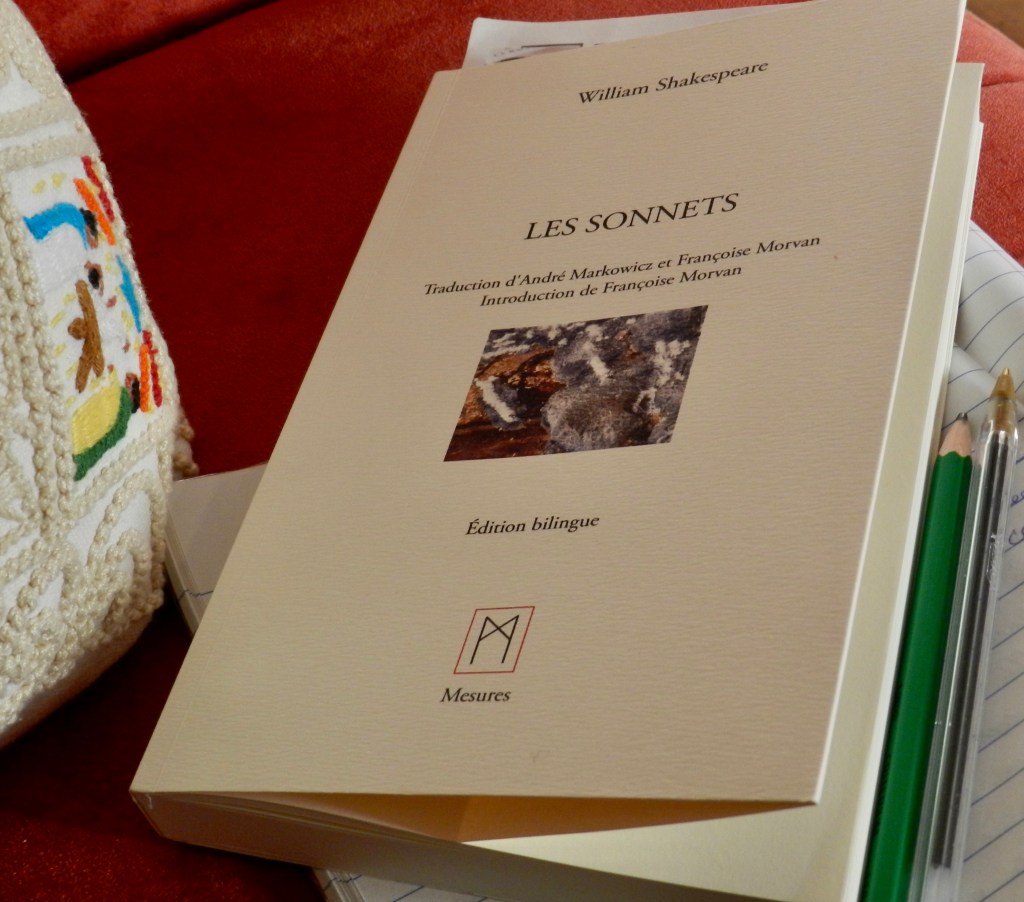
Au contact du mot “iambique” dans l’Introduction de Françoise Morvan aux traductions des Sonnets* (les siennes et celles d’André Markowicz, et parfois les deux en tandem), me revient un lointain souvenir (j’avais treize ans) d’un cours de grec classique, à annoter des vers pour marquer les iambes et les trochées; le résultat ressemblait à une sorte de code morse. Douée, je ne l’étais pas; je fus surtout connue dans cette classe pour ma traduction de ta zoa trekein par “les oies tricotent”.
L’introduction débute par les mots : L’énigme des sonnets. Tout est étrange dans dans la destinée des sonnets de Shakespeare.” Aux étrangetés qu’elle détaille – et non la moindre, ce refus persistant des traducteurs français à les rendre dans leur forme originelle, les modifiant soit en prose, en alexandrin ou en vers libre – s’en rajoute une autre pour moi: celle de les lire autrement qu’en anglais et, du fait que ces traductions-ci respectent au mieux la forme choisie par Shakespeare, l’étrangeté de découvrir des frères faux jumeaux, très ressemblants et pourtant différents; manifestement, de la même lignée, mais ne s’exprimant pas de la même façon.
Une évidence, sans doute, mais à laquelle je ne suis pas vraiment sensible lorsque je ne possède pas bien la langue d’origine d’un texte, comme c’est le cas ici. Alors, me voici avec deux versions (non, trois, celles d’André Markowicz, celles de Françoise Morvan, et celles en tandem).
Et, conséquence de cette découverte, je veux lire la traduction qu’elle a faite du Roi Lear, alors que j’ai toujours évité les traductions françaises de Shakespeare; elles me faisaient l’effet d’un mélange de faux Corneille et Racine, qui passait complètement à côté de l’esprit des originaux.
*
J’aurais aimé parlé aussi des textes lus hier sur K – la revue (en français et en anglais), mais ça sera pour un autre jour.
J’ai vraiment très envie de dormir.
*William Shakespeare, Les Sonnets, édition bilingue, traduction d’André Markowicz et Françoise Morvan, introduction de Françoise Morvan, Les Éditions Mesures, janvier 2023
*
4:30 AM and up for an hour already. Coughing and sore throat in the increase. As for the kitten, I was clearly told any old thing to be rid of it: she is much too small to control her bladder and, now that sh’es discovered the joys of snuggling in a nice warm and soft bed, myself and my blankets “benefit” from her sprinklings. Washed the comforter last night, sheets and blankets will follow today.
*
When I came across the word “iambic’ in Françoise Morvan’s translations of the Sonnets (hers and those of André Markowicz, or some in tandem), a distant memory cropped up (when I was thirteen years old) during a class in classical Greek, annotating poetry to mark iambs and trochee. This resulted in a kind of Morse code. Gifted, I was not; I was mostly known in this class for my translation of ta zoa trekein as “the geese are knitting”.
The Introduction opens on the words : The enigma of the sonnets. Everything is strange in the destiny of Shakespeare’s sonnets. To the strange things she outlines – not the least of them being the persistent refusal of French translations to render them in their original form – modifying them either into prose, alexandrines or free verse – another is added on for me: that of reading them other than in English and since these translations respect as best they can the form chosen by Shakespeare, the strangeness of discovering something like brothers who are false twins, very much resembling one another, yet different; clearly of the lineage but with different ways of expressing themselves.
Which is something obvious, of course, but I had never been truly conscious of this in cases where I don’t have a full knowledge of the original language of a text, as is the case here. So, I now find myself with two versions (no, three, since some sonnets are translated by André Markowicz, others by Françoise Morvan, and some in tandem).
As a consequence of this discovery, I want to read her translation of King Lear, whereas I had always avoided French translations of Shakespeare, reminding me as they do of a phony hodge podge of Corneille and Racine, totally missing the spirit of the originals.
*
I would have liked to mention here some of the texts read yesterday on K- la revue (both in French and in Englis), but it will be for another day.
I really feel like sleeping.
 iknowiknowiknowblog