Déjà, je trouvais le 3e chapitre de The Road to Unfreedom de Timothy Snyder difficile – difficile à absorber au plan éthique. Il y est question de toute la dérive fasciste de ce concept “eurasien” d’un empire centré sur la Russie et dans lequel les notions de ‘légalité’ – invention purement occidentale, apparemment – n’auraient pas cours.
Et puis, au détour d’une page, je tombe sur le nom de Lev Goumilev. Le fils d’Anna Akhmatova. Défendant une conception mystico-hallucinée d’un fascisme intégral. Choc de la “découverte” de la passionarité relative des peuples, terme de son invention expliquant splendeurs et décadences des civilisations, n’est-ce pas. On aura compris que la passionarité est vibrante d’énergie du côté de la Russie – d’où son rôle déterminant en tant que tête gouvernante de l’Eurasie – pendant que la passionarité des occidentaux se diluent dans les eaux dont ils sont entourés. Quant à l’antisémitisme de Goumilev et de ses soutiens, il ne le cède en rien à celui d’Hitler.
En bref, tout l’attirail sordide des marchands de haine. Ce qui rend la lecture de ce chapitre si difficile, c’est de voir tout ça se dérouler en temps réel dans la guerre russe contre l’Ukraine et le déploiement en accéléré de la propagande pro-russe en Occident par les soutiens avérés du Kremlin, comme par les innocents en proie au somnambulisme. “La guerre en Ukraine” étant dorénavant utilisée comme l’irritant, cause de tous les désagréments imaginables, et ses soutiens, accusés d’être des va-t-en-guerre.
Je relis le poème L’été de Kari Unksova pour reprendre pied.
*
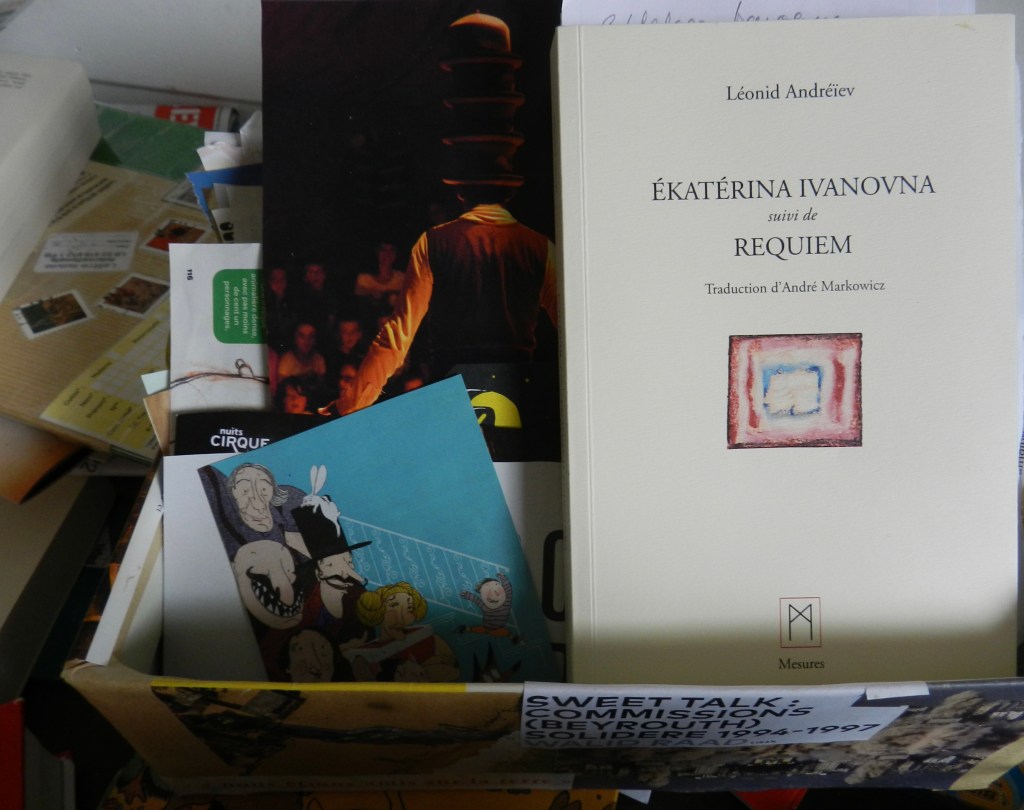
Ce matin dans son billet, André Markowicz parle de la version de La Cerisaie de Tchekhov dans la mise en scène de Tiago Rodrigues, avec Isabelle Huppert dans le rôle de Lioubov Andreïevna. Le genre de splendeur que je n’aurai sans doute jamais l’occasion de voir. Pour une raison que je ne m’explique pas, l’image qui m’est venue en lisant les commentaires de ses lecteurs, était celle des figures en bois représentant le public dans le Requiem de Léonid Andreïev. Rien à voir avec les commentaires en eux-mêmes; probablement une image émergeant tout simplement du sentiment d’être exclus de tout ça, et de devoir l’assumer; parce que s’il fut un temps de perspectives qui s’ouvraient, époque où je lisais le premier chant du Purgatoire de Dante comme une promesse, l’époque a changé, et la Terre voyagé des millions de kilomètres à travers l’espace depuis.
Sombres pensées ? Oui. Sur ce blog, je note ce que j’observe. Je me ferai un plaisir de ressentir et de noter à son apparition la “dolce color d’oriental zaffiro
che s’accoglieva nel sereno aspetto
del mezzo, puro infino al primo giro... ” que vante Dante du treizième au quinzième vers de ce même chant,
et, à défaut, de l’imaginer.
*
I was already finding the 3rd chapter of Timothy Snyder’s a difficult slog – difficult to absorb, ethically speaking. It’s about the whole fascist ‘Eurasian’ concept of an empire centered on Russia in which all notions of legality – a purely Western invention, apparently – would have no bearing.
And then, turning a page, I came across the name of Lev Gumilev. Anna Akhmatova’s son. Defending a mystico-hallucinatory concept of integral fascism. The shock of “discovering” the concept of a relative “passionarity” among peoples, explaining the rise and fall of civilizations, don’t you know. We are invited to understand that vibrant and energetic passionarity is on the rise in Russia – which explains its determining role as head of Eurasia, while the passionarity of peoples in the West is being diluted in the waters surrounding them. As for his antisemitism, Hitler had nothing on Gumilev and his followers.
In short, the whole sordid back store dreck of hate-mongers. What makes the reading of that chapter so difficult is seeing all this playing out in real time in the Russian war against Ukraine and the spreading deployment of pro-Russian propaganda by its averred Kremlin supporters as well as by the innocents in the thrall of somnambulism. “The war in Ukraine” now being used as the irritant causing every unpleasantness imaginable, and its supporters being accused of war-mongering.
I read Kari Unksova’s poem Summer to ground myself.
*
This morning in his facebook entry, André Markowicz spoke about the version of Chekhov’s The Cherry Orchard directed by Tiago Rodrigues, with Isabelle Huppert in the role of Lioubov Andreyevna. The kind of splendor I will probably never have the opportunity to witness. For some inexplicable reason, the image that came to mind while reading the comments from his readers was that of the wooden figurines representing the audience in Leonid Andreyev’s Requiem. Nothing to do with the comments as such, probably an image arising quite simply from the feeling of being excluded from it all, and of having to put up with that fact; because if there was a time when perspectives were opening up, a time when I read the first Canto in Dante’s Purgatory as a promise, the times have changed, and the Earth has travelled millions of kilometers through space since then.
Somber thoughts? Yes. On this blog, I jot down what I observe. I’ll be delighted to experience and note the apparition of the
“dolce color d’oriental zaffiro
che s’accoglieva nel sereno aspetto
del mezzo, puro infino al primo giro... ” praised by Dante in the thirteenth to the fifteenth line of this same canto,
and, barring that, to imagine it.
 iknowiknowiknowblog