J’ai préparé ce texte hier, et j’hésitais à savoir si je le publierais aujourd’hui ou un autre jour. Puis, j’ai lu un commentaire sur la page facebook d’André Markowicz, commentaire portant sur le rejet proprement viscéral de tout ce qui est russe par des personnes ayant souffert ou souffrant encore des violences diverses imposées par le régime en place au Kremlin.
Ce qui signifie Poutine en ce moment: constamment, il tâte, il teste, il teste, puis il frappe là où il décèle une faille. C’est aux autres de céder, pour lui, il n’en est pas question. De toute façon, il est engagé à fond, et c’est aux autres de mourir. Se croit-il invulnérable? J’en doute et en même temps, je m’en fous parce que les états d’âme ou leur absence chez Poutine, ça n’est pas de mon ressort.
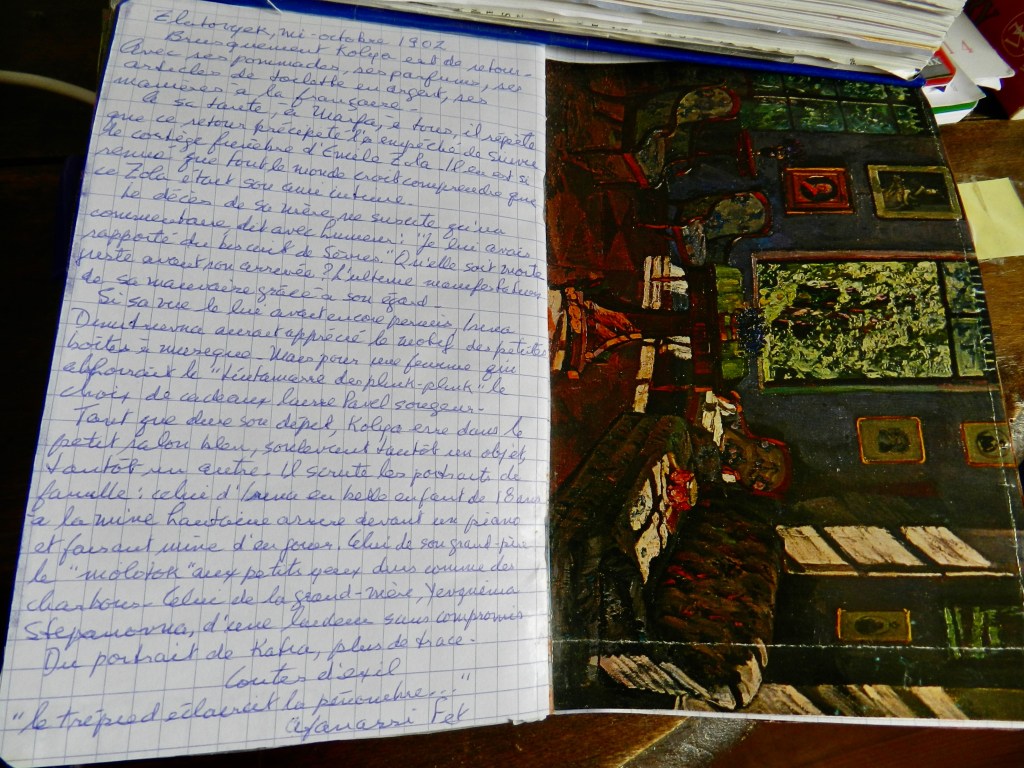
Ma première expérience du russe (ou était-ce de l’ukrainien ?) a été toute autre. “Ma” Russie intérieure ne l’est pas moins. Non, ceci n’est pas un récit de vie. Simplement, en feuilletant l’un de mes nombreux carnets, je suis tombée sur ce qui sert d’illustration aujourd’hui.
*
1983. Retour au Québec après 3 ans en Israël. Le choc culturel, c’est toujours au retour qu’on le ressent. Au départ, on s’y attend. Au retour, on voit d’un autre oeil ce que l’accoutumance avait occulté. On me demande ce que j’aimerais pour mon anniversaire et on me l’offre: l’anthologie de la poésie russe du XVIIIe au XXe siècle chez Maspero.* Un des livres qui ont fait partie de la valise “bibliothèque nationale” lorsque je me suis installée en France. Lu, relu, relululu.
1983. Cours de russe à l’université McGill, non pas avec l’ambition de le parler (avec qui, d’ailleurs?). Non, pour pouvoir lire certains poèmes dans leur langue d’origine, Mandelstam, entre autres, dont j’avais acheté certaines traductions chez Steimatzky à Tel-Aviv, traductions françaises et anglaises recopiées dans un carnet d’arpenteur, un soir dans le désert du Négev. “Me lavant de nuit dans la cour, le ciel brillait d’étoiles grossières…” et leur lueur “…comme du sel sur la hache.**
Les Contes d’exil me sont venus beaucoup plus tard. Un personnage d’abord, au détour d’une exposition sur les Peuples de Sibérie lors d’un passage pour affaires à Paris. Cette vieille femme m’accompagne toujours d’ailleurs, je ne sais pas toujours pourquoi. Puis suivirent des récits, écrits au fil des pérégrinations à travers l’Amérique en camping car; récits que je relis parfois avec une certaine indulgence, une sorte de décor intérieur trop familier pour qu’on songe à y renouveler les tentures ou les papiers peints qui en auraient sans doute bien besoin.
*
Ces jours-ci, je lis, relis, et re-re-lis le poème L’Été de Kari Unksova.*** Chaque fois, une image, une impression me retient, j’y reste accrochée. (Et pour ce qui est de déchiffrer le cyrillique, oui, ça revient.Les mots plus longs demeurent un défi – tixo tixo tixo.)
*Poésie russe Anthologie du XVIIIe et XXe siècle présentée par Efim Etkind, Anthologies/La Découverte/Maspero 1983
**Ossip Mandelstam (mais j’ai oublié de noter l’édition à l’époque)
***Kari Unksova, La Russie l’Été, traduction André Markowicz, éditions Mesures 2021
(Le titre ? L’un des poèmes d’Afanassi Fet dans l’anthologie Maspero)
*
I prepared this text yesterday, and hesitated this morning as to whether I would publish it today or some other time. Then I read a commentary on André Markowicz’ facebook page, a commentary dealing with the frankly gut-level push-back on anything having to do with Russian by people who suffered, or still suffer, from the violences imposed by the regime controlling the Kremlin.
Which means Putin at the moment: constantly, he gropes, he tests, he tests, then he strikes where he senses a flaw. The others have to step down, it’s out of the question for him. In any event, he’s in it too deep, and dying is for other people. Does he think he’s invulnerable? I doubt it and at the same time, I couldn’t care less because the state of Putin’s soul or the absence of same is not part of my purview.
My first experience of Russian (or was it Ukrainian?) was completely different. “My” inner Russia is totally different also. No, what follows is not a life story. Simply, while leafing through one of my many notebooks, I came across what serves as illustration today.
*
1983. Back in Québec after 3 years in Israel. Culture shock is always what you experience when you come home. You expect it when you leave. But when you return, you see things to which force of habit had blinded you. I was asked what I would like for my birthday, and received it: the Anthology of Russian poetry from the XVIIIth to the XXth century published by Maspero. One of the books included in my “national library” suitcase when I settled in France. Read, re-read, and read several times more.
1983. A Russian course at Mc Gill University Continuing Education Department. Not with the ambition of speaking it (in any event, with whom would that have been?). No, in order to be able to read certain poems in their original form, Mandelstam among others, some translations of whom I had bought at Steimatsky’s in Tel-Aviv and copied out in a surveyor’s notebook, out in the Negev desert (“washing at night in the courtyard a sky rich with coarse stars…“) and the starlight “like salt on an axe-head”.*
The Tales of Exile came to me much later. At first with the appearance of a character, following an exhibition on the Peoples of Siberia, during a business trip to Paris. She’s still with me, in fact, I don’t always really know why. Then came the tales, written while travelling through the United States in a camper, some of which I read over at times with a certain indulgence, a kind of inner landscape too familiar to even think of renovating the drapes or the wallpaper even if they could surely use it.
*
These days, I read, read over then read again Kari Unksova’s poem L’Été. Every time, yet another image, an expression grabs my eyes, and stays with me. (As for deciphering the cyrillic, it’s coming back. The longer words are still a challenge. slowly slowly slowly.)
*Osip Mandelstam, but I forgot to note the edition at the time.
(The title? From a poem by Afanassi Fet in the Maspero Anthology)
 iknowiknowiknowblog