En ce qui a trait à Cicéron, la lecture fut expédiée en moins d’une heure. Je ne saurais dire ce que les lecteurs de l’Eloge de la vieillesse en ont pensé à l’époque (il fut publié aux environs de l’an 50 avant notre ère), mais pour une femme le lisant en 2021, le tout dégage un sentiment de poncifs bien ennuyeux. Et puis, on reste tout de même ébahie lorsque Cicéron fait l’éloge enthousiaste d’un certain Appius avec ses “quatre fils grands garçons, cinq filles, une légion d’esclaves, des clients sans nombre…” et tout ça sans la moindre mention d’une quelque épouse ayant peut-être contribué, d’une certaine façon, à ce beau palmarès. Les quatre grands garçons et les cinq filles, Appius se les est tricotés tout seul?? Reste à souhaiter que les soldats d’Antoine aient été rapides et efficaces quand ils ont assassiné Cicéron, peut-être alors que l’expérience fut aussi indolore que d’être avalé par un requin. Et ainsi, passer à autre chose.
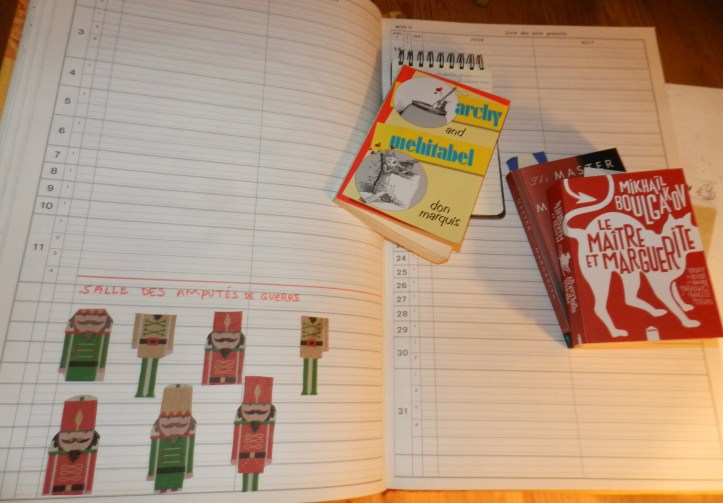
Et, en fait, au réveil ce matin, je n’ai qu’une seule envie de lecture (les autres viendront sans doute plus tard) : les trois paragraphes à la fin de la deuxième partie du Maître et de Marguerite, après que Woland se soit jeté dans l’abîme. Le passage qui débuté par: “Ecoute l’absence de bruit, dit Marguerite au maître…” * Etant donné tout les bruits dissonants dans la vie de Boulgakov, combien précieux un tel cadeau a dû paraître – comme la plus belle des berceuses et des récompenses.
Mikhaïl Boulgakov, Le Maître et Marguerite, traduit du russe par André Markowicz et Françoise Morvan, inculte/barnum, 2020.
*
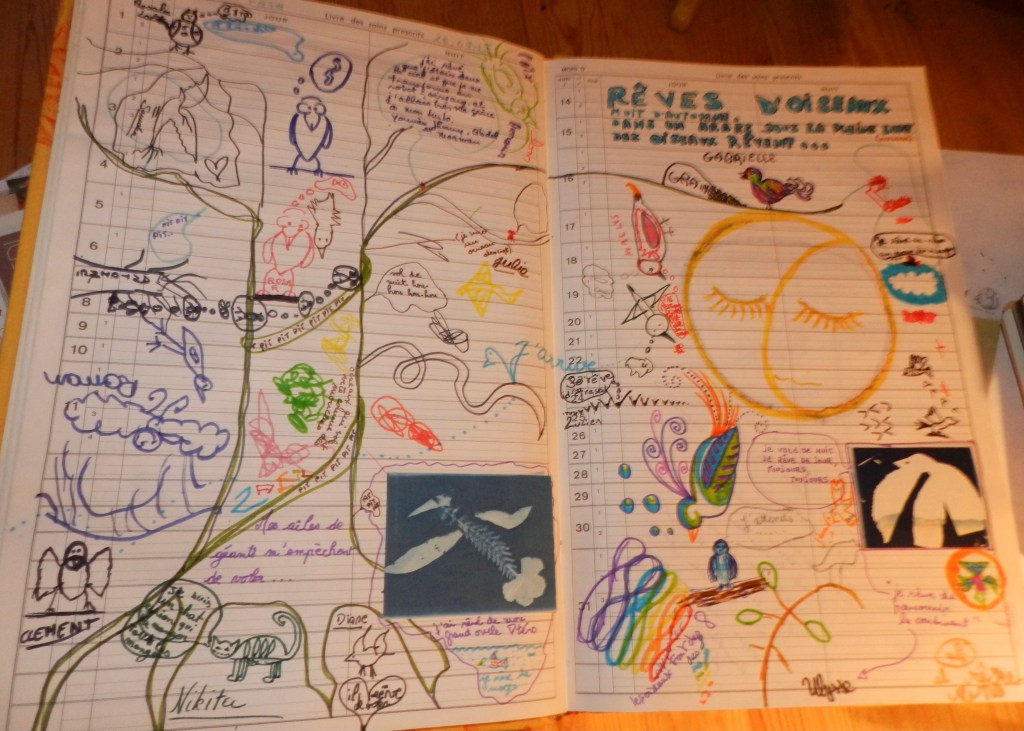
Pour ma part, j’ai ressorti le grand Livre des Soins Prescrits de sous une pile de livres. Je l’ai trouvé, initialement, dans un réduit d’une vieille maison à Capestang. Depuis, il a servi de grand cahier de notes personnelles pour moi et les gamins de passage dans ma vie. Une “cachette” qui n’en est pas une, le plus physiquement imposant des ‘carnets’ dans lesquels je note un mélange d’inepties, d’amorces de nouvelles et de gribouillis divers. Depuis hier, il a repris du service en tant que terrain de jeu intérieur, avec l’arrivée de la salle des amputés de guerre.
*
As pertains to Cicero, the reading was expedited in less than a hour. I cannot say what readers of In Praise of Old Age thought of it at the time (it was published around the year 50 before our era), but for a woman reading it in 2021, the whole thing gives off a sense of boring cliches. Plus, you are fairly astounded when Cicero launches into enthusiastic praise for a certain Appius with his “four sons big boys, five daughters, a legion of slaves, clients without number…” and all that without the slightest mention of some wife or other who might have contributed somewhat to this fine tally. The four big boys and five girls were knitted solo by Appius?? Well, I certainly hope Anthony’s soldiers were quick and efficient when they came to assassinate Cicero, perhaps then the experience was as painless as being swallowed by a shark. And so, on to something else.
*
And, in fact, on waking this morning, I had only one reading urge (the others will undoubtedly show up later): the final paragraphs of Part II in The Master and Margarita, beginning where Margarita says to the Master, after Woland has thrown himself into the abyss: “Listen to the silence…”* And given all the noisy aggravations in Bulgakov’s life, how precious and dear such a gift must have seemed – like the very finest of lullabies and rewards.
* Mikhail Bulgakov, The Master and Margarita, translated by Diana Burgin and Katherine Tiermnan O’Connor, Vintage Books, Random House, 1996
*
As for me, I’ve pulled out the Great Book of Prescribed Treatments from under a pile of books. I found it initially in the back room in an old house in Capestang. Since then, it has served as a massive notebook for personal thoughts, my own, and those of the kids who have passed through my life. A “hiding place” that isn’t one, the most physically impressive of the “notebooks” in which I jot down a mix of nonsense, of beginnings to short stories, and various scribblings. Since yesterday, it took on fresh duties as inner playground with the arrival of the room of war amputees.
 iknowiknowiknowblog