D’abord, il faut savoir que depuis une semaine, je lis quelques pages de Le Docteur Faustus de Thomas Mann, dans une traduction française réalisée par Louise Servicen pour les éditions Albin Michel en 1950. Quelques pages seulement car le moins qu’on puisse dire chez Mann, c’est que l’intellect, ses arguties et ses argumentations ont droit de cité. Comme, par exemple, l’extraordinaire ‘explication’ du théologien Schleppfuss (son nom peut se traduire par ‘traîne-patte’) pour la justification du mal dans le monde créé par l’Etre Parfait entre tous. Ah, il est fort, ce Schleppfuss car expliquer la façon de penser de l’Etre parfait, quand même, n’est pas donné à tout le monde. Et voyez le dilemme pour le Créateur. La perfection, c’est à la fois l’Etre et le Non-Etre, au-delà des broutilles comme le mal et le bien. Alors que, justement, la création exige la diversité, la multiplicité, la… Bref, même le peintre le plus nul pourrait vous le dire: sans contraste, pas d’oeuvre. Voilà. Et donc, le Parfait doit d’abord distinguer – la matière de la non-matière, le jour de la nuit, le haut du bas, le cornichon du chou de Bruxelles, et ainsi de suite. La démonstration de Schleppfuss est à tel point excellentissime que je me la relis à voix haute – j’habite seule, ça n’embête personne. Ah lala, voilà donc le Mal qui rôde et Dieu a beau être Parfait, sa présence est inévitable dans cette version de sa Création (Il a peut-être résolu la difficulté dans une autre version, nous sommes peut-être l’Epreuve d’Artiste, pour ainsi dire, et me revient alors la phrase de Goethe que Boulgakov a choisi en exergue à son Le Maître et Marguerite.
Bien. Samedi matin, je vais me faire re-vacciner – la pharmacienne est aussi dégoûtée que moi par les directives politiques plus variables que les variants eux-mêmes. Puis, incapable de passer devant la librairie sans y entrer, que vois-je dès le deuxième coup d’oeil ? Le maître et Marguerite dans une traduction d’André Markowicz et Françoise Morvan. Vite, je l’ouvre. En exergue – eh oui, la citation de Goethe: “-Mais qui es-tu enfin ? -Je suis une partie de cette puissance qui veut éternellement le mal et fait éternellement le bien.”*
Allez hop, emballez-moi ça, je vais me délecter à comparer la traduction française avec celle réalisée en anglais par Diana Burgin et Katherine Tiernan O’Connor. Eh oui, à chacun ses plaisirs, comparer les traductions entre ces deux langues est un des miens.
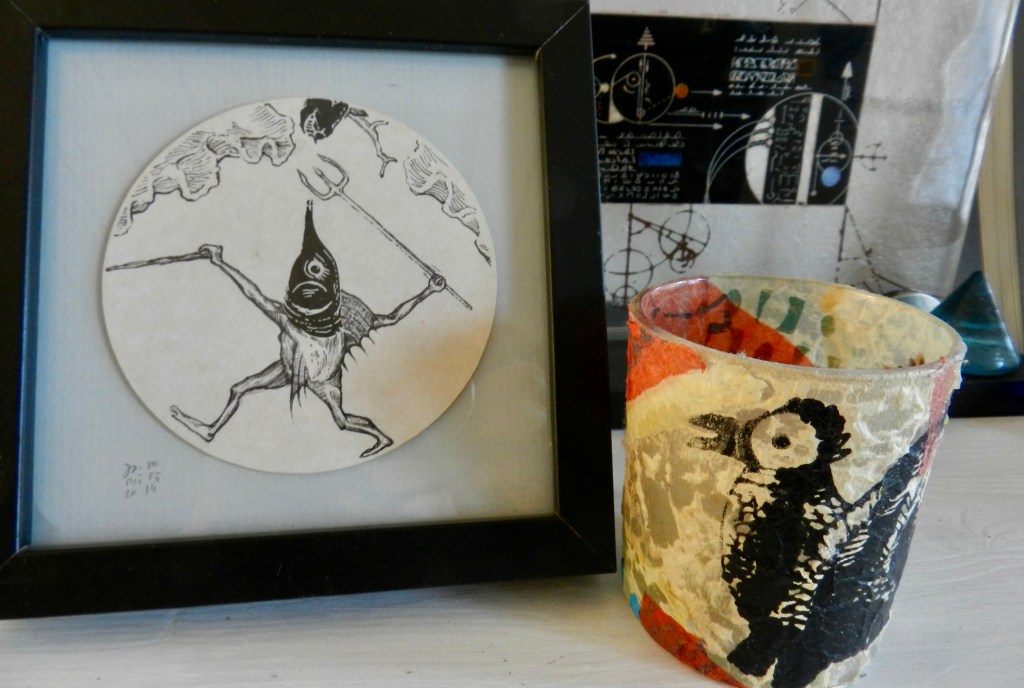
Je passe ensuite à l’Artonef pour un coup d’oeil à l’exposition des petits formats. Marianne est en train de dessiner un ours sur une carte des Pyrénées et nous échangeons des blagues au sujet d’un martyr de Saint Sébastien, revu et corrigé, où le bienheureux et languissant martyr se trouverait transpercé de seringues Pfizer, Moderna, Janssen… et je tombe sur le formidable diablotin ci-haut, par Antonio José Jaenada**, et à tout petit prix. Allez, il est des hasards trop beaux pour les dédaigner, le diablotin rentre avec moi à la maison. Il aura droit, en alternance, à des extraits du Docteur Faustus de Mann et des deux traductions de Boulgakov.
J’ouvre le nouveau-venu au hasard, comme de coutume. Je tombe sur: “…Quelle section a délivré le passeport ? demanda le chat examinant une page. Il n’y eut pas de réponse. – La 412, se répondit le chat, passant la patte sur le passeport qu’il tenait à l’envers. Mais oui, bien sûr ! Je la connais cette section ! Ils donnent des passeports à n’importe qui ! Moi, par exemple, je n’en aurais pas donné à quelqu’un comme vous ! Jamais de la vie je vous en aurais donné un ! J’aurais juste regardé votre figure, à l’instant même j’aurais refusé ! “*
C’est à croire que le chat travaille à la préfecture. Mais je m’égare, comme d’habitude.
(Parmi les premières ‘petites’ différences, je note que la disposition du texte n’est pas la même dans les deux versions. Et alors qu’en français, un personnage se voit servir de la brème avec sa vodka, en anglais, il se retrouve devant de la carpe.***
Détails, me direz-vous. Eh oui, mais demandez à l’Etre Suprême si le diable ne loge pas dans les détails, justement…)
*
Et maintenant, une traduction à terminer pour une compagnie de théâtre dans lequel le terme français de ‘pendrillons’ devient ‘legs’, en anglais.
*Mikhaïl Boulgakov, Le maître et Marguerite, traduit du russe par André Markowicz et Françoise Morvan, inculte/barnum, © éditions inculte/dernière marge, 2020 pour la traduction française.
*
** Antonio José Jaenada, antoniojaenada@gmail.com
*** Mikhail Bulgakov, The Master and Margarita, translated by Diana Burgin and Katherine Tiernan O’Connor, Vintage Books, Random House, March 1996.
*
First, there’s need to know that for a week or so, I’ve been reading a few pages of Thomas Mann’s Doctor Faustus in the evening, in a French translation done by Louise Servicen for Albin Michel in 1950. A few pages because the least you can say about Mann is that the intellect has full pride of place in his work with all its quibbling and complications. As, for example, in the extraordinary “explanation” by the theologian Schleppfuss (his name could be taken to mean drag-footed) for the presence of Evil in the Perfect Being’s creation. You must admit the matter is annoying. Not to worry, Schleppfuss has it all figured out, which is remarkable in itself, because not everyone is able to explain the thought processes of the Perfect One. So, please consider the dilemma for the Perfect One. Perfection means something beyond Being and Non-Being, way beyond such silly details as Good and Evil. Yet, as even the most mediocre of painters will tell you, creation requires contrast, without it there can be no work. Period. And so, the Perfect one has to operate distinctions – matter vs non-matter, day vs night, up vs down, the pickle vs the Brussels sprout, and so on. Schleppfuss’ demonstration is so splendiferously excellent that I read it out loud to myself – I live alone, I don’t disturb anyone. Boy oh boy, so here we are with Evil lurking and even though God is Perfect there’s nothing He can do except tolerate it in this version of creation (He may have resolved the issue in another version, but we are his artist’s proof, so to speak, and that’s when I remember the sentence out of Goethe Bulgakov chose as an epigraph for The Master and Margarita.)
Fine. So on Saturday morning, I go for another vaccination – the pharmacist is as disgusted as I am with political directives more variable than the variants themselves. After which, since I can’t walk by the bookstore without stepping inside and what do I see there on second glance ? Bulgakov in the French translation by André Markowicz and Françoise Morvan. I open it quickly and – yes, there it is the quote from Goethe’s Faust: “-…and so, who are you, after all? – I am part of the power which forever wills evil and forever works good.”
Quick as a wink, wrap this up for me, I’ll have a great time comparing the French translation with the English one done by Diana Burgin and Katherine Tiernan O’Connor. * Yes, to each his own, comparing translations done in these two languages happens to be one of my pleasures.
Then I drop in to Artonef for a look at the exhibition of small formats. Marianne is drawing a bear over a map of the Pyrénées and we kibbitz over a revised version of the painting of Saint Sebastian, the blessed and languishing one, pierced with seringes filled with vaccines of Pfizer, Moderna, Janssen…after which I come across the wonderful little devil by Antonio Jose Jaenada at a very modest price. All right, some coincidences are too lovely to ignore, the little devil comes home with me. He will be entitled to alternating readings out of Mann’s Doctor Faustus and the two translations of Bulgakov.
As is customary, I open the new purchase at random (but what follows is the English translation of what I read, where I also discover than paragraph layout is different in both versions):
“Which department issued this document?” asked the cat, staring at it intently. No answer was forthcoming.
Department 412, replied the cat himself, tracing his paw over the passport, which he held upside down. But, of course! I know that department very well! They give passports to anyone who walks in! But I, on the other hand, wouldn’t give a passport to someone like you! Not on your life! One look at you and I’d refuse on the spot!”
You’d think the cat worked at the prefecture. But I digress, as usual.
(Among the first ‘small’ differences I note, I see the text is not laid out in the same way in the two versions. And while in French, one of the characters is served bream with his vodka, in French he gets a plate of carp.
Details, you might say. But ask the Supreme Being if that isn’t precisely where the devil likes to lurk…)
*
And now, a translation I must finish for a theatre Company in which the French”pendrillons” translates in English as “legs”.)
 iknowiknowiknowblog