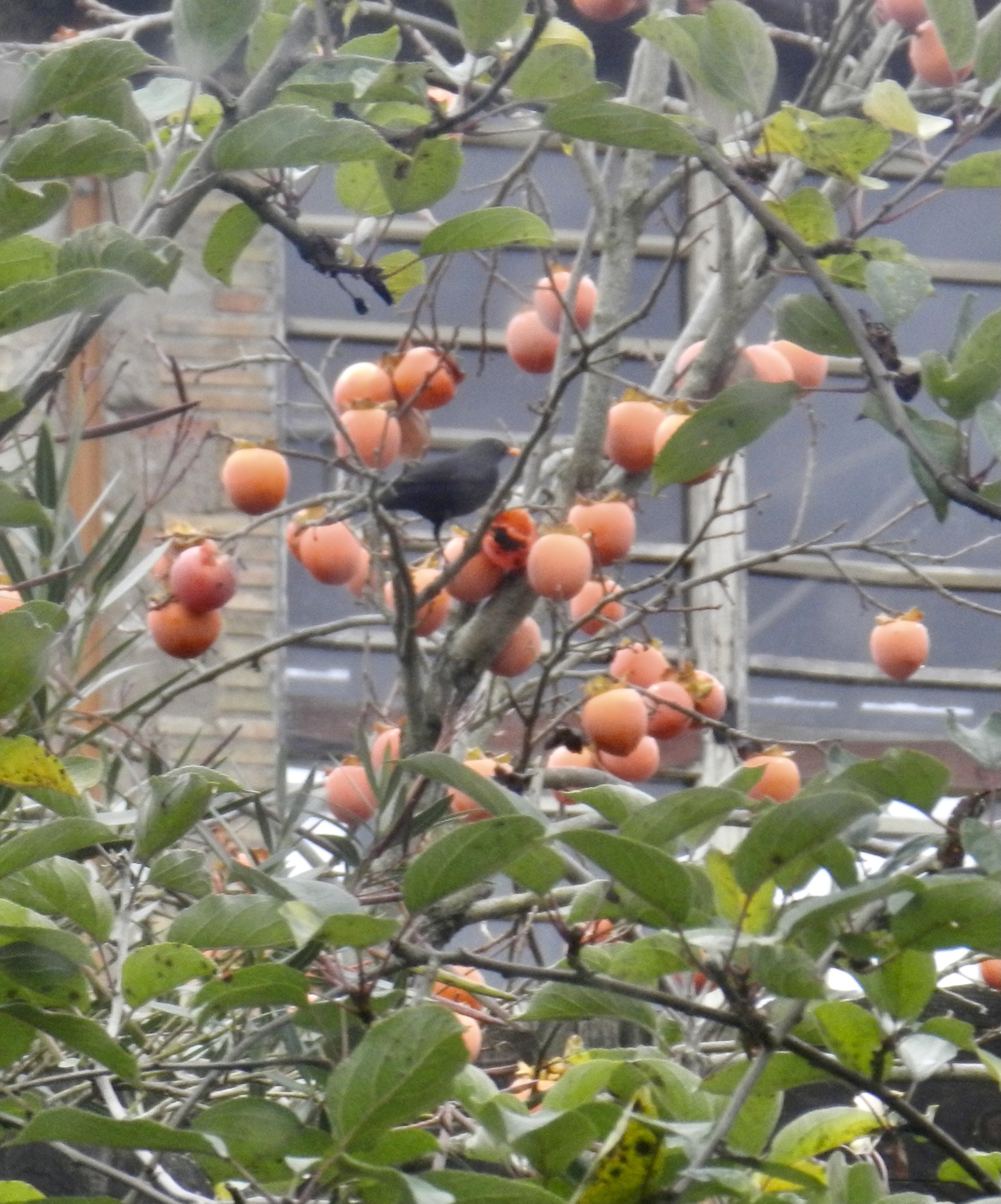
Les merles ont-ils la sensation du goût? Je m’interroge parce que le plaqueminier dans la cour du cirque est couvert de kakis murs et magnifiques mais d’une astringence telle qu’un humain prend une bouchée et dit “je passe”. Alors que les merles piquent dans l’un, piquent dans l’autre et se chamaillent lorsqu’ils sont plusieurs à lorgner le même fruit. Alors, l’effet de l’astringence sur le merle ?
Une étude universitaire devrait résoudre la question.
*
Je viens de passer deux jours, radicalement incapable d’écrire. Comme si ma vie était suspendue à la lettre que j’ai envoyée. Et puis, ce matin au réveil, je me suis demandé quelles pouvaient être les meilleures et les pires réactions à mon courrier. Dans le meilleur des cas : la personne accepterait de renouer une relation, en privé et sans en faire l’objet de tonnes d’annonces. Dans le pire: la personne se déchaînerait sur les réseaux qu’elle fréquente (et moi pas), où les propos injurieux reprendraient avec vigueur.
Je ne sais pas pourquoi, mais le simple fait de me poser les deux extrêmes possibles et de me demander si j’y pouvais quelque chose et – pouf ! – le “suspense” s’est dissous.
Aujourd’hui, je crois que je vais transcrire “Les mémoires de Strelka” depuis leur état manuscrit.
*
Extrait de The Dawn of Everything (L’aube de tout) par David Graeber et David Wengrow :
“Nous, les humains contemporains, avons tendance à exagérer nos différences. Les résultats de telles exagérations sont souvent catastrophiques. Entre la guerre, l’esclavage, l’impérialisme, et la simple oppression quotidienne du racisme, les siècles récents ont vu tellement de souffrance humaine justifiée par des différences mineures dans l’apparence qu’on en oublie facilement à quel point ces différences sont vraiment minimes… Les ancêtres humains n’étaient pas seulement différents les uns des autres; ils co-existaient de plus avec des espèces plus proches du singe et à cerveau plus restreint tel Homo naledi. Comment se comportaient ces sociétés ancestrales ? A cette étape-ci, l’honnêteté exige que nous admettions, pour une large part, ne pas en avoir la moindre idée… La seule chose que nous puissions dire avec quelque certitude, sans doute, c’est qu’en terme d’origine, nous sommes tous africains.” *
*
J’en suis à la page 92, et j’ai hâte de lire la section avec l’intitulé suivant: DANS LEQUEL NOUS NOUS DÉBARRASSONS DE SUPPOSITIONS SUBSISTANT SELON LESQUELLES LES ‘PRIMITIFS’ ÉTAIENT D’UNE CERTAINE FAÇON INCAPABLES DE RÉFLEXION CONSCIENTE, ET ATTIRONS L’ATTENTION SUR L’IMPORTANCE HISTORIQUE DE L’EXCENTRICITÉ.”
Ah oui. Je veux bien qu’on parle d’excentricité.
*David Graeber and David Wengrow, The Dawn of Everything, Farrar, Straus and Giroux, New York 2021
*
Et voici une courte biographie de Strelka (mais dans ses mémoires, elle nous informe que les humains ne racontent pas les choses exactement comme elles se sont passées):
Courte biographie : née par -40°C dans une allée derrière le Bolchoï une nuit de février à Moscou, la plus vigoureuse des 9 chiots (dont 6 survivants), Strelka fut choisie pour sa taille – moins de 35 cm – et son poids – moins de 6 kg – pour être désignée comme habitante d’un vol spatial soviétique (Spoutnik 5) en 1960. Ce vol fut le premier habité après le décès de la chienne Laïka à bord du Spoutnik 2 en 1957.
Accompagnée de la chienne Belka, d’un lapin gris, de 40 souris, de 2 rats et d’un certain nombre de mouches, de plantes et de champignons, le vol orbital fut ainsi le premier à ramener ses occupants vivants.
Belka et Sttrelka connurent alors la célébrité et l’une des filles de Belka fut offerte en cadeau au président des Etats-Unis, John F. Kennedy. On ne connait aucune descendance à Strelka qui connut une fin de vie tranquille au chenil d’Etat. Son corps naturalisé trône aujourd’hui’hui avec celui de Belka au musée des Conquérants de l’Espace.
La biographie officielle ne dit rien au sujet du sort du lapin gris. Mais Strelka le sait, elle.
*
Do blackbirds have a sense of taste? I wonder because the kaki in the yard at the circus is covered with ripe and magnificent fruit so astringent that a human takes one bite and says “pass”. While blackbirds peck a one fruit, peck at another and get into a tussle when several of them aim for the same fruit So, the effect of astringence on the blackbird ?
A university study should resolve the matter.
*
For the past two days, I’ve been totally blocked as a writer. As if my life was hanging suspended on the letter I sent. And then, this morning, when awaking, I asked myself what might be the best and the worst I could expect as reactions to my letter.
In the best of cases: the person will accept to re-establish a communication, at the private level, without making a public show of it.
In the worst: the person will rant on those social networks I don’t frequent, where insulting words will fly with renewed vigour.
I don’t know why but the simple fact of establishing the two extreme possibilities and the fact I can’t do a thing about the outcome – poof! – went the “suspense” as it dissolved.
Today, I think I’ll transcribe “The Memoirs of Strelka” from their handwritten form.
*
Excerpt from The Dawn of Everything by David Graeber and David Wengrow:
“We modern-day humans tend to exaggerate our differences. The results of such exaggeration are often catastrophic. Between war, slavery, imperialism and sheer day-to-day racist oppression, the last several centuries have seen so much human suffering justified by minor differences in human appearance that we can easily forget just how minor these differences really are...Ancestral humans were not only quite different from each other; they also coexisted with smaller-brained, more ape-like species such as Homo naledi. What were these ancestral societies like? At this point, at least, we should be honest and admit that, for the most part, we don’t have the slightest idea… Perhaps the only thing we can say with real certainty is that, in terms of ancestry, we are all Africans.” *
*
I’m at page 92 and looking forward to reading what follows on this heading:
IN WHICH WE DISPOSE OF LINGERING ASSUMPTIONS THAT ‘PRIMITIVE’ FOLK WERE SOMEHOW INCAPABLE OF CONSCIOUS REFLECTION, AND DRAW ATTENTION TO THE HISTORICAL IMPORTANCE OF ECCENTRICITY.
Ah yes. I’m all for talking about eccentricity.
David Graeber and David Wengrow, The Dawn of Everything, Farrar Straus and Giroux, New York 2021
*
And here is a brief biography of Strelka (although in her memoirs, she specifies that humans don’t tell it as it really was):
Brief biography : born by -40°C in an alley behind the Bolshoi one February night in Moscow, the hardiest of 9 puppies (of which 6 survived), Strelka was chosen because of her height – less than 35 cm – and her weight – less than 6 kg – to be one of the inhabitants of a Soviet space flight (Sputnik 5) in 1960. This flight was the first inhabited one following the death of the dog Laïka aboard Sputnik 2 in 1957.
Along with the dog Belka, a grey rabbit, 40 mice, 2 rats and a certain number of flies, plants and mushrooms, the orbital flight was thus the first to bring back its occupants alive.
Belka and Sttrelka then became famous and one of Belka’s daughters was offered as a gift to the President of the United States,John F. Kennedy. Strelka has no known descendants and ended her life quietly in a State dog kennel. Her embalmed body is now featured in the Space Conquerors’ Museum, along with Belka’s.
The official biography says nothing about the grey rabbit’s fate. But Strelka knows.
 iknowiknowiknowblog