Donc: petit a par petit b par petit d, en français il faut :
a – identifier parmi les 1 020 éditeurs répertoriés, ceux que son écriture pourrait, éventuellement, intéresser. C’est un peu comme d’éplucher les offres d’emplois pour éliminer les non-conformes aux attentes ou aux compétences, pour ensuite
b – étudier le catalogue des auteurs publiés chez un éditeur potentiellement ouvert à ses élucubrations personnelles et
c – en appliquant à la lettre ses désidérata concernant l’envoi du manuscrit ou d’un résumé,
d -écrire sa lettre de présentation, faire l’envoi, attendre, et recommencer jusqu’à épuisement de la liste ou de l’auteur, c’est selon.
En sachant que, dans le meilleur des cas, un ou deux parmi les milliers de manuscrits ainsi lancés là où Minerve souffle, Apollon vous conduit et les autres dieux de l’Olympe ont la tête ailleurs, trouvera grâce aux yeux du comité de lecture et résultera en un contrat en bonne et due forme.
Et voilà pour le secteur français.
Puis, vérifier la typographie et les espacements sur ses textes en anglais pour ensuite
a – consulter le répertoire des agents littéraires qui officient à titre de garde-barrières qui démarcheront le texte de l’heureux élu chez les éditeurs en répétant les b, c, et d vers les garde-barrières ayant chacun leurs propres désidérata, question lettre de présentation + synopsis (1 500 mots ? 500 seulement ? accompagné des 10 premières pages ? oui ? non ?) et cetera.
Et heureux qui comme Ulysse arrivera à bon port (mais, nous l’espérons, sans avoir à massacrer des hordes d’autres prétendants) – le bon port dans ce cas-ci étant la maison d’édition ou l’agence littéraire où l’on ressent quelques atomes crochus avec son propre univers.
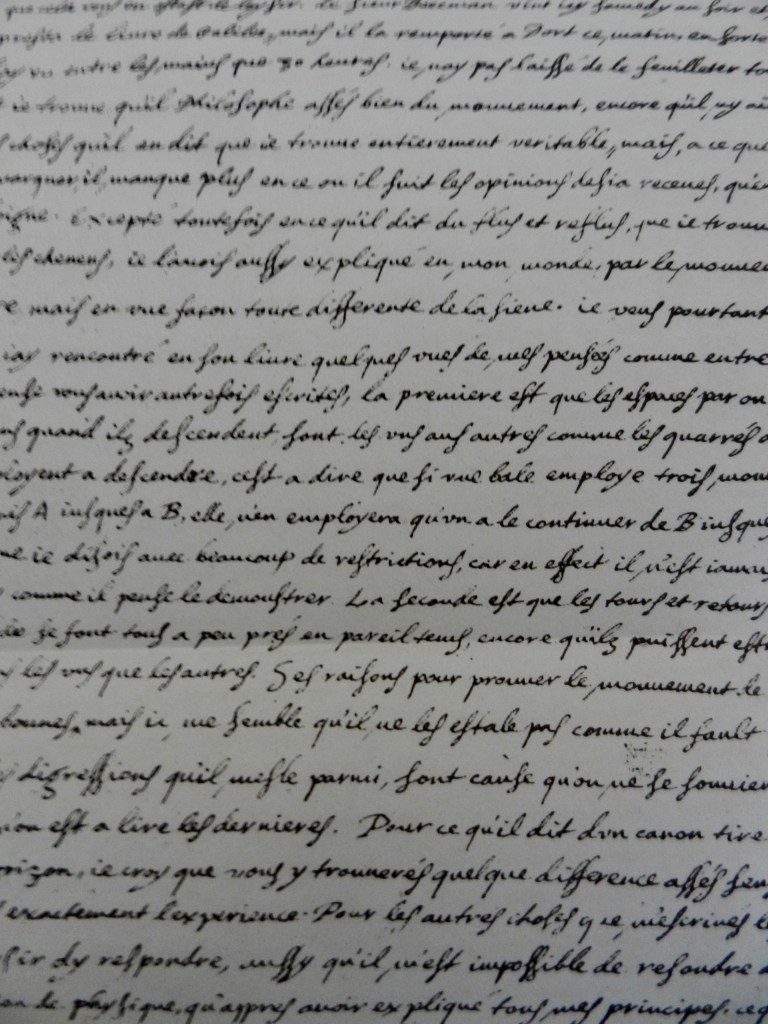
(Illustration : lettre de Descartes en 1634, alors que la typographie et les codes stylistiques n’étaient pas tout à fait les mêmes qu’aujourd’hui.)
*
When writing, I have anything but a Cartesian mind-set. And yet, when prospecting in the field of publishers, one must be me-tho-di-cal. One must even be both mé-tho-di-que and me-tho-di-cal, for learn, o laymen, that one does not apply the same methods of prospection nor the same typographical codes, depending on whether the manuscript is for the French or for the English market.
So, from small a to small d, for the French market, you must:
a – identify, among the 1 020 listed editors those who might eventually be interested in your writing. This is a bit like running through job offers to eliminate those you don’t want or for which you are unsuited, to then
b – study the catalogue of authors published by this editor potentially open to your personal mental wanderings and
c – following his or her instructions to a T, write a presentation letter, send your manuscript, wait, and repeat until you’ve exhausted the list or the writer, whichever comes first.
And this, knowing that in the best of cases, one or two out of the thousands of manuscripts thus launched where Minerva blows, Apollo leads, and the other gods on Olympus have their minds on other things, will find favor with the reading committee and lead to an honest-to-goodness binding contract.
So much for the French market.
Then, check your typography and your spacings again for your English manuscripts in order to
a – consult the listings of literary agents who officiate as the gate-keepers who will peddle your material to publishers, repeating the same b, c and d in their direction, each gate-keeper having his or her specific requirements for a cover letter + a synopsis (1 500 or 500 words ? along with the first 10 pages? Yes? No?) etc.
And as happy as Ulysses is the one who (without having to kill off hords of other pretenders, one hopes) reaches the right harbor, which is to say the publishing house or the literary agency where some common atoms flow with those of your own universe.
(Illustration : a letter by Descartes in 1634 – a period when typography and stylistic codes weren’t quite the same as they are now.)
 iknowiknowiknowblog