c’est curieux: lorsque je réside dans un pays dans lequel la vie quotidienne se déroule en anglais, j’ai tendance à écrire mes fictions en français; et vice-versa. La seule explication que j’y trouve étant la suivante: une certaine distance s’installe entre le réel et l’imaginaire, distance dans laquelle l’imaginaire a toute liberté pour s’exprimer. Evidemment, ça ne simplifie en rien une approche des marchands du livre dans le pays de résidence – chose dont je ne me suis pas préoccupée depuis plusieurs années déjà. On me dira sans que j’en disconvienne qu’un récit se déroulant entre citoyens français en douce France mais dans lequel tout le monde s’exprime en anglais, ça manque…d’évidence immédiate. C’est vrai. Mais je ne choisis pas la langue dans laquelle les mots des personnages me viennent à l’esprit – quitte à les traduire ensuite dans mon “autre” langue maternelle, si le récit est plus court que long et que la traduction n’empiète pas trop sur du temps que je pourrais consacrer à l’écriture d’un autre récit.
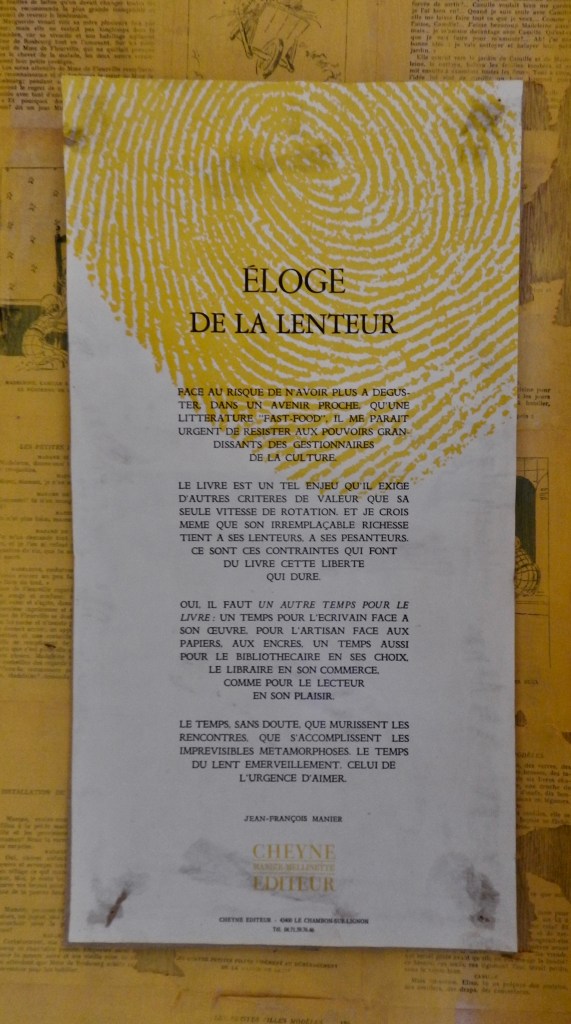
L’affiche ci-dessus est un peu maculée par ses nombreux déménagements. Elle m’accompagne depuis plusieurs années – rappel de certaines vérités fondamentales, et rappel aussi qu’il existe (encore ?) des maisons d’édition qui doivent se préoccuper de rentabilité comme les autres, bien sûr, mais où le livre n’est pas comme l’une de ses laitues primeur qu’on jette lorsqu’elle se flétrit.
*
L’un des personnages qui m’occupe ces jours-ci a l’habitude de relire chaque année le livre qui a marqué sa jeunesse au sceau de l’indépendance: Moby Dick par Herman Melville. Du coup, je replonge dedans moi aussi, ne serait-ce que pour le lire de son point de vue à lui, et comprendre ce qui fait la valeur particulière de ce roman à ses yeux.
Et, comme le commentait quelqu’un à qui je racontais les goûts littéraires du personnage en question : “c’est aussi une façon de savoir quels sont les livres qui résistent à l’usure du temps.”
Très juste.
*
odd: when I live in a country in which daily life occurs in English, I tend to write my fictional things in French; and vice-versa. The only explanation I can find to this being the following: this allows a certain distance between reality and the imaginary, a distance in which the imaginary has full freedom of expression. Of course, this does not simplfy approaches to book merchants in the country of residence. And I will not disagree with anyone saying that a story taking place between French-speaking people in which everyone speaks in English, is not in the realm of the immediately obvious. True enough. But I don’t choose the language in which the characters’ words come to mind – even if this involves translating them later into my “other” maternal language, when the story is short enough and when the translation doesn’t take up too much of the time I could be devoting to writing another story.
The poster shown above has become soiled during multiple moves. It has been with me for many years – a reminder of certain fundamental truths about writing and publishing, and as a reminder that there (still?) exist publishing houses who must concern themselves with solvency like all the others, of course, but where a book is not treated like one of those early lettuces thrown out as soon as it wilts.
*
One of the characters holding my attention these days proceeds every year to reading through the book that sealed his personal flight to independence: Herman Melville’s Moby Dick. This means I must also plunge into it again, if only to read it from his point of view and find what it is that gives special value to this book, in his eyes.
And, as someone commented to whom I was mentioning the literary tastes of the character in question: “It is also a way of finding out which books withstand the passing of time.”
Quite so.
 iknowiknowiknowblog