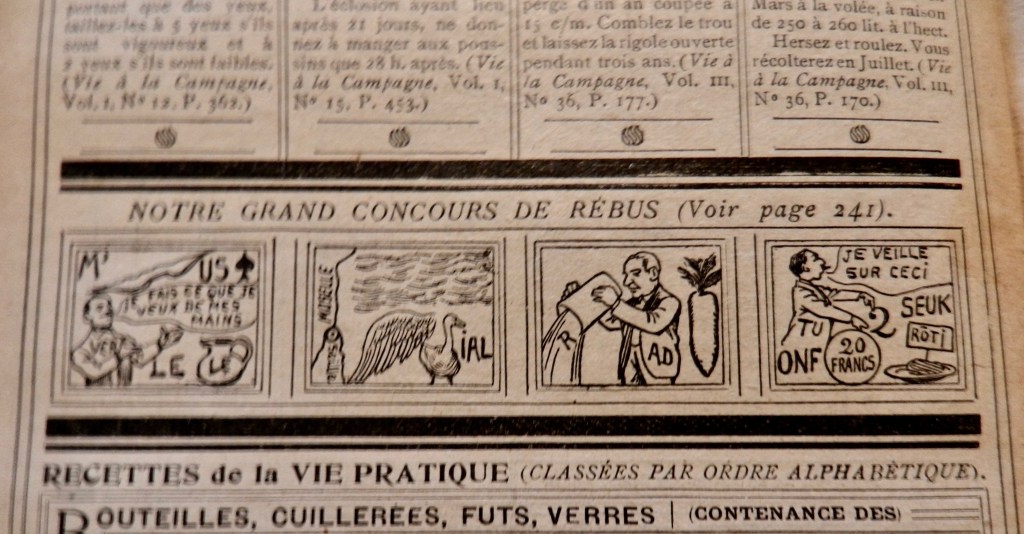
L’autre soir sur Arte, depuis mon ordi, j’ai regardé une émission sur les origines de l’écriture où l’on affirmait que celle-ci avait débuté avec des hiéroglyphes, comme ceux utilisés par les égyptiens. Les divers alphabets basés sur des sons auraient suivi. Je n’ai aucun moyen de savoir si tel est bien le cas. Je me souviens que les rébus faisaient partie des jeux courants dans mon enfance et je ne m’étais jamais posé la question de leurs origines.
Le seul lien avec mes pensées immédiates étant dû au fait que je relisais Le timbre égyptien de Mandelstam hier soir. Et que l’Egype apparaît en tant que destination réelle ou imaginée dans une histoire que j’écris en ce moment.
Un fouillis ? Eh oui, et c’est comme ça que l’écriture procède chez moi.
À cette étape, relire Le timbre égyptien est tout à fait compréhensible, justement parce que le récit de Mandelstam n’a rien à voir avec un exposé A vers B vers C ni avec un timbre égyptien, d’ailleurs. Après trop d’heures gaspillées à rendre fonctionnels des appareils électroniques supposés nous épargner du temps, il est doux de lire: « Il téléphonait de la pharmacie, il téléphonait au poste de police, il téléphonait au gouvernement, à l’Etat qui était disparu, qui s’était endormi comme une carpe.
Il aurait pu avec autant de succès téléphoner à Proserpine ou Perséphone chez lesquelles le téléphone n’a pas encore été installé. » *
Ou alors, en anglais dans le Finnegans Wake de James Joyce: “During our brief apsence from this furtive feugtig season adhere to as many as probable of the ten commandments touching purgations and indulgences and in the long run they will prove your better guidance along your path of right of way.”**
Ça désencrasse les écoutilles internes, pour ainsi dire.
Le rapport avec le rebus ? À première vue, aucun. Mais qui peut dire ce qui se trouve derrière le prochain tournant dans la route ?
*Ossip Mandelstam, Le timbre égyptien, Le bruit du temps, 2009
**James Joyce Finnegans Wake, faber and faber 1975
*
The other night on Arte, I watched on my computer a program on the origins of writing in which it was said it had begun with hieroglyphics, like those used by the Egyptians. Various alphabets based on sounds would have followed. I have no way of knowing if this was truly the case. I recall rebus as being one of the common games in my childhood and had never wondered about their origin.
The only connection with current thoughts being the fact I was re-reading Mandelstam’s The Egyptian Stamp last night. And that Egypt appears as a real or imaginary destination in the story I’m writing at the moment.
A muddle? Absolutely, and that is how writing proceeds for me.
At this point, re-reading The Egyptian Stamp is perfectly understandable, precisely because Mandelstam’s narrative has nothing to do with an A then B then C type of iteration, nor anything to do with Egyptian stamps, for that matter. After wasting too many hours on attempts to render time-saving electronic devices functional, it is soothing to read words such as: “He was calling from the pharmacy, he was calling the police station, he was calling the government, the State that had disappeared, that had fallen asleep like a carp.
He could just as successfully have called Proserpina or Persephone where the phone hasn’t been installed yet.”
Or in English, in James Joyce’s Finnegans Wake: “During our brief apsence from this furtive feugtig season adhere to as many as probable of the ten commandments touching purgations and indulgences and in the long run they will prove your better guidance along your path of right of way.”
This clears out the inner hatchways, so to speak.
What does this have to do with rebus? At first glance, nothing I can make out. But who’s to say what’s behind the next bend in the road?
 iknowiknowiknowblog