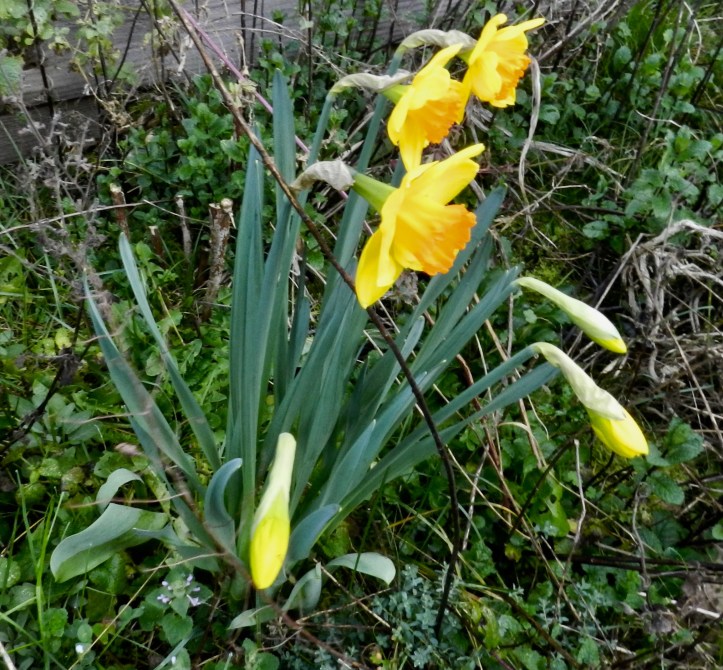
Jusqu’ici, l’hiver a été beaucoup trop doux. Résultat: le mimosa local fleurit comme si nous étions en Provence, les pruniers sauvages sont en fleurs et les jonquilles dans mon jardin s’imaginent annoncer le printemps. Ce que tout ça va donner plus tard dans la saison, on est en droit de s’interroger.
Mais, pour moi, le plus clair de cette journée printanière a été consacré à un extrait de La Tempête de Shakespeare, après être tombée sur une traduction française minable du magnifique “full fathom five thy father lies..” Tellement minable que j’ai tenté en vain d’en rendre quelque chose de la beauté, totalement détruite dans une traduction publiée qui se lit comme un rapport dans lequel le plus important du mot anglais “fathom” semble être d’apprendre aux français que c’est une mesure maritime de profondeur. Toute la beauté de ce vers disparaît, ainsi que le mystère de cette transformation dans les abysses insondables où le père mort se transmue en perles, en corail et en “toutes choses riches et étranges”.
Je ne suis pas parvenue à l’améliorer suffisamment alors que garde mes tentatives pour moi. Peut-être y a-il des beautés de langage qui sont intraduisibles.
full fathom five thy father lies
Of his bones are coral made:
Those are pearls that were his eyes.
Nothing of him that doth fade,
But doth suffer a sea-change
Into something rich and strange…
Shakespeare, The Tempest, I, 2,400
.
*
Thus far, the winter has been much too mild. As a result, the local mimosa is in bloom, the wild plum trees have blossomed and the daffodils in my back yard imagine they are announcing spring. What all this will add up to later is a valid question.
But foe me, the best part of this springlike day was spent on an excerpt from Shakespeare’s The Tempest, after I came across a terribly lousy translation in French of the magnificent “full fathom five thy father lies.” So lousy that I treid in vain to capture something of its beauty, totally destroyed in a published translation that reads like a report in which the greatest importance of the English word “fathom” seems to be the need to inform a French speaker that this is a maritime measure for the sounding of the depths. The entire beauty of the verse disappears, along with the mystery of this transformation in the fathomless depths where the dead father is transmuted into pearls and coral and all things “rich and strange.”
I was unable to improve it sufficiently so I’ll keep my attempts to myself. Perhaps there are beauties in language that are untranslatable.
full fathom five thy father lies
Of his bones are coral made:
Those are pearls that were his eyes.
Nothing of him that doth fade,
But doth suffer a sea-change
Into something rich and strange…
Shakespeare, The Tempest, I, 2,400
 iknowiknowiknowblog