musical
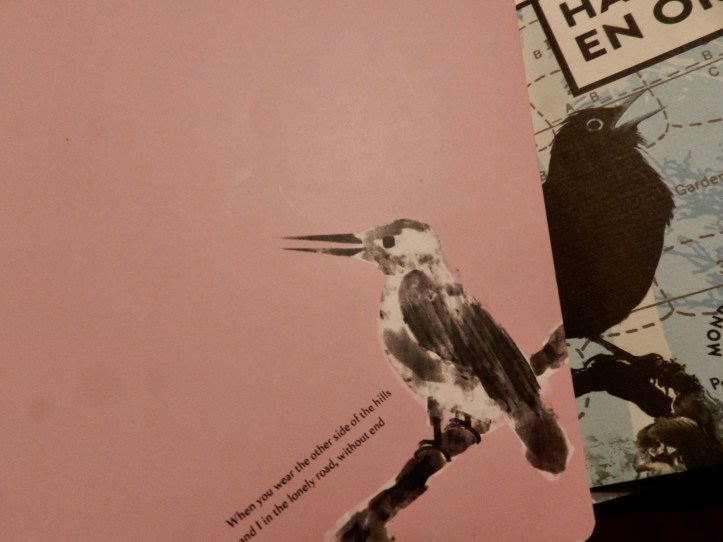
J’ai presque terminé le cahier dans lequel je note des réflexions personnelles, des phrases entendues ou des éléments fictifs. Alors, j’en ai sorti un autre, offert par une amie. Elle a dû l’acheter dans l’un des commerces locaux qui se spécialisent dans le “pas cher”. Le cahier vient de Chine. Il est illustré d’un oiseau (voir ci-haut). J’aime bien les oiseaux. Il comporte aussi une phrase des plus énigmatiques: “When you wear the other side of the hills and I in the lonely road, without end” On se trouve là dans le très lourd et le complètement loufoque aussi. Car je suppose que le traducteur-traductrice en Chine voulait écrire quelque chose dans le genre de “while you bear your load on the far side of the hills, I am here alone on the endless road“. Pensée bien triste, en effet.
Mais voilà. En anglais, “to wear” veut dire porter un vêtement. Porter une charge, c’est “to bear”. Alors, porter (to wear) les collines, que ce soit à l’endroit ou à l’envers, ça doit peser, en effet.
D’une façon ou d’une autre, la question se pose: le chant de l’oiseau traverse-t-il les collines et les espaces au-delà de celles-ci ?
Si oui, déjà, les perspectives sont un peu moins désolantes…
*
A force de parler d’oiseaux et d’oreille absolue, je me réveille d’un rêve dans lequel un enfant chantait d’une façon merveilleuse, et en me disant qu’un oisillon qui n’aurait pas l’oreille absolue se tirerait fort mal d’affaire dans la vie. Pas question pour lui, de gagner sa vie en chantant faux !
Ce qui m’a donné le goût d’y voir de plus près concernant cette fameuse théorie de Steven Mithen concernant le proto-langage des Néanderthals dans lequel l’oreille absolue aurait été aussi nécessaire qu’elle ne l’est aux oiseaux. Théorie, tout au plus, mais qui intrigue suffisamment pour commander son livre.*
Une question encore plus intrigante, en ce qui concerne la musique et le langage, que la fameuse question à savoir ce qui vint d’abord, l’oeuf ou la poule.
Et comme un oiseau des plus mystérieux s’est introduit dans une des nouvelles que j’écris en ce moment…
*Steven Mithen, The singing Neanderthals, Harvard University Press, 2007
musical
I’ve almost finished the notebook in which I jot down random thoughts, things overheard or bits useful for fiction. So I pulled out another one, offered by a friend. She must have bought it at one of the many local discount stores. The notebook was printed in China. The cover shows a bird (see above). I like birds. It also carries an enigmatic sentence: “When you wear the other side of the hills and I in the lonely road, without end.” It all sounds pretty heavy and ridiculous at the same time. I suppose the Chinese translator meant to write something like “while you bear your load on the far side of the hills, I am here alone on the endless road“. Which is heavy enough, I suppose, but nothing like carrying a couple of hills on your shoulders, I bet.
Either way, I ask myself: does the bird song carry over the hills and beyond? If so, the outlook are a bit less distressing already…
*
After all this talk about birds and absolute pitch, I wake from a dream in which a child was singing in a marvelous way, and thinking that a young bird without absolute pitch would have a hard time of it. No question of making a living singing off-key for him!
Which led me to wanting a closer look at Steven Mithen’s famous theory about the Neanderthals having a proto-langage in which absolute pitch was as essential as it is to birds. A theory, and nothing more, but sufficiently intriguing to order his book.*
An even more intriguing one, as relates to music and language, than the famous question of what came first, the chicken or the egg.
And as a most mysterious bird has worked his way into a short story I’m working on these days…
*Steven Mithen, The singing Neanderthals, Harvard University Press, 2007
 iknowiknowiknowblog