Emotion –
Le pouvoir émotionnel des mots. Ou, comme le disait un chroniqueur du New York Time ce matin: “Trump n’utilise jamais les mots pour leur sens littéral, mais pour leur capacité à produire une désorientation émotionnelle.”
Ça n’est pas seulement le cas de Trump. Ecoutez les insultes et les railleries dans un préau et observez à quelle vitesse elles sont remplacées par des coups lorsque le climat devient suffisamment échauffé, et vous verrez le pouvoir émotionnel des mots à l’oeuvre.
Le ravissement que ressentent ses supporteurs à ses explosions verbales sont en lien direct avec ce niveau chez chacun d’entre nous – tout comme le sentiment d’outrage qu’éprouvent ses opposants au même moment. Et lorsque ses supporteurs disent “ils parlent en notre nom à tous” ou “il dit ce que je pense“, c’est justement de cela qu’il s’agit. La personne en question n’a pas la visibilité, le pouvoir ou le vocabulaire requis pour s’en prendre à tout et à tous ceux qu’elle considère responsable de ses malheurs? Trump est là pour faire le travail en son nom.
Je serais étonnée d’apprendre que nous fûmes nombreux en France à passer plus de sept heures à visionner la deuxième journée des audiences sur “l’impeachment”. Je n’ai pas l’intention d’y passer mes journées mais je voulais me faire une idée des différents intervenants, de leurs arguments et du niveau d’écoute qu’ils ciblaient auprès du public.
Le pouvoir émotionnel des mots y était pleinement exposé, tant par ceux et celles qui savent utiliser le langage et par les autres. La palette émotionnelle s’étendait de la crétinerie la plus plate au contrôle affectif le plus admirable avec beaucoup de niveaux intermédiaires entre ces deux extrêmes. Et, tout comme avec un joueur de trompette, par exemple, l’interprétation pouvait aller d’un bruit criard jusqu’au contrôle exquis d’un Wynton Marsalis et confrères.
Que dire. Je préfère Winton et confrères.
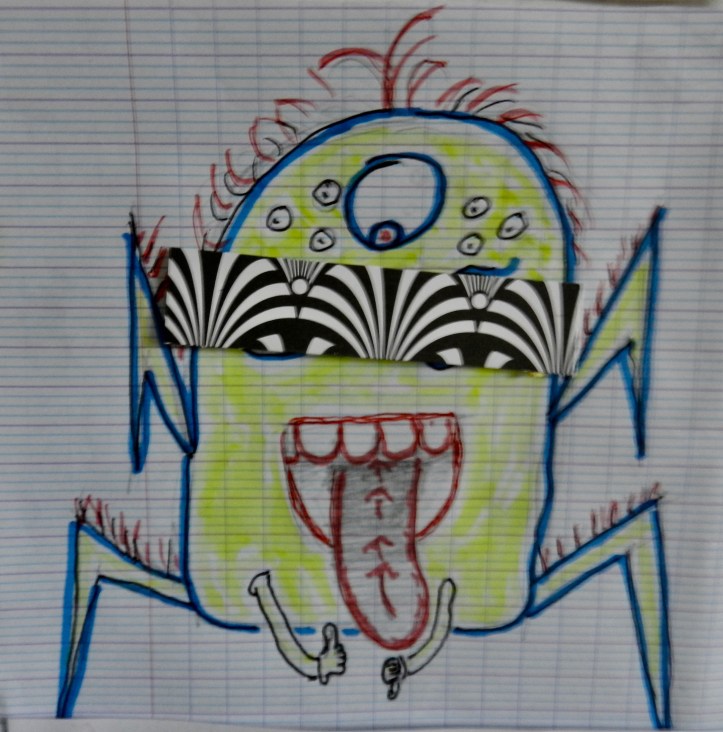
Illustration: dessin récupéré dans le cahier non complété d’un écolier (j’utilise les pages inemployées en papier brouillon ou pour la fabrication de carnets en papier recyclé).
*
The emotional power of words. Or, as one of the op ed people wrote this morning in The New York Times: “Trump never uses words for their literal meaning but for their disorienting emotional impact.”
It’s not only Trump. Listen to the insults and the jeers exchanged in a school playground and watch how quickly they give way to physical scuffles once the mood is sufficiently charged up, and you see the emotional power of words at work.
The delight his followers experience in Trump’s verbal outbursts links straight back to that level in all of us – as does the outrage his opponents experience at the same moment. And when his followers say “he speaks for all of us” or “he says what I think“, this is precisely what they are referring to. The person may not have the visibility, the power or the vocabulary to trash every thing and individual he or she considers responsible for their troubles? There’s Trump doing the job for them.
I would be surprised to learn many other people in France spent over seven hours of their time viewing the second day of the impeachment hearings. I don’t intend to spend my days in this manner but I did want to get a solid view on the various players, on their arguments, and on the listening level they were targeting in the audience.
The emotional power of words was on full display, both by the ones who know how to use language, and by those who don’t. The emotional range covered a spectrum from moronic to admirable, with many, many stops between those two poles. And, just as is the case with a trumpet player, for instance, the performance can range from jarring, ear-splitting noise to exquisitely controlled playing such as that of Wynton Marsalis and companions.
What can I say. I prefer Wynton and colleagues.
Illustration: recovered in an unfinished school notebook (I use the blank pages either for note taking or in notebooks made from recycled paper).
 iknowiknowiknowblog