Pause –
Je ne crois pas que la plupart des américains se rendent compte que Trump n’est qu’un symptôme et non pas la maladie en elle-même.
*
Comme bien d’autres langues, le français fait des distinctions de genre. Les humains et les objets sont désignés par un “il” ou un “elle”. Il n’existe pas d”équivalent au “it” neutre en anglais.
Et donc, dans la plus récente grande embrouille “découverte” – ah, seigneur, nous faisons de la discrimination contre les femmes ! – un vaste mouvement se met en branle pour corriger cette injustice. Comment? En changeant les mots, bien sûr: la féminisation des descriptions de tâche. C’est beaucoup plus économique que l’instauration d’une échelle de salaire unique qui s’appliquerait indifféremment aus hommes comme aux femmes remplissant les mêmes tâches.
Moi, par exemple, j’ai le choix. Au lieu de me décrire avec le bon vieux “écrivain” (il s’agit d’une fonction, celle que je remplis), je pourrais me décrire comme écrivaine, auteure ou le tout dernier et très laid autrice que j’ai découvert sur un marque page à la librairie locale, mot qui décrivait une pauvre praticienne de l’écriture.
Je ne suis rien de tel. Je suis écrivain. Non par envie du pénis, simplement parce que le français est une langue de genres et que la fonction a reçu le genre masculin. Je n’ai cure de savoir qui tient la plume ou tape les mots sur un écran, écrire, c’est écrire. Tout comme les personnes qui pratiquent la médecine sont des docteurs (médecin, docteur). Si votre médecin s’adonne à être une femme, êtes-vous supposés la saluer en disant “bonjour, doctrice” ? Sa compétence n’a rien à voir avec son genre. Si le mot a commencé sa carrière au masculin ou au féminin, ainsi soit-il, je n’étais pas présente au baptême.
*
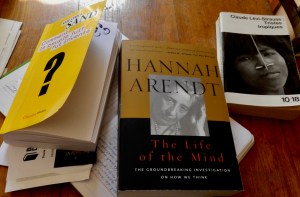
“It was this absence of thinking – which is so ordinary an experience in our every life, where we have hardly the time, let alone the inclination, to stop and think – that awakened my interest.” (C’était cette absence de réflexion qui suscita mon intérêt – une expérience tellement ordinaire dans notre vie quotidienne où nous avons à peine le temps, sans parler du désir, de nous arrêter et de réfléchir.’) Hannah Arendt écrivit ces mots dans son introduction à The Life of the Mind. Elle les écrivit quelque part à la fin des années soixante ou au début des années soixante-dix.
Prenez les mêmes, ajoutez les technologies actuelles qui éliminent le temps de réflexion comme un obstacle inutile au coup de tête qui dit clique et achète ces chaussures maintenant !, et observez les résultats.
*
Quant aux commentaires de Lévi-Strauss au sujet des voyages et des voyageurs – écrits dans les années cinquante…ça sera pour demain.
Pause –
I don’t think most Americans realize that Trump is only a symptom, not the disease itself.
*
Like many other languages, French is gendered. People and things are assigned a “he” or a “she”. There is no such thing as “it”.
So in the latest kafuffle over the “discovery” – oh my lord, we discriminate against women! – there is a big movement afoot to correct this injustice. How? Through changes in the words, of course. The feminization of job descriptions. This is a lot cheaper than creating a single salary scale applicable to both men and women performing the same tasks.
I, for instance, have a choice. Instead of calling myself a good old “écrivain” meaning “writer” (which is a function and what I do) I could describe myself as an écrivaine,an auteure or the latest and very ugly autrice which I discovered on a page marker at the local bookstore where some poor soul was thus described.
I am none of these. I am an écrivain. Not through penis envy, simply because French being a gendered language, the function has been given a masculine gender. I don’t care who is holding the pen or typing out the words on a screen, writing is writing. Just as people who practice medecine are doctors (médecin, docteur). If your doctor happens to be a woman, are you supposed to say “bonjour, doctrice” ? His or her competence has nothing to do with gender. If the word started off as masculine or feminine, amen and so be it. I wasn’t there for the christening.
*
“It was this absence of thinking – which is so ordinary an experience in our every life, where we have hardly the time, let alone the inclination, to stop and think – that awakened my interest.”Hannah Arendt wrote these words in her Introduction to The Life of the Mind*. She wrote them at some point in the late sixties or early seventies.
Take same, add current technologies that eliminate thinking time as a useless impediment to that impulse to click and buy those shoes now!, and watch the results.
* Hannah Arendt, The Life of the Mind, Harcourt, 1978
*
As for Levi-Strauss’ words on travelling and travelers, written in the fifties…those will be for tomorrow.
 iknowiknowiknowblog