Et puis, il y a …
Et puis, il y a autre chose que les informations. Il y a la poésie, le théâtre, le chant, les romans, les petits comme les grands.
Il y a les documentaires aussi. Comme 8, avenue Lénine, heureuse comme une Rom en France. Que je n’ai pas vu encore, mais dont le propos me semble particulièrement juste, à lire ce qu’on en dit sur le blog de Juliette Keating:
“Le grand intérêt de ce documentaire est de montrer par l’exemple que la volonté politique d’un élu de terrain, soutenu par un groupe actif de voisins et d’amis, peut en moins de dix ans, faire passer une famille d’une situation de détresse économique et sociale et d’exclusion à la vie « comme tout le monde ». Cette sacro-sainte « intégration » dont on nous rebat les oreilles, surtout pour reprocher aux familles roms pauvres de la refuser et ainsi justifier leur mise au ban, elle est donc, évidemment, possible à cette condition qu’elle soit voulue par ceux et celles qui en détiennent la clé. L’aide ici, est locale, très individualisée et la solidarité est particulièrement efficace car nul n’a rien à gagner à maintenir la famille dans la misère, bien au contraire.”
L’hospitalité à l’oeuvre, quoi.
*
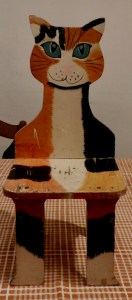
Et puis, il y a les petits détails. Comme la petite chaise-chat chez une copine (voir illustration). Elle est sympa, cette chaise. (La copine aussi, évidemment. Pour posséder une chaise pareille, il faut bien qu’elle le soit.)
*
Et puis, il y aura la Fête des 18 ans samedi. Mais j’en reparlerai demain.
Plus, there are…
Plus, there are other things beside the news. There are poems, plays, songs, novels big and small.
There are documentaries too. Such as 8, avenue Lénine, heureuse comme une Rom en France.* I haven’t seen it yet but what I read about it on Juliette Keating’s blog seems particularly apt:
“The greatest interest of this documentary is to give an example of how the political will of a local politician, supported by an active group of friends and neighbors, can, in less than ten years, lift a family out of a situation of economic and social distress and stigmatization, to the status of a life like “everybody else’s”. The sacred “integration” we keep hearing about, especially as a way of blaming destitute Rom families of refusing it as a justification for ostracizing them, is possible, obviously, if it is willed by those who hold the keys to it. Here, the aid is localized, very individualized and the solidarity is particularly effective because no one has the least interest in maintaining the family in misery, quite the contrary.”
*If your French reading skills are not up to speed: In 2003, Salcutta and her children were among those whose mobile homes were bulldozed out of existence by order of the Prefect. A fairly ordinary scene in the life of Rom families in this country. Except, in this case, neither the children’s schoolteacher, nor the neighbors, nor the Mayor, accepted the verdict. The children stayed in school, the Mayor provided another venue for another mobile home and, slowly, over a period of ten years, Calcutta managed to pull herself and the children into a “life like everybody else’s”, with a little help from her friends.
Hospitality, you know?
*
Plus, there are the small details. Such as the small cat-chair at a pal’s (see illustration). It’s a nice chair. (So is the pal, of course. To own such a chair, she has to be.)
*
Plus there will be the 18th Birthday Party on Saturday. But I’ll talk about it tomorrow.
 iknowiknowiknowblog