Je sortais de réunion. Je venais tout juste de parler d’elle. De l’autre côté de la rue, une petite voix joyeuse crie mon nom. Elle est là, rentrant de l’école avec sa mère et ses soeurs. On se salue de la main. Je lui crie: “Bonnes vacances!” – “Toi aussi!” crie-t-elle, le visage épanoui.
Épanoui parce qu’à ce moment précis, il y a trève. La petite fille n’a rien à prouver. Il y a des “raisons” pour son choix de la lecture comme champ de bataille contre les adultes. Une autre enfant aurait choisi de refuser la nourriture ou de ne pas dormir, ou de faire des scènes. La petite fille a choisi de ne plus lire. (Aucun rapport? Je pense quand même à Nathalie Sarraute dans Enfance*. Et à moi aussi, enfant, refusant obstinément d’avaler la bouchée de viande réduite en bouillie à force de mastication).
Mais voilà: il lui faut un lieu de pouvoir. Elle l’a trouvé dans son refus de lire (alors que tout démontre qu’elle sait parfaitement le faire.)
Elle s’éloigne. Nous nous retrouverons dans deux semaines. Je lui ai donné le choix de cesser l’accompagnement ou de continuer. Elle a choisi de continuer et moi, je sais déjà que je n’ai pas l’intention de “faire bataille”.
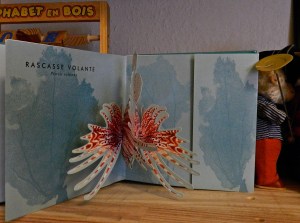
Vacances. Impression que mes poumons s’ouvrent, que je respire mieux. Devant la librairie, un étalage de livres à prix réduit. Dont Poissons Tropicaux de David Hawcock** avec 8 planches magnifiques de poissons qui se déplient. La petite fille adore les découpages et les pliages de papier. Elle adore aussi raconter des histoires. J’achète Poissons Tropicaux à prix réduit pour le bonheur de pouvoir m’offrir quelque chose juste pour le plaisir. Est-ce que j’apporterai le livre à notre prochaine séance? Je ne sais pas. Pour l’heure je l’installe sur mon “étagère des enfants”. En le voyant, je sais que je penserai à la petite fille avec plaisir et confiance. Elle sait lire. Je le sais. Elle sait que je le sais. Lui reste à trouver une autre manière de tenir tête aux adultes sans se faire de mal. Comme de me raconter ses histoires, que je les note et qu’elle les illustre, par exemple (et les relise en cachette, quand personne ne peut la voir…)?
On verra. Bonnes vacances, petite.
*Nathalie Sarraute, Enfance, éditions Gallimard 1983
** David Hawcock, Poissons Tropicaux, texte, illustrations et pop-ups David Hawcock, traduction et adaptation: Irène Gallo, nuinui 2015
*
The little girl who doesn’t want to read
I was coming out of a meeting. I had just been talking about her. From the other side of the street, a joyful little voice calls out my name. She is there, coming home from school with her mother and her sisters. We wave. I yell: “Happy Holiday!” – “You too!” she yells back, beaming.
Beaming, because at that precise moment, there is a truce. The little girl has nothing to prove. There are “reasons” for her choice of reading as her battle ground against adults. Another child would have chosen to refuse to eat, or to sleep, or would pull tantrums. The little girl has chosen not to read anymore. (Nothing to do with this? I think of Nathalie Sarraute anyway, in Childhood*. And of myself too, as a child obstinately refusing to swallow the mouthful of meat reduced to liquid mush from all the chewing).
But there you have it: she needs a power space. She has found it in her refusal to read (although she has demonstrated she is totally capable of it).
She moves on. We will meet up in two weeks. I offered her the choice of ending the sessions or of carrying on. She’s chosen to carry on; as for me, I already know I have no intention of “doing battle”.
Holiday. The feeling that my lungs are expanding, that I’m breathing better. In front of the bookstore, books on sale. Including Tropical Fish** by David Hawcock in French translation, with 8 magnificent pop-ups. The little girl loves to cut and fold paper. She loves telling stories. I buy Poissons Tropicaux on sale for the joy of buying something just for the fun of it. Will I bring the book along at our next session? I don’t know. For now, I set it up on my “children’s shelf”. Looking at it, I’ll think about the little girl with pleasure and confidence. She knows how to read. I know it. She knows that I know. All that’s left is for her to find another way to stand up to adults without hurting herself. Such as telling me stories that I’ll write down and that she’ll illustrate, for instance (and read over secretly, when no one is looking)?
We’ll see. Happy holiday, little one.
*Nathalie Sarraute, Childhood, translated by Barbara Wright, George Braziller 1985
** David Hawcock, Tropical Fish Universe Pop Edition, 2017
 iknowiknowiknowblog