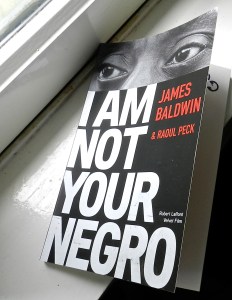
“Que suis-je venu chercher dans les mots de Baldwin?
Je viens d’un pays qui a une forte idée de lui-même, un pays qui a combattu et vaincu l’armée la plus puissante du monde – celle de Napoléon – et qui, chose historiquement unique, a stoppé net l’esclavage, accomplissant en 1804 la première révolution d’esclaves réussie dans l’histoire mondiale. Je parle là d’Haïti, le premier pays libre des Amériques (car ce n’est pas, contrairement à ce que l’on croit couramment, les États-Unis d’Amérique). Les Haïtiens ont toujours su que le récit dominant n’était pas le récit véridique.
Cette révolution haïtienne réussie, l’histoire n’en a pas tenu compte parce qu’elle imposait un récit radicalement différent, lequel rendait intenable le discours esclavagiste dominant de l’époque. Sans leur justification civilisatrice, les conquêtes coloniales de la fin du XIXe siècle auraient été idéologiquement impossibles. Et cette justification n’aurait pas été viable si le monde avait su que les “sauvages” africains avaient anéanti de puissantes armées (surtout celles des Français et des Espagnols) moins d’un siècle auparavant.
Dans un consensus inhabituel, les quatre superpuissances de l’époque ont étouffé Haïti, cette toute première République noire. Ils l’ont placée sous un embargo économique, diplomatique et militaire strict, c’est-à-dire l’ont étranglée et plongée dans la misère, l’ont rendue négligeable.
À la suite de quoi ils ont réécrit toute l’histoire.”
Raoul Peck*
*Raoul Peck dans l’introduction Remember Baldwin à I Am Not Your Negro, textes rassemblés et édités par Raoul Peck, compilation accompagnant le film du même nom, © Robert Laffont/Velvet Film, Paris 2017
*
“What did I come looking for in Baldwin’s words?
I come from a country with a strong self-identity, a country that fought against and vanquished the most powerful army in the world – that of Napoleon – and, accomplishing something historically unique, stopped slavery in its tracks in 1804 with the first successful revolution conducted by slaves in world history. I speak here of Haiti, the first free country in the Americas (for, contrary to current belief, the first free country was not the United States of America). Haitians have always known that the dominant account was not the true one.
History did not wish to take into account this successful Haitian revolution because it imposed a radically different story, one that rendered untenable the dominant pro-slavery discourses of the times. Without its civilizing justification, the colonial conquests of the end of the 19th century would have been ideologically impossible. And this justification would not have been viable, had the world known that African “savages” had annihilated the most powerful world armies (especially those of the French and of the Spaniards) less than a century earlier.
In an unusual moment of consensus, the four superpowers of that period snuffed out Haiti, this first ever black Republic. They placed it under a strict economic, diplomatic and military embargo, which is to say they strangled it and plunged it into misery, rendering it negligible.
Following which they rewrote the entire story.”
Raoul Peck*
*Raoul Peck in his introduction Remember Baldwin to I Am Not Your Negro, texts assembled and edited by Raoul Peck, in a compilation accompanying the film by the same name © Robert Laffont/Velvet Film, Paris 2017.
In this instance, the English translation is my own.
 iknowiknowiknowblog